Identification
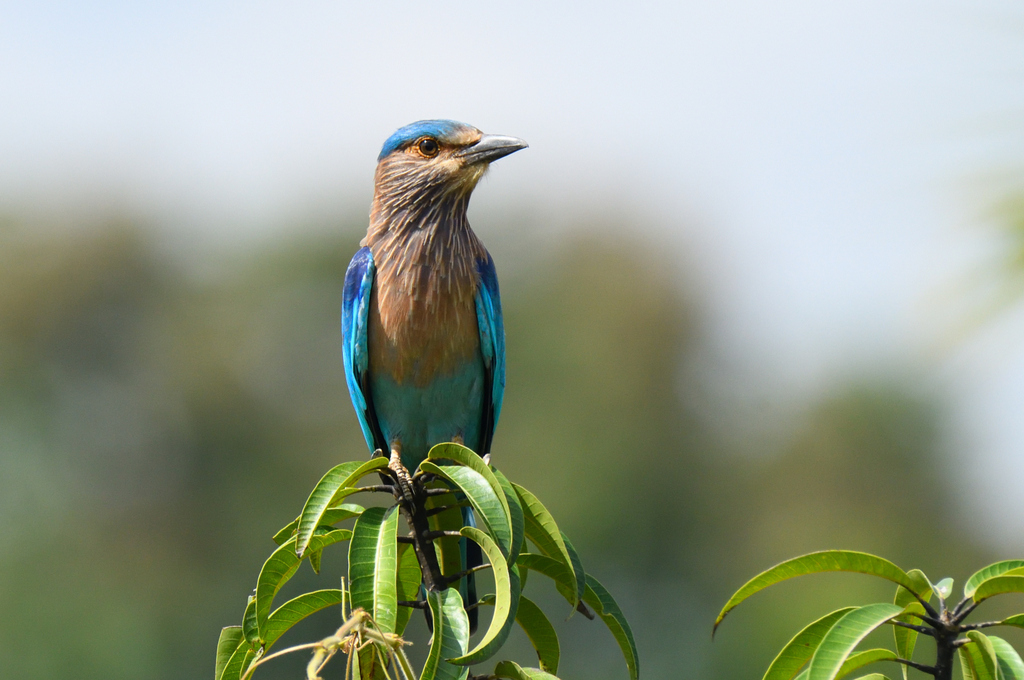
The Indian roller is a striking medium-sized bird, measuring 30–34 cm in length with a wingspan of 65–74 cm and weighing 166–176 g. It is a bulky, broad-winged bird with a large head, short neck, and short legs. The most distinctive features are its vibrant blue markings, which are especially prominent in flight. The face and throat are pinkish, the head and back are brown, while the rump displays bright turquoise colouration. The wings and tail showcase contrasting light and dark blue, with the tail feathers displaying intense purple-blue with pale blue bands. Interestingly, these brilliant blues are structural colours created by microstructures in the feather barbs rather than pigmentation. The bare skin around the eyes is dull orange, and the legs and feet are yellow-brown. Adult males and females are similar in appearance, though juveniles are noticeably duller, paler, and browner with less vibrant plumage.
Range & Habitat
The Indian roller occurs widely across West Asia and the Indian subcontinent, with two recognized subspecies: the northern benghalensis, found from western Asia to India north of the Vindhya Range, and the southern indicus, occurring in central and southern India and Sri Lanka. The species is highly adaptable and has thrived in human-modified landscapes. It is commonly found perched on roadside trees and telephone wires, making it a familiar sight to travellers. The roller favours open grassland and scrub forest habitats, though its ability to exploit disturbed and cultivated areas has made it widespread throughout its range.
Behaviour & Diet
The Indian roller is primarily insectivorous, feeding mainly on insects, particularly beetles. The species is best known for the spectacular aerobatic displays performed by males during the breeding season, which make it a memorable sight for birdwatchers. Adults form pair bonds and raise their young together. Females lay 3–5 eggs in a cavity or crevice, lining the nest with a thin mat of straw or feathers. The species is culturally significant across its range, serving as the state bird of three Indian states.
Best Time & Places to See It
The Indian roller is common throughout open grasslands and scrub forests across the Indian subcontinent and western Asia. Its habit of perching prominently on roadside trees, wires, and exposed branches makes it relatively easy to locate. The breeding season offers the best viewing opportunities, as males perform their distinctive aerobatic displays at this time. Look for them in open habitats and along roadsides, particularly in areas with scattered trees and bushes.
Photography Tips
The Indian roller's vibrant blue plumage is far more striking in flight than when perched, so photographing birds in action will yield the most impressive results. The structural blue colours photograph beautifully in good natural light. Position yourself to capture birds either in flight or taking off from perches, where the bright blue on the wings and tail becomes most visible. The contrasting colours—turquoise rump, purple-blue wings and tail with pale blue bands—are best rendered in bright daylight. Early morning light is ideal for capturing the subtle colour variations across the plumage.
Kanha Tiger Reserve
Minneriya National Park
Bandhavgarh National Park
Bandipur National Park
Banke National Park
Bardiya National Park
Chitwan National Park
Eravikulam National Park
Gir National Park
Nothing matches these filters.
No community photos yet. Log in to add the first one.
No community observations of this species yet.