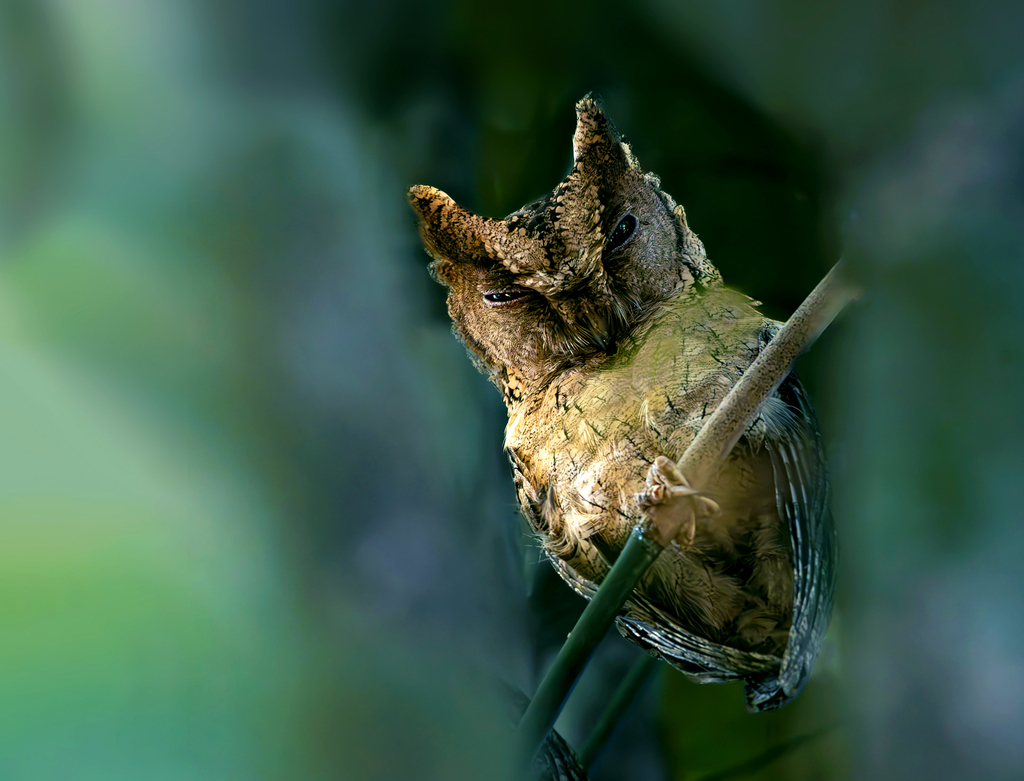
Identification
The Indian Scops Owl is a small but relatively robust member of the scops owl family, measuring 23–25 cm in length. Like all scops owls, it bears distinctive small head tufts, or "ears," which are actually just feathered points rather than true ears. The plumage varies between grey and brown morphs, both displaying faint buff spotting on the upperparts. The underparts are buff-coloured with fine darker streaking, and a characteristic buff neckband encircles the neck. The whitish or buff facial disc frames striking orange or brown eyes. Males and females are similar in appearance. In flight, this owl displays a deeply undulating pattern characteristic of its family.
Separating the Indian Scops Owl from closely related species—particularly the slightly larger collared scops owl and the oriental scops owl—requires careful observation. The most reliable field marks are the bird's call and eye colour, making audio identification especially useful for nocturnal observers.
Range & Habitat
The Indian Scops Owl is native to South Asia, with a distribution extending from eastern Arabia through the Indian subcontinent, though it is absent from the far north. This range makes it a species of particular interest to birdwatchers and travellers exploring the forests and woodlands of the region.
Behaviour & Diet
This is a strictly nocturnal species, active only under cover of darkness. During daylight hours, the Indian Scops Owl's excellent camouflage makes it extremely difficult to locate, even for experienced observers. However, it may sometimes be found by following the alarm calls and aggressive behaviour of small birds that mob it at its daytime roost in trees. The owl's presence can thus be betrayed by the commotion it creates among resident songbirds.
The Indian Scops Owl feeds primarily on insects, hunting under the cover of night. The species nests in tree cavities, where females lay 3–5 eggs. Its call is a distinctive soft, single note described as "whuk?"—a sound that becomes invaluable for confirming the bird's presence and identity in the field.
Best Time & Places to See It
Since the Indian Scops Owl is entirely nocturnal, night-time is essential for successful observation. Dawn and dusk may offer marginal opportunities, but dedicated nocturnal birdwatching will yield the best results. Listen for the characteristic "whuk?" call in suitable woodland habitat throughout the bird's South Asian range, excluding the far north.
Photography Tips
Photographing the Indian Scops Owl presents considerable challenges due to its nocturnal habits and cryptic daytime behaviour. Night photography with appropriate equipment and technique is necessary for direct observation. Alternatively, patient daytime scanning of trees where small birds are actively mobbing may reward you with glimpses of this well-camouaged owl at rest. Early morning and late evening light will provide better visibility than deep darkness, and audio recording of the distinctive call can be a valuable complement to visual documentation.
Lunugamvehera National Park
Sri Lanka
+204 birds+14 mammals
Dry scrubland and shallow wetlands converge in Sri Lanka's southeastern lowlands, where Lunugamvehera National Park anchors one of the island's most ecologically vital landscapes. The park's…
VIEW NATIONAL PARKRanthambhore National Park
Sawai Madhopur, India
+294 birds+20 mammals
Granite ridges and ravines carved through the Aravalli Range frame this protected landscape in eastern Rajasthan, where deciduous forest mingles with open scrubland and seasonal water…
VIEW NATIONAL PARKKanha Tiger Reserve
Kanha Kisli F.V., India
+321 birds+23 mammals
Where sal forests give way to emerald meadows and crystalline streams carve through ancient valleys, one of India's finest wilderness reserves unfolds across the Maikal Range.…
VIEW NATIONAL PARKTadoba National Park
Palasgaon Singru, India
+270 birds+20 mammals
Where sal forests meet open grasslands and rocky outcrops rise from red laterite soil, central India's landscape unfolds in raw, untamed beauty. Ancient teak woodlands and…
VIEW NATIONAL PARKBandhavgarh National Park
Garhpuri, India
+285 birds+17 mammals
Where granite ridges rise dramatically above sal and bamboo forests, one of India's most pristine tiger reserves unfolds across the Vindhyan plateau. Ancient rock formations tower…
VIEW NATIONAL PARKPanna National Park
Badgadi Kalan, India
+271 birds+17 mammals
Where granite gorges slice through central India's Vindhyan plateau, a landscape of stark beauty unfolds across nearly six hundred square kilometers. The Ken River carves through…
VIEW NATIONAL PARKKeoladeo National Park
Shreenagar Rural, India
+326 birds+14 mammals
Where shallow wetlands shimmer beneath vast Rajasthani skies, one of Asia's finest bird sanctuaries pulses with extraordinary life. This former maharaja's hunting reserve, now spanning 29…
VIEW NATIONAL PARKPeriyar National Park
Mlappara, India
+232 birds+4 mammals
Dawn breaks over mist-shrouded ridges where the Western Ghats tumble toward Kerala's spice-scented lowlands. Here, ancient tropical forests envelope a glittering artificial lake, creating a mosaic…
VIEW NATIONAL PARKBandipur National Park
Hirehalli, India
+302 birds+19 mammals
Where the Western Ghats descend into the Deccan plateau, ancient deciduous forests blanket a landscape carved by the Nugu River. Bandipur unfolds across 880 square kilometres…
VIEW NATIONAL PARKNagarahole Tiger Reserve
Nalkeri Forest, India
+323 birds+23 mammals
Where granite escarpments rise above dense deciduous forests and the Kabini River carves through pristine wilderness, one of India's most biodiverse landscapes unfolds across the Western…
VIEW NATIONAL PARKGir National Park
Asundrali, India
+258 birds+13 mammals
Dry deciduous forests cloak the rolling hills of western Gujarat where the Gir landscape rises as a final sanctuary for one of the world's rarest felids:…
VIEW NATIONAL PARKNo community photos yet. Log in to add the first one.
No community observations of this species yet.