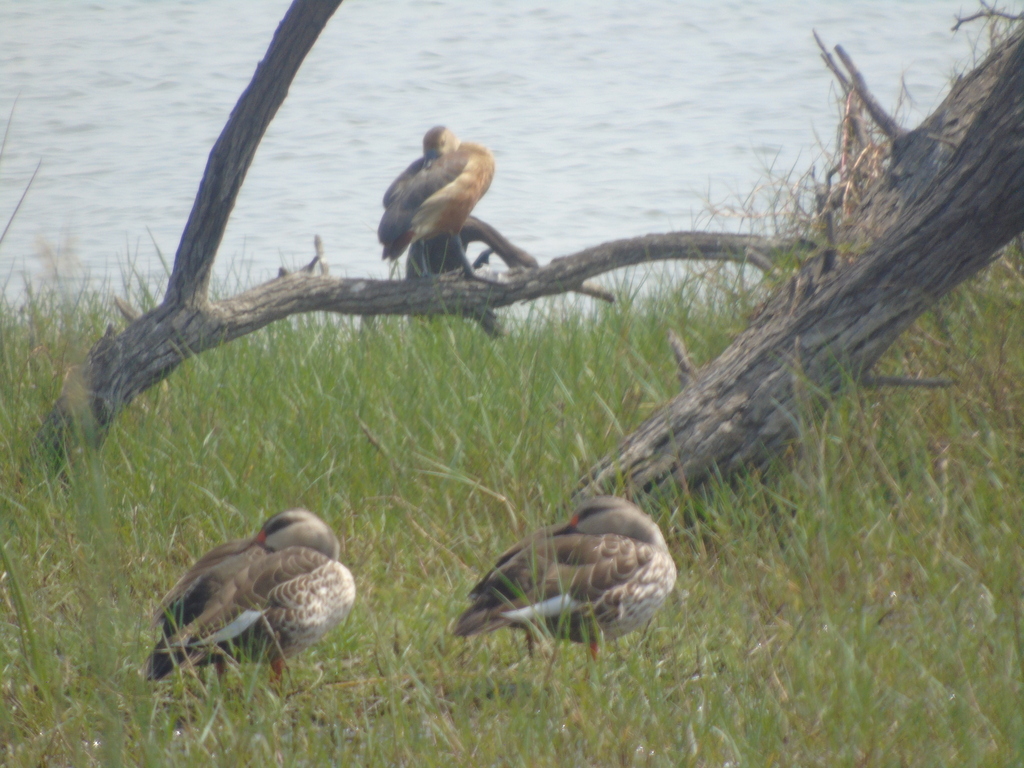
Indian Spot-billed Duck
Photo © Rajesh Thomas
Photo © Rajesh Thomas — CC BY 4.0 — Source: iNaturalist #347477770Identification
The Indian spot-billed duck is a large dabbling duck roughly the size of a mallard, measuring 55–63 cm in length with a wingspan of 83–95 cm. These mainly grey ducks have a distinctive paler head and neck, with a black bill tipped bright yellow. The most striking field mark in the nominate subspecies is the red spot at the base of the bill—absent or inconspicuous in females and absent entirely in the haringtoni subspecies found from Myanmar to southern China and Laos. At rest, a prominent white stripe formed by the white tertials stands out conspicuously on the side of the body. In flight, the species is distinguished by a green speculum bordered with a broad white band at the base. The legs and feet are bright orange to coral red. Males lack an eclipse plumage, remaining visually similar year-round, while juveniles are browner and duller than adults.
Range & Habitat
This species is a non-migratory resident throughout freshwater wetlands across the Indian subcontinent, with populations found in Pakistan, India, and Sri Lanka. The nominate subspecies inhabits India and Sri Lanka, while the haringtoni subspecies ranges from Myanmar to southern China and Laos. These ducks prefer medium-sized wetlands with vegetation cover and tend to avoid very large patches of open water. Interestingly, the northernmost populations have expanded their range northwards by more than 500 km since the early 20th century, possibly in response to global warming.
Behaviour & Diet
The Indian spot-billed duck is gregarious outside the breeding season, forming small flocks on freshwater lakes and marshes in fairly open country. These dabbling ducks feed mainly in the evening or at night, consuming plant material including rice crops, as well as invertebrates such as snails. Breeding season timing varies with rainfall and water conditions, occurring from July to September in northern India and November to December in southern India, with multiple broods possible in a single season. Nests are built on the ground hidden in vegetation near water, though nests have occasionally been found on tree branches covered by creepers. Females typically lay 8–14 eggs, with chicks hatching after approximately 24 days of incubation. The black chicks with yellow backs resemble mallard chicks but have a wider eyestripe. Both males and females undergo a complete post-breeding moult, dropping all wing feathers simultaneously.
Best Time & Places to See It
The Indian spot-billed duck can be found year-round throughout freshwater wetlands across Pakistan, India, and Sri Lanka, as this species is non-migratory. Birds are most readily seen and concentrated during the breeding season—July to September in northern India and November to December in southern India. Outside breeding season, look for them in small flocks on medium-sized lakes and marshes with vegetation cover. Early morning and evening visits to wetland habitats offer the best chances of observation, as these ducks are most active during these times.
Photography Tips
Photographers should position themselves during dawn or dusk when these dabbling ducks are most active and feeding. The distinctive white stripe on the flanks provides an excellent identifier at distance and should be featured in side-profile shots. In-flight photography will showcase the striking green speculum with white border—a key field mark. The bright orange-red legs and feet contrast beautifully with the grey plumage and can be highlighted in water-level shots. For subspecies poecilorhyncha, try to capture the red spots at the bill base, which are a defining feature. Patience is essential, as these ducks prefer medium-sized wetlands with vegetation that may partially obscure views. Using vegetation as foreground framing can add natural context to your images.
Orang National Park
Rangagarapathar, India
+298 birds+1 mammals
Where the Brahmaputra's floodplains meet the foothills of Assam, Orang National Park unfolds across a mosaic of riverine grasslands, forests and wetlands that pulse with the…
VIEW NATIONAL PARKRanthambhore National Park
Sawai Madhopur, India
+294 birds+20 mammals
Granite ridges and ravines carved through the Aravalli Range frame this protected landscape in eastern Rajasthan, where deciduous forest mingles with open scrubland and seasonal water…
VIEW NATIONAL PARKKanha Tiger Reserve
Kanha Kisli F.V., India
+321 birds+23 mammals
Where sal forests give way to emerald meadows and crystalline streams carve through ancient valleys, one of India's finest wilderness reserves unfolds across the Maikal Range.…
VIEW NATIONAL PARKTadoba National Park
Palasgaon Singru, India
+270 birds+20 mammals
Where sal forests meet open grasslands and rocky outcrops rise from red laterite soil, central India's landscape unfolds in raw, untamed beauty. Ancient teak woodlands and…
VIEW NATIONAL PARKBandhavgarh National Park
Garhpuri, India
+285 birds+17 mammals
Where granite ridges rise dramatically above sal and bamboo forests, one of India's most pristine tiger reserves unfolds across the Vindhyan plateau. Ancient rock formations tower…
VIEW NATIONAL PARKPanna National Park
Badgadi Kalan, India
+271 birds+17 mammals
Where granite gorges slice through central India's Vindhyan plateau, a landscape of stark beauty unfolds across nearly six hundred square kilometers. The Ken River carves through…
VIEW NATIONAL PARKKaziranga National Park
Kohora, India
+422 birds+26 mammals
Dawn breaks over the floodplains of the Brahmaputra, where tall grasslands stretch endlessly beneath monsoon-heavy skies. This sprawling wilderness of northeastern Assam is a mosaic of…
VIEW NATIONAL PARKKeoladeo National Park
Shreenagar Rural, India
+326 birds+14 mammals
Where shallow wetlands shimmer beneath vast Rajasthani skies, one of Asia's finest bird sanctuaries pulses with extraordinary life. This former maharaja's hunting reserve, now spanning 29…
VIEW NATIONAL PARKPeriyar National Park
Mlappara, India
+232 birds+4 mammals
Dawn breaks over mist-shrouded ridges where the Western Ghats tumble toward Kerala's spice-scented lowlands. Here, ancient tropical forests envelope a glittering artificial lake, creating a mosaic…
VIEW NATIONAL PARKPampadum Shola National Park
Vattavada, India
+258 birds+14 mammals
Where misty shola forests cling to the high plateaus of the Nilgiri Mountains, ancient evergreen remnants create a world apart. This 2,316-hectare reserve protects one of…
VIEW NATIONAL PARKBandipur National Park
Hirehalli, India
+302 birds+19 mammals
Where the Western Ghats descend into the Deccan plateau, ancient deciduous forests blanket a landscape carved by the Nugu River. Bandipur unfolds across 880 square kilometres…
VIEW NATIONAL PARKNagarahole Tiger Reserve
Nalkeri Forest, India
+323 birds+23 mammals
Where granite escarpments rise above dense deciduous forests and the Kabini River carves through pristine wilderness, one of India's most biodiverse landscapes unfolds across the Western…
VIEW NATIONAL PARKGir National Park
Asundrali, India
+258 birds+13 mammals
Dry deciduous forests cloak the rolling hills of western Gujarat where the Gir landscape rises as a final sanctuary for one of the world's rarest felids:…
VIEW NATIONAL PARKGaoligong Mountain National Nature Reserve
Nujiang Lisu Autonomous Prefecture, China
+443 birds+13 mammals
VIEW NATURE RESERVENo community photos yet. Log in to add the first one.
No community observations of this species yet.