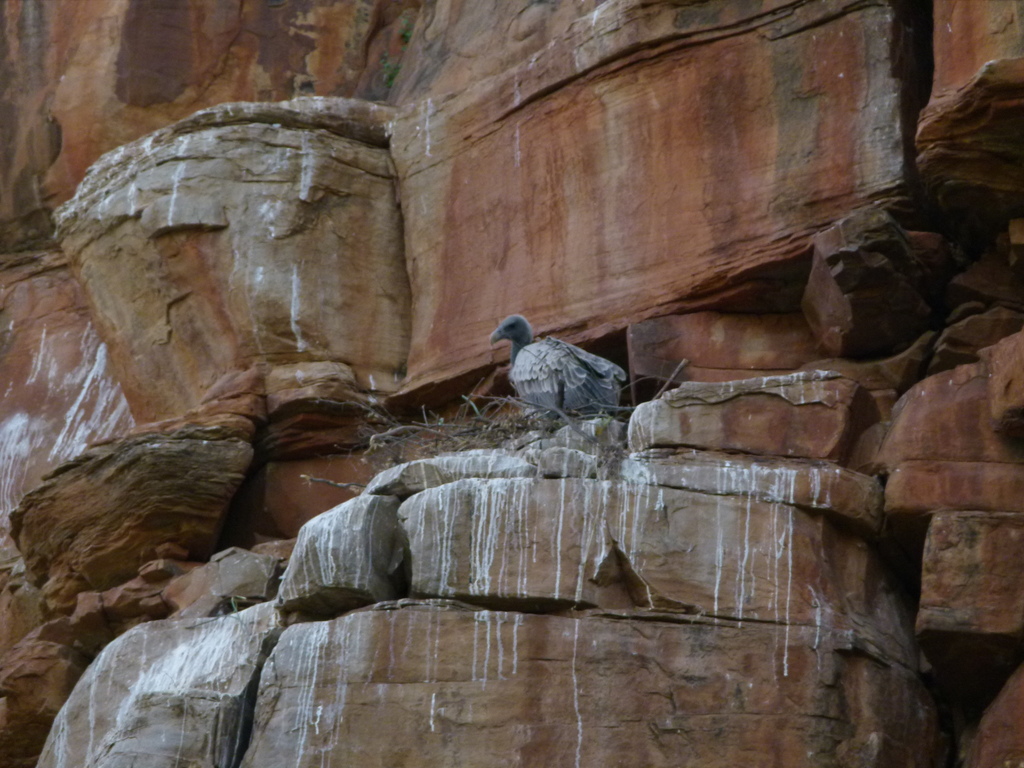
Indian Vulture
Photo © Yves Bas
Photo © Yves Bas — CC BY 4.0 — Source: iNaturalist #45530031Identification
The Indian vulture is a medium-sized vulture, measuring 89–103 cm in length with an impressive wingspan of 2.22–2.58 m. Its most distinctive features include a small, bare, dark-brown head with minimal feathering on the neck—adaptations that allow it to feed hygienically on carrion. The body and covert feathers are pale brown with darker flight feathers, white thighs scattered with white fluff, and broad wings with short tail feathers. The bird possesses a long yellowish beak with a pale green-yellow cere and dark eyes. It is comparatively smaller and less bulky than the Eurasian griffon vulture, which helps distinguish it in the field.
Range & Habitat
Once ranging from southeastern Pakistan to south India and eastward to Indochina and the northern Malay Peninsula, the Indian vulture is now extinct in Southeast Asia. Current populations exist mostly in central and peninsular India, south of the Gangetic plains, with smaller numbers in southwest Pakistan, Bangladesh, and Nepal. These non-migratory birds inhabit diverse landscapes including semi-desert, dry foothills, open fields, cultivable lands near villages, garbage dumps, and slaughter houses in urban areas. They nest on cliffs, high buildings, and occasionally in trees.
Behaviour & Diet
Indian vultures are powerful fliers capable of reaching speeds of 35 km/h when gliding and can remain airborne for six to seven hours continuously, soaring on thermal convection currents. They travel hundreds of miles daily in search of food, relying primarily on eyesight to locate carrion. These scavengers feed mainly on dead cattle and leftovers from large predators, playing a vital ecological role by removing rotting meat that would otherwise spread disease. Often found in small flocks, sometimes alongside other vulture species, individual birds compete at carcasses to maintain feeding position, occasionally yielding to larger species.
Best Time & Places to See It
Indian vultures breed between November and March, with nest building commencing in September, making these months excellent for observing breeding birds. They are most active during daylight hours, soaring overhead in search of carrion. Look for them near cliffs and rocky outcrops in central and peninsular India, as well as in open country near villages, cultivated lands, and areas with livestock. Their habit of gathering at carcasses makes them visible in agricultural regions where dead cattle are common.
Photography Tips
Capturing Indian vultures in flight offers the best photographic opportunities, as they soar majestically on thermals. Wide-angle lenses are valuable for capturing their impressive 2.2+ meter wingspan against clear skies. When photographing perched birds, their distinctive bare heads and pale plumage contrast well with rocky cliff backgrounds. Early morning and late afternoon light often provides optimal conditions for flight photography. Be patient and scan the skies systematically; binoculars will help locate birds at distance before they come into photographic range.
Indravati National Park
Bijapur, India
+41 birds
Where the Indravati River cuts through the elevated plateaus of central India, a landscape of deciduous forest and open woodland unfolds across Bijapur district in Chhattisgarh.…
VIEW NATIONAL PARKRanthambhore National Park
Sawai Madhopur, India
+294 birds+20 mammals
Granite ridges and ravines carved through the Aravalli Range frame this protected landscape in eastern Rajasthan, where deciduous forest mingles with open scrubland and seasonal water…
VIEW NATIONAL PARKKanha Tiger Reserve
Kanha Kisli F.V., India
+321 birds+23 mammals
Where sal forests give way to emerald meadows and crystalline streams carve through ancient valleys, one of India's finest wilderness reserves unfolds across the Maikal Range.…
VIEW NATIONAL PARKBandhavgarh National Park
Garhpuri, India
+285 birds+17 mammals
Where granite ridges rise dramatically above sal and bamboo forests, one of India's most pristine tiger reserves unfolds across the Vindhyan plateau. Ancient rock formations tower…
VIEW NATIONAL PARKPanna National Park
Badgadi Kalan, India
+271 birds+17 mammals
Where granite gorges slice through central India's Vindhyan plateau, a landscape of stark beauty unfolds across nearly six hundred square kilometers. The Ken River carves through…
VIEW NATIONAL PARKKeoladeo National Park
Shreenagar Rural, India
+326 birds+14 mammals
Where shallow wetlands shimmer beneath vast Rajasthani skies, one of Asia's finest bird sanctuaries pulses with extraordinary life. This former maharaja's hunting reserve, now spanning 29…
VIEW NATIONAL PARKBandipur National Park
Hirehalli, India
+302 birds+19 mammals
Where the Western Ghats descend into the Deccan plateau, ancient deciduous forests blanket a landscape carved by the Nugu River. Bandipur unfolds across 880 square kilometres…
VIEW NATIONAL PARKNagarahole Tiger Reserve
Nalkeri Forest, India
+323 birds+23 mammals
Where granite escarpments rise above dense deciduous forests and the Kabini River carves through pristine wilderness, one of India's most biodiverse landscapes unfolds across the Western…
VIEW NATIONAL PARKGir National Park
Asundrali, India
+258 birds+13 mammals
Dry deciduous forests cloak the rolling hills of western Gujarat where the Gir landscape rises as a final sanctuary for one of the world's rarest felids:…
VIEW NATIONAL PARKNo community photos yet. Log in to add the first one.
No community observations of this species yet.