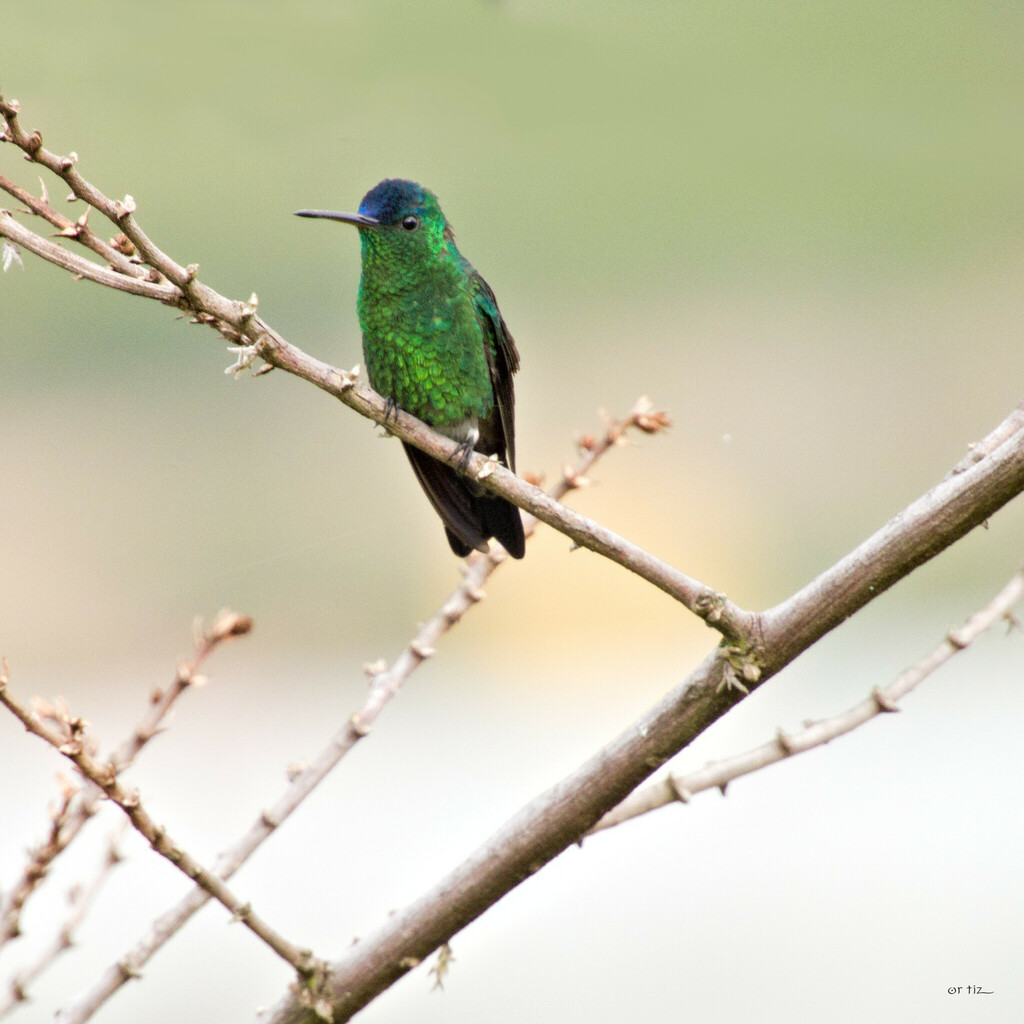
Indigo-capped Hummingbird
Photo © Manuel Ortiz
Photo © Manuel Ortiz — CC0 1.0 — Source: iNaturalist #260423379Identification
The indigo-capped hummingbird is a small species, measuring 7 to 10 cm in length and weighing only about 5 g, making it a delicate jewel of the Colombian highlands. The adult male is unmistakable, displaying a brilliant indigo-blue crown that contrasts sharply with shining green upperparts and a deep steel-blue tail. The rump gleams with bronze to coppery tones, while the underparts shimmer with glittering golden green. Both sexes sport a distinctive black bill with a red base to the mandible. Females are somewhat less ornate, with a turquoise-blue crown towards the rear and grayish barring on the throat feathers, while juveniles resemble females but with a grayer belly.
Range & Habitat
This species is endemic to Colombia, found primarily in the north and central regions, with populations concentrated in Norte de Santander Department, the Magdalena River valley, and the upper Cauca River valley. The indigo-capped hummingbird favours semi-open to open landscapes, including forest edges, savanna, shrubby areas, plantations, and gardens—particularly in fairly dry settings. Elevation is important for understanding where to find this bird: it is most common between 1,000 and 2,000 m, though it regularly descends to 400 m during the breeding season and occasionally reaches near sea level, with rare sightings as high as 3,000 m.
Behaviour & Diet
The indigo-capped hummingbird is an active forager that feeds on nectar and small arthropods throughout its habitat, though it concentrates its efforts in the upper canopy layers. This species makes apparent seasonal elevational movements, tracking the availability of flowering plants. While it sometimes congregates with other indigo-capped hummingbirds at flowering trees, it is generally territorial and vigorously defends feeding patches from rival hummingbirds and other nectar-feeding birds such as bananaquits. The bird typically hunts arthropods by hawking from a perch in the canopy, though it occasionally gleans insects directly from foliage.
Best Time & Places to See It
The breeding season, extending from April through at least July, offers the best opportunities to observe this species, as birds are more active and vocal during this period. Look for indigo-capped hummingbirds in the montane regions of Colombia between 1,000 and 2,000 m elevation, particularly around flowering plants in semi-open habitats, gardens, and forest edges. The bird's adaptability to man-made habitats means that planted areas and cultivated gardens can be productive locations. Listen for its distinctive vocalizations—a repeated buzzy, squeaky phrase "tzuk-keee ... tsrp" and sharp "tsit" calls—which can help pinpoint its presence.
Photography Tips
Patience is essential when photographing this small, active hummingbird. Position yourself near flowering plants and cultivated gardens where the species is known to visit, and wait for the bird to establish a feeding routine. The male's brilliant indigo crown and shimmering golden-green underparts photograph best in good natural light, so morning hours with directional sunlight can be particularly rewarding. Fast shutter speeds of at least 1/2000s will be necessary to freeze the bird's rapid movements and hovering flight. Since the species forages mostly in the upper canopy, look upward and scan flowering trees and shrubs at mid-storey height for the best viewing and photographing opportunities.
No community photos yet. Log in to add the first one.
No community observations of this species yet.