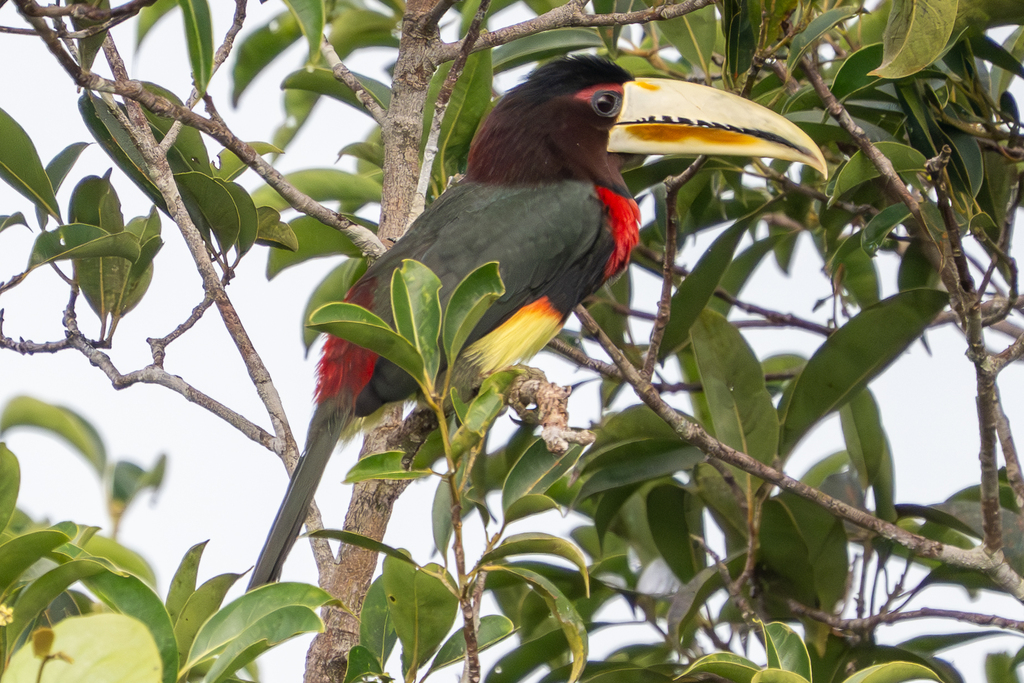
Ivory-billed Aracari
Photo © Michael Eisen
Photo © Michael Eisen — CC BY 4.0 — Source: iNaturalist photo #525359364Identification
The ivory-billed aracari is a medium-sized toucan measuring 36 to 45 cm in length and weighing 120 to 160 g. Adult males display striking plumage: a black cap crowning a chestnut head and throat, with a maroon-red nape and upper back, green lower back, and red rump. A narrow black band runs under the throat, followed by a distinctive wide red band on the upper breast and wide black band on the lower breast, yellow belly, and green thighs. Females are similar but sport a dark brown cap and narrower black throat band than males.
The species' most distinctive feature is its remarkable bill, which gives it its common name. The bill is mostly yellow with deep red to brown markings and distinctive red, black, and ivory marks along its edge that resemble teeth. Different subspecies show subtle bill color variations, though plumage differences are negligible across populations.
Range & Habitat
The ivory-billed aracari is found across northwestern South America in Brazil, Colombia, Ecuador, Peru, and Venezuela. The nominate subspecies occupies the Brazilian state of Amazonas between the Rio Solimões and Rio Negro, while P. a. flavirostris ranges through southeastern Colombia, southern Venezuela, eastern Ecuador, northeastern Peru, and northwestern Brazil. The species is believed to be a year-round resident throughout its range.
These birds inhabit varied forest landscapes including várzea, gallery forest, and secondary forest, showing a preference for early- to mid-successional forest over mature growth. They are also found in terra firme, bamboo, cloudforest, and plantations to a lesser extent. Elevation ranges mostly below 600 m, though they are regularly found to 900 m and locally higher in some areas.
Behaviour & Diet
Ivory-billed aracaris are canopy foragers, typically observed in pairs or small groups working through the forest's upper levels. Their diet appears to consist primarily of fruit supplemented with arthropods, though detailed dietary information remains limited. The species is vocal, with its song described as a distinctive series of 2–6 wailing notes variously rendered as "twaaa-a-a," "tweee-ee," or "traaa-at."
The breeding season occurs from December to May across most of the range, extending to February through August in western and southwestern populations. Like other toucans, they are assumed to nest in tree cavities, with clutches of two to four eggs. Beyond these basic facts, little else is documented about their breeding biology or other behavioral details.
Best Time & Places to See It
Year-round residence throughout the species' range means that ivory-billed aracaris can be encountered in any season, though breeding activity peaks December through August depending on location. The best opportunities for observation lie in the várzea and gallery forests of the Amazon basin, particularly in areas with early- to mid-successional growth where the species shows greater abundance.
Travelers visiting northwestern Amazonia in Brazil, Peru, Ecuador, Colombia, or Venezuela have the best chances of encountering this species. Look for them in the forest canopy, scanning the upper levels of secondary growth forests and forest edges where fruit availability is greatest.
Photography Tips
The ivory-billed aracari's bold coloration and distinctive bill make it a rewarding photographic subject. Focus your efforts on the canopy and upper forest levels where these birds forage, typically in small groups. Early morning hours often provide the best light for capturing the species' vibrant reds, blacks, yellows, and greens against the forest backdrop.
The bird's relatively small size compared to larger toucans means a telephoto lens is essential for frame-filling shots. Watch for feeding activity in fruiting trees, where pairs or small groups may linger long enough for extended observation. The distinctive bill markings and color variations between subspecies are worth documenting, as they provide visual interest and scientific value to your images.
Yasuní National Park
Aguarico, Ecuador
+601 birds+43 mammals
Where the western Amazon basin converges with Ecuador's Orellana Province, lowland rainforest reaches toward the horizon in an unbroken canopy of staggering botanical density. Yasuní National…
VIEW NATIONAL PARKNatural Sierra de Chiribiquete National Park
Solano, Colombia
+359 birds+27 mammals
Massive table-top mountains rise abruptly from the lowland rainforest of southeastern Colombia, their sheer sandstone cliffs and isolated summits creating some of the most dramatic topography…
VIEW NATIONAL PARKNatural la Paya National Park
Puerto Leguízamo, Colombia
+262 birds+4 mammals
Where the Amazon's western reaches fold into the Andes foothills, La Paya National Park sprawls across more than 8,500 square kilometers of pristine Amazonian rainforest in…
VIEW NATIONAL PARKNatural Sierra de la Macarena National Park
Vista Hermosa, Colombia
+566 birds+15 mammals
Across nearly 20,000 square kilometres of Colombia's Meta Department, the terrain rises from lowland savanna into Andean foothills through a mosaic of gallery forests, palm-fringed wetlands,…
VIEW NATIONAL PARKAmacayacu National Park
Leticia, Colombia
+567 birds+25 mammals
Where the Rio Amazonas curves through the tri-border region where Colombia, Peru, and Brazil converge, Amacayacu National Park sprawls across more than 5,250 square kilometres of…
VIEW NATIONAL PARKMapinguari National Park
Brazil
+354 birds
Vast tracts of western Amazonian rainforest blanket the remote terrain of this 56,827 square kilometre national park in Amazonas state, where seasonal rivers wind through dense…
VIEW NATIONAL PARKJaú National Park
Brazil
+354 birds+3 mammals
Vast floodplain forests and blackwater rivers define this remote corner of western Amazonas, where the Rio Negro and its tributaries have carved an intricate mosaic of…
VIEW NATIONAL PARKAnavilhanas National Park
Brazil
+468 birds+8 mammals
Across the Rio Negro in central Amazonas, an archipelago of over a thousand islands rises from the world's largest rainforest river system, creating a labyrinth of…
VIEW NATIONAL PARKYanachaga–chemillén National Park
Palcazu, Peru
+639 birds+6 mammals
Where the eastern slopes of Peru's central cordillera plunge into cloud forest, Yanachaga–Chemillén National Park protects nearly three thousand square kilometres of montane wilderness that few…
VIEW NATIONAL PARKManu National Park
Manu, Peru
+892 birds+26 mammals
Across the eastern slopes of the Peruvian Andes, tropical rainforest descends into the Amazon basin with a complexity that few terrestrial ecosystems match. Manu National Park…
VIEW NATIONAL PARKSierra del Divisor National Park
Alto Tapiche, Peru
+298 birds+2 mammals
Where the western Amazon meets the Andes foothills, nearly 41,000 square kilometres of pristine rainforest rise across Peru's Alto Tapiche region in a landscape of extraordinary…
VIEW NATIONAL PARKBahuaja Sonene National Park
San Pedro de Putina Punco, Peru
+602 birds+8 mammals
Where the Madre de Dios and Heath rivers converge in southeastern Peru rises one of South America's most biodiverse wilderness regions: a vast protected realm of…
VIEW NATIONAL PARKNo community photos yet. Log in to add the first one.
No community observations of this species yet.