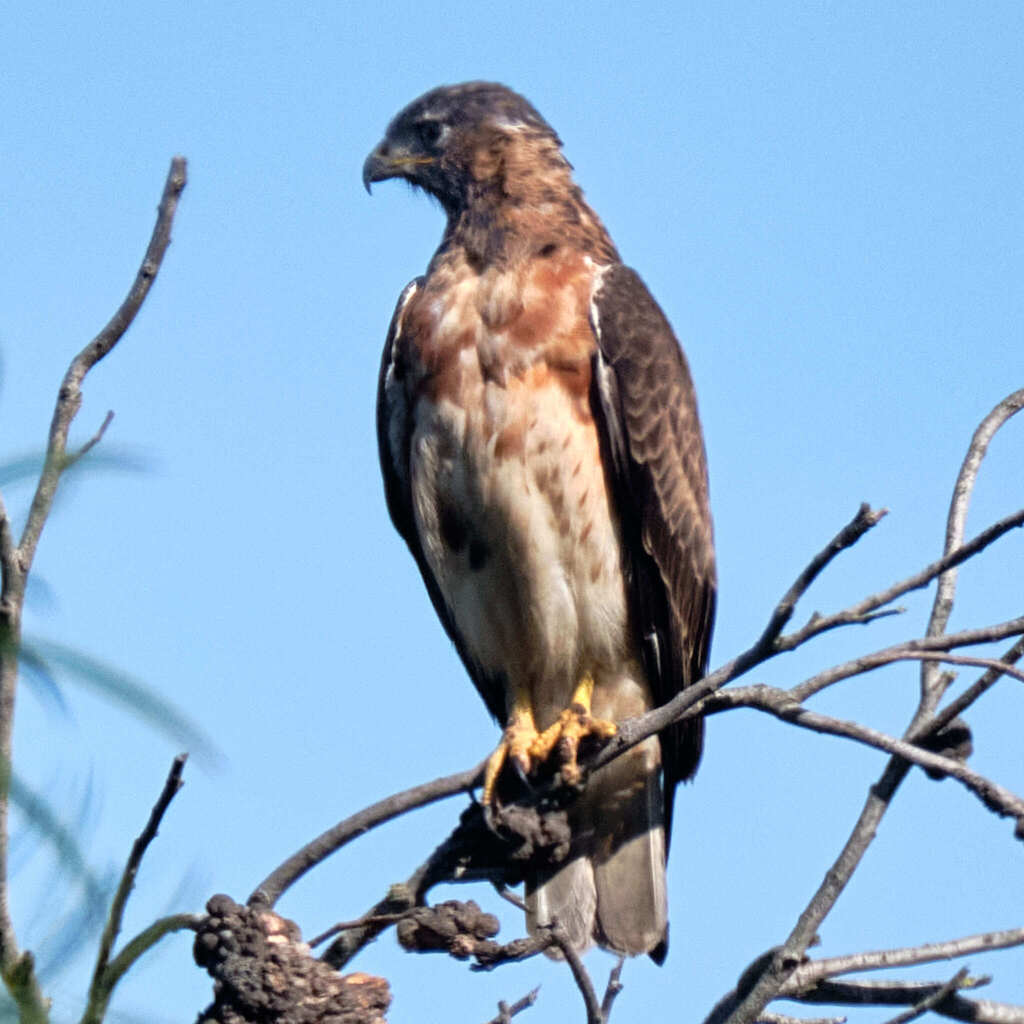
Jackal Buzzard
Photo © John Barrow
Photo © John Barrow — CC BY 4.0 — Source: iNaturalist #277691161Identification
The Southern Augur Buzzard is one of Africa's largest Buteo raptors, measuring 44–60 cm in length with a wingspan of 127–143 cm. Adults are strikingly plumaged with slate-grey upperparts and highly variable underparts. The typical adult shows a rich rufous breast patch separated from the white throat by a ragged band, with a black-and-white barred belly. The tail is rufous, flight feathers blackish with off-white secondaries barred in black, and the underwing displays a prominent white panel contrasting with black hand feathers and dark trailing edges. Light and dark (melanistic) morphs occur, with the darker form having a predominantly black breast. Juveniles are mainly brown above with washed-out rufous-buff underparts, often showing worn feathers as lighter streaking, and a buff-brown tail with a pale tip. The species has a distinctive sharp, barking call—weeah ka-ka-ka or kyaahh-ka-ka-ka—thought to resemble the black-backed jackal, from which the bird derives its name.
Range & Habitat
Endemic to southern Africa, this buzzard is fairly common throughout most of South Africa, with an absence in some north-central regions but common in the northeast. Its range extends west to central Namibia and east through Lesotho and Eswatini into southern Mozambique and extreme southeast Botswana. It is primarily a mountain-dwelling species, ranging from rocky outcrops and rubble at sea level to high mountains in Lesotho reaching 3,500 m. The species adapts well to both arid, desert-like conditions and areas with high rainfall and lush vegetation, though it typically prefers proximity to grassland for hunting. Nesting densities vary considerably by location, from as low as 2.8 pairs per 100 km² in some areas to 22.2 pairs per 100 km² in the Lesotho highlands.
Behaviour & Diet
Pairs engage in noisy aerial displays both during and outside the breeding season, though these displays are typically less dramatic than those of the closely related augur buzzard, usually consisting of circling or gentle stooping. The species is resident and non-migratory throughout its range. Like other African raptors, it hunts from the air, utilizing its powerful frame and keen eyesight to pursue prey in grassland habitats.
Best Time & Places to See It
The Southern Augur Buzzard is resident year-round throughout its range, making it observable at any season. The highest densities occur in the Lesotho highlands, where nesting pairs reach 22.2 per 100 km². Look for this species soaring over grasslands and mountainous terrain from South Africa's northeast through Lesotho, Eswatini, and into southern Mozambique, with populations also present in Namibia and extreme southeast Botswana. In South Africa's Cape Peninsula, birds show preference for low-lying and south-facing cliff faces.
Photography Tips
The Southern Augur Buzzard's striking plumage makes it a rewarding subject. The contrast between the slate-grey upperparts and variable rufous, white, and black underparts is particularly dramatic in adults, especially the rich rufous breast patch. When photographing in flight, capture the distinctive white underwing panel contrasting with black hand feathers and dark trailing edges—a key field mark. Look for birds soaring and circling over grasslands and cliff faces, where they are most active. Early morning light will best reveal the subtle colour polymorphism between individuals. Telephoto lenses of 400–600 mm will help capture detailed plumage patterns from a distance.
Addo Elephant National Park
Agulhas National Park
Augrabies Falls National Park
Bontebok National Park
Camdeboo National Park
Cederberg Wilderness Area
Dorob National Park
Garden Route National Park
Ithala Game Reserve
Nothing matches these filters.
No community photos yet. Log in to add the first one.
No community observations of this species yet.