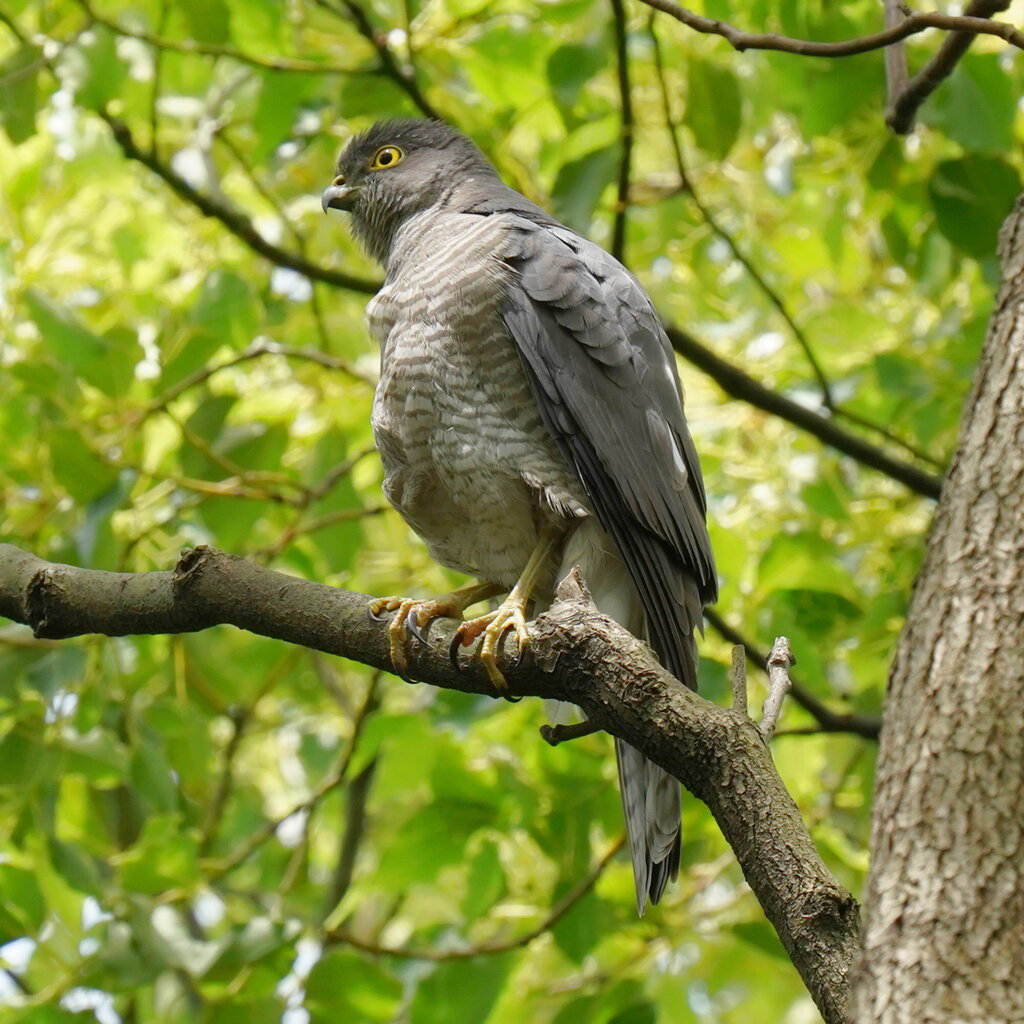
Japanese Sparrowhawk
Photo © Daniel S. Katz
Photo © Daniel S. Katz — CC BY 4.0 — Source: iNaturalist #286157960Identification
The Japanese sparrowhawk is a small raptor measuring 23–30 centimetres in length, with distinctive broader and rounder wings and a relatively short tail. Adult males display slate-black upperparts with white on the nape, whitish underparts with grey-brown and red-brown barring, yellow legs, and red-orange eyes. Females are noticeably larger, with brown upperparts, white body and wing-linings with brown-grey barring, and yellow eyes. Both sexes feature a characteristic throat stripe, more prominent in females. Juveniles are dark brown above with buff or red-brown sides and cream underparts streaked with red-brown. The iwasakii subspecies found in the South Ryukyu Islands is smaller and darker than its mainland relatives.
In flight, males show a faint red-brown wash on the chest sides, distinct brown-grey bars on wing-linings and flanks, and thin bands on flight feathers. The species occasionally produces a distinctive chattering kiki-kik-kik sound, though visual identification is typically more reliable. The long, slim legs and pointed wingtips reflect the bird's aerial hunting prowess.
Range & Habitat
The Japanese sparrowhawk inhabits forest environments across eastern Russia, the Korean peninsula, Japan, and northeastern China, with three recognized subspecies showing different distribution patterns. The species typically favours deciduous, coniferous, and mixed forests at elevations up to 1800 metres, usually below 1000 metres, preferring southern taiga and subalpine zones near rivers. The migratory subspecies Tachyspiza gularis sibiricus breeds from Mongolia to eastern China and winters in southeast Asia and Indonesia, while the widespread gularis subspecies breeds in northeast China, the Russian Far East, and Japan. The sedentary iwasakii subspecies remains year-round in evergreen subtropical forests of the South Ryukyu Islands.
During migration and winter months, these sparrowhawks adapt to more open habitats, appearing in villages and areas where woodlands and shrubs mix with marshes and fields. This flexibility in habitat use allows them to occupy diverse landscapes across their broad Asian range.
Behaviour & Diet
As a diurnal raptor in the family Accipitridae, the Japanese sparrowhawk is an active aerial hunter, though specific details of its hunting behaviour and primary prey species are not extensively documented in available sources. The species' relatively short tail and pointed wingtips suggest adaptation for agile flight and pursuit hunting through forested environments.
The sparrowhawk's breeding distribution across Russia, Korea, Japan, and China indicates seasonal movement patterns, with migratory subspecies undertaking significant journeys between breeding and wintering grounds. Despite being closely related to other Tachyspiza species like the Besra, the Japanese sparrowhawk maintains distinct ecological and behavioural characteristics that support its status as a separate species.
Best Time & Places to See It
For travellers seeking the Japanese sparrowhawk, Japan offers the most accessible opportunities, particularly in regions supporting breeding populations of the gularis subspecies. The South Ryukyu Islands provide year-round sightings of the sedentary iwasakii subspecies in subtropical evergreen forests. In northeastern China and the Russian Far East, the species is present during breeding season, while migratory populations may be encountered during spring and autumn passage.
The species is listed as endangered in Japan and protected in China, reflecting conservation concerns despite its global "least concern" status. Travellers should seek out forest habitats near rivers and elevation zones between 1000–1800 metres where the species is most regularly encountered. During migration periods, birds appear in more open woodland and shrubland areas, offering additional viewing opportunities.
Photography Tips
Photographing the Japanese sparrowhawk requires patience and attention to subtle plumage details. The key to identification lies in capturing the distinctive throat stripe (especially prominent in females), the colour and pattern of barring on underparts and wing-linings, and the eye colour—red-orange in males, yellow in females. In flight, look for the characteristic brown-grey bars on flanks and wing-linings, and the thin banding on flight feathers.
For subspecific documentation, note that iwasakii shows a darker back and broader abdominal spots than mainland birds. Since the species occasionally vocalizes with a chattering call, audio recording alongside photography enriches documentation. Forest habitats near rivers in mixed woodland zones provide the best lighting and perching opportunities, while migration periods in more open areas may offer clearer sightlines for capturing diagnostic field marks.
Baikal National Park
Ольхонский район, Russia
+184 birds+11 mammals
Where the world's deepest freshwater lake meets ancient Siberian taiga, Baikal National Park sprawls across 66,203 square kilometers of one of Earth's most singular ecosystems. The…
VIEW NATIONAL PARKNortheast China Tiger and Leopard National Park
Mu Dan Jiang Shi, China
+202 birds+19 mammals
Across the temperate forests of northeastern China, where winters grip the landscape in subzero silence and summers remain cool and brief, the Mudanjiang region supports a…
VIEW NATIONAL PARKNo community photos yet. Log in to add the first one.
No community observations of this species yet.