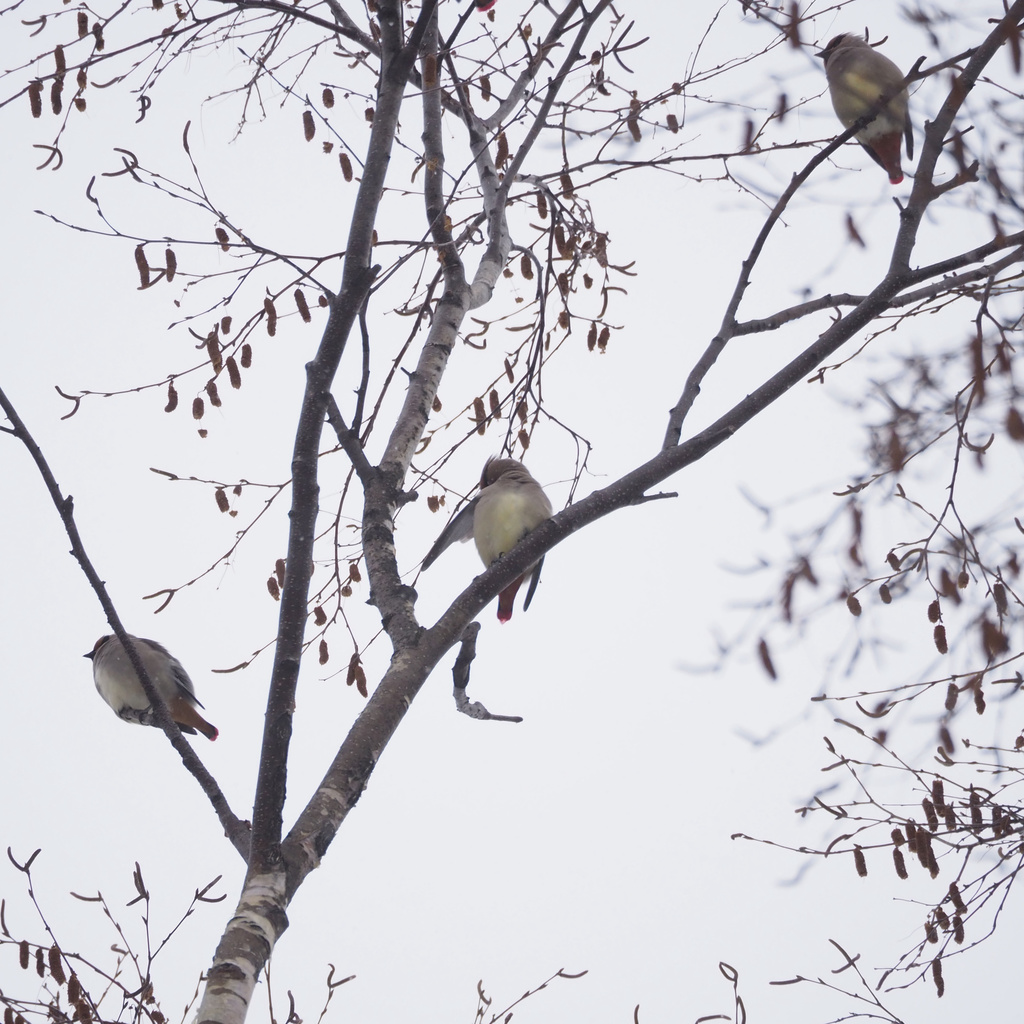
Japanese Waxwing
Photo © ITÔ, Hiroki
Photo © ITÔ, Hiroki — CC BY 4.0 — Source: iNaturalist #67242550The Japanese waxwing (Bombycilla japonica) is a fairly small passerine bird in the waxwing family found in the eastern Palaearctic, where it breeds south of the breeding range of the related Bohemian waxwing, but overlaps extensively with it in winter. It feeds mainly on fruit and berries but also eats insects during the summer. The nest is a cup of twigs lined with grass and moss which is built in a tree. In males, the secondary wing feathers have red tips, the resemblance of which to sealing wax gives these birds their common name. It is listed by IUCN as Near Threatened, due to loss and degradation of its preferred forest habitat. == Taxonomy == The Japanese waxwing is one of three species placed in the genus Bombycilla by Louis Pierre Vieillot in 1808. Bombycilla is Vieillot's attempt at Latin for "silktail", translating the German name Seidenschwänze. Vieillot thought that motacilla, Latin for wagtails, was derived from mota for "move" and cilla, which he thought meant "tail"; however, Motacilla actually combines motacis, a mover, with the diminutive suffix -illa. He then combined this "cilla" with the Latin bombyx, meaning silk. The specific epithet japonica is Latin for "of Japan". ==…
Giant Panda National Park
Mianyang, China
+447 birds+47 mammals
Where the eastern slopes of China's Sichuan plateau descend into cloud-wrapped valleys, one of Asia's most biodiverse landscapes unfolds across more than 350,000 square kilometres. This…
VIEW NATIONAL PARKYancheng National Nature Reserve
Yancheng, China
+208 birds+4 mammals
Where the East China Sea's tidal rhythms sculpt the Jiangsu coast, Yancheng National Nature Reserve sprawls across one of Asia's most dynamic wetland complexes. This vast…
VIEW NATURE RESERVENo community photos yet. Log in to add the first one.
No community observations of this species yet.