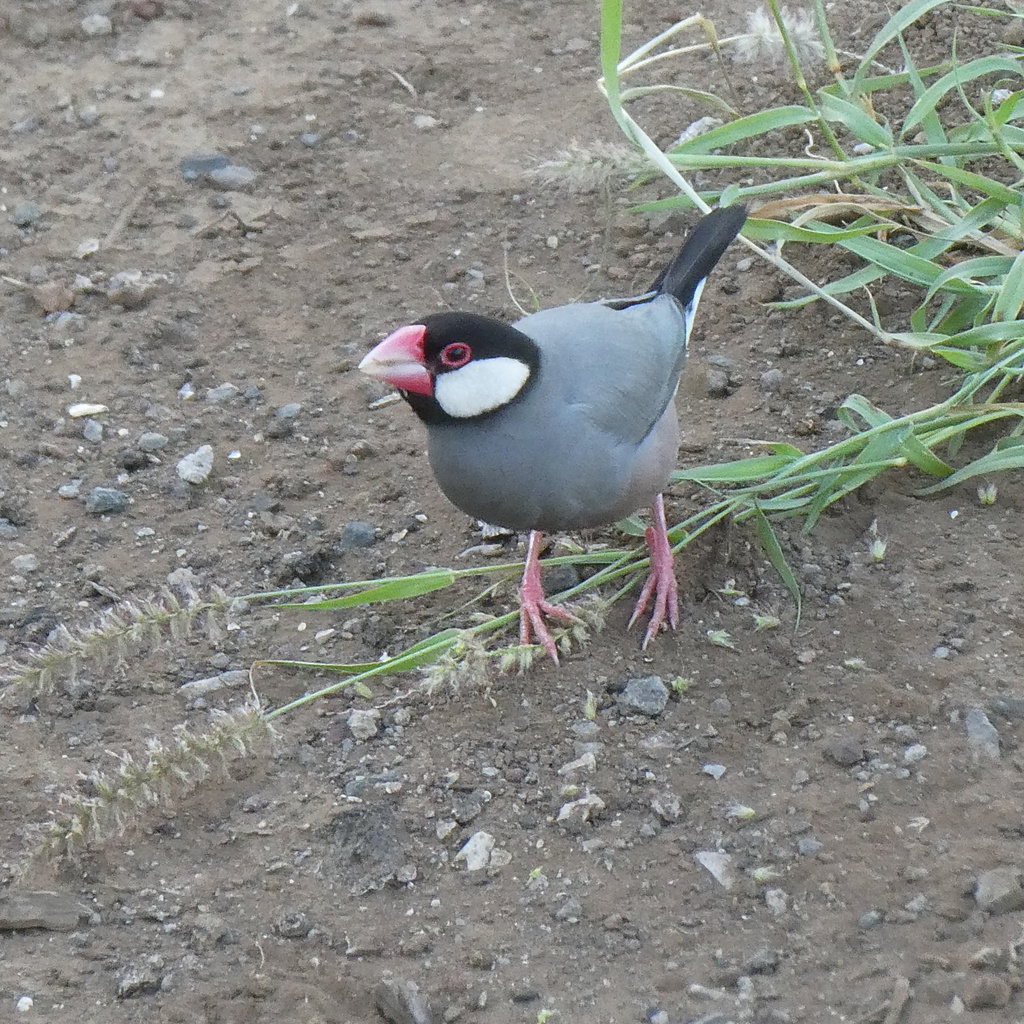
Java Sparrow
Photo © Julie Mount
Photo © Julie Mount — CC0 1.0 — Source: iNaturalist #201034128Identification
The Java sparrow is a small passerine bird measuring 15 to 17 cm in length, making it about the size of a house sparrow but possibly the largest species in the estrildid family. Adults are unmistakable and striking in appearance: they feature grey upperparts and breast, a distinctive white-cheeked black head, a prominent red eye-ring, pink belly and feet, and a thick red bill. Both sexes are similar in plumage. Immature birds are quite different, displaying brown upperparts and pale brown underparts with a plain head, while very young birds have a black beak with a pink base. The species communicates through a chip call and produces a rapid, repetitive song of call notes. Research has shown that Java sparrows produce distinct trill-calls that vary contextually—faster and louder during aggressive interactions, and slower and softer during affiliative behaviour—allowing them to convey different social intentions through acoustic variation.
Range & Habitat
The Java sparrow is a resident breeding bird native to Java, Bali, and Bawean in Indonesia. However, due to its popularity as a cage bird and subsequent introductions by humans, it now occurs in many other regions worldwide, including breeding populations on several Hawaiian Islands (especially Oahu), Puerto Rico where it is fairly common near San Juan, Jamaica, and Christmas Island off Western Australia. It was also introduced to the Indian subcontinent but failed to establish as a successful resident on the mainland.
In its natural habitat, the Java sparrow is highly gregarious and frequents open grassland and cultivation. It was formerly a pest in rice fields—a characteristic reflected in its scientific name oryzivora, meaning "rice-eating." The species nests in trees or buildings, typically laying up to eight eggs per breeding effort.
Behaviour & Diet
The Java sparrow is a very social bird with a strong preference for grain and other seeds as its primary food. Its gregarious nature and seed-eating habits made it notorious as an agricultural pest in rice-growing regions historically. Beyond basic vocalizations, the species engages in sophisticated social communication through context-dependent trill-calls that vary in repetition rate and acoustic properties depending on behavioural circumstances, enabling nuanced communication among flock members.
Best Time & Places to See It
For travellers seeking to observe Java sparrows in their native range, Indonesia—particularly Java and Bali—remains the primary destination, though sightings in natural habitats have become increasingly uncommon due to habitat loss and trapping. Outside its native range, Hawaii (especially Oahu), Puerto Rico near San Juan, and Christmas Island offer more reliable opportunities to encounter established populations. The species' gregarious nature means that when found, multiple individuals are usually present together.
Photography Tips
The Java sparrow's distinctive and colourful plumage makes it highly photogenic. The bold contrast between its white-cheeked black head, grey upperparts, and pink belly provides excellent subject definition. The bird's red eye-ring and thick red bill are particularly striking features worth capturing in close-up shots. Since Java sparrows are gregarious, photographers may have opportunities to document flock behaviour and social interactions. The bird's relatively small size (15–17 cm) and tendency to frequent open grasslands and cultivated areas mean good natural lighting conditions are often available. In introduced populations, particularly in Hawaii and Puerto Rico, birds may be somewhat habituated to human presence, allowing for closer approach.
Hawaiʻi Volcanoes National Park
Hawaiʻi County, United States
+84 birds+2 mammals
Where volcanic slopes descend toward the Pacific across more than five thousand square kilometers, Hawaiʻi Volcanoes National Park presents one of Earth's most dynamic laboratories of…
VIEW NATIONAL PARKTaman Nasional Baluran
Situbondo, Indonesia
+189 birds+9 mammals
Across the northeastern tip of East Java, where monsoon winds sweep down from the Bali Strait, a landscape of contrasts unfolds within 374 square kilometres of…
VIEW NATIONAL PARKWest Bali National Park
Gerokgak, Indonesia
+240 birds+8 mammals
Across West Bali's northwestern reaches, where the Indian Ocean meets volcanic slopes and limestone cliffs plunge toward turquoise shallows, sprawls a protected realm of roughly 325…
VIEW NATIONAL PARKHaleakalā National Park
Maui County, United States
+66 birds+4 mammals
Ascending from sea level to over 10,000 feet across a mere thirty miles, Haleakalā National Park commands one of the Pacific's most dramatic elevation gradients, where…
VIEW NATIONAL PARKKīlauea Point National Wildlife Refuge
Kilauea, United States
+79 birds+1 mammals
At the northernmost tip of Kauai, where the Pacific trades collide with volcanic rock, Kīlauea Point National Wildlife Sanctuary crowns a dramatic headland overlooking one of…
VIEW WILDLIFE SANCTUARYNo community photos yet. Log in to add the first one.
No community observations of this species yet.