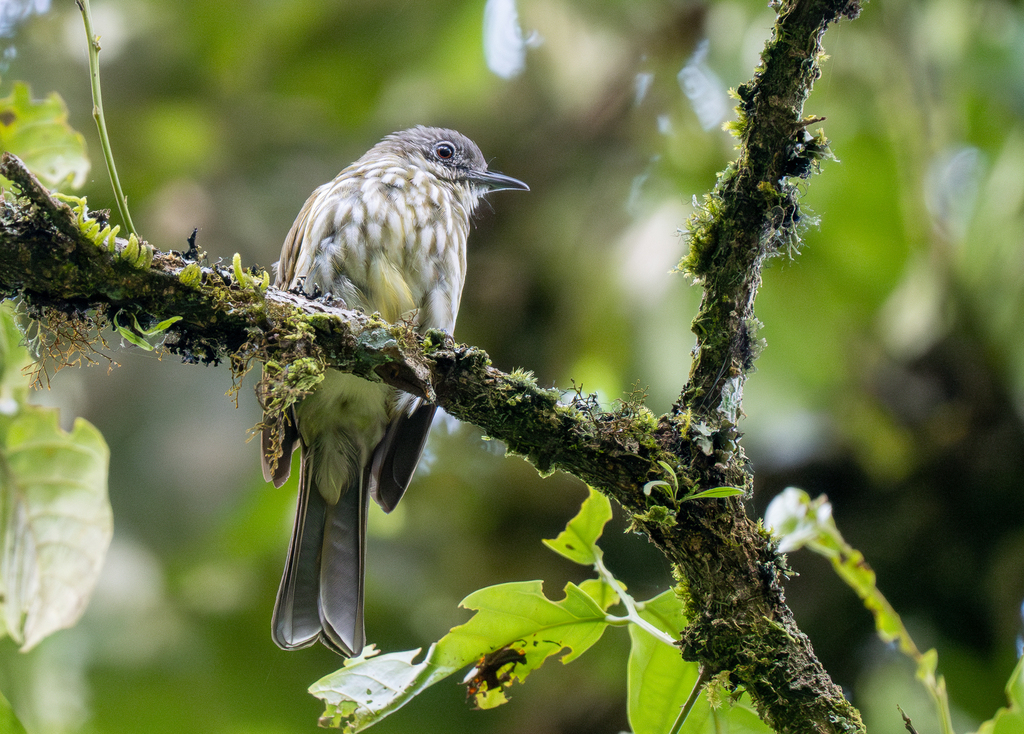
Javan Bulbul
Photo © Forest Botial-Jarvis
Photo © Forest Botial-Jarvis — CC BY 4.0 — Source: iNaturalist #179921671The Javan bulbul (Ixos virescens) is a songbird species in the bulbul family. It is the type species of the genus Ixos. It is endemic to the island of Java in Indonesia in its natural habitat of subtropical or tropical moist montane forests. It is not considered a threatened species by the IUCN. == Taxonomy and systematics == The Javan bulbul is sometimes classified in the genus Hypsipetes, presumably based on an earlier error in the Sibley taxonomy. The specific epithet virescens was given to the present species by Coenraad Jacob Temminck in 1825 and pre-dates the same name as given to the Nicobar bulbul by Edward Blyth in 1845. The olive bulbul has also been given the same scientific binomial, Hypsipetes virescens. Alternate names for the Javan bulbul include the green mountain bulbul, green-backed bulbul, green-winged bulbul, rufous-bellied bulbul, streaked bulbul and streaked mountain bulbul. The name 'streaked bulbul' should not be confused with the species of the same name, Ixos malaccensis. === Subspecies === One subspecies is currently recognized: Javan bulbul (I. v. virescens) - Temminck, 1825: Also named the Javan streaked bulbul. Found on Java The Sumatran bulbul (I. sumatranus) of Sumatra was formerly considered a subspecies…
Taman Nasional Baluran
Situbondo, Indonesia
+189 birds+9 mammals
Across the northeastern tip of East Java, where monsoon winds sweep down from the Bali Strait, a landscape of contrasts unfolds within 374 square kilometres of…
VIEW NATIONAL PARKGunung Ciremai National Park
Majalengka, Indonesia
+116 birds+1 mammals
Volcanic slopes rise sharply from West Java's interior, where Gunung Ciremai's 3,078-metre summit dominates a landscape carved by geological upheaval and shaped by equatorial monsoon rainfall.…
VIEW NATIONAL PARKGunung Merbabu National Park
Magelang, Indonesia
+61 birds+2 mammals
Where volcanic slopes rise sharply from the plateau of Central Java, Gunung Merbabu National Park encompasses nearly 200 square kilometers of montane forest that transitions through…
VIEW NATIONAL PARKMount Merapi National Park
Hargobinangun, Indonesia
+150 birds+3 mammals
Where the volcanic slopes of central Java rise into mist and montane forest, Mount Merapi National Park guards one of Indonesia's most dynamic landscapes. Spanning roughly…
VIEW NATIONAL PARKNo community photos yet. Log in to add the first one.
No community observations of this species yet.