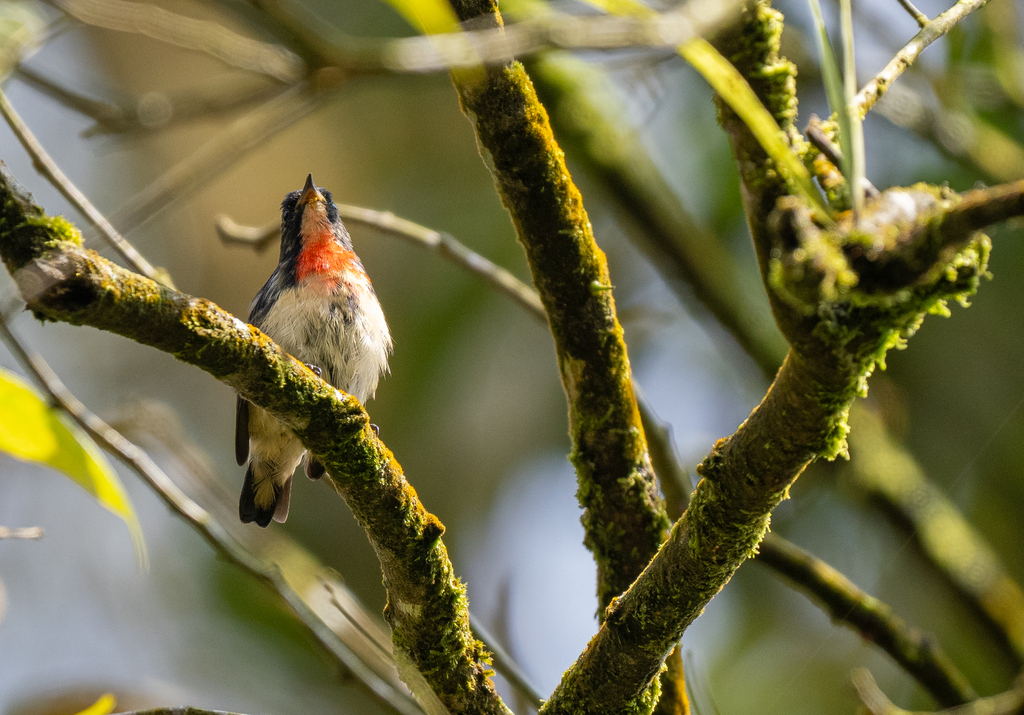
Javan Flowerpecker
Photo © Forest Botial-Jarvis
Photo © Forest Botial-Jarvis — CC BY 4.0 — Source: iNaturalist #232477874The Javan flowerpecker (Dicaeum sanguinolentum), formerly named the blood-breasted flowerpecker, is a species of passerine bird in the flowerpecker family Dicaeidae. It is found on the Indonesian islands of Java and Bali in the Lesser Sunda Islands. Its natural habitats are subtropical or tropical moist lowland forest and subtropical or tropical moist montane forest. It was formerly considered to be conspecific with the Flores, Sumba, and Timor flowerpeckers. == Taxonomy == The Javan flowerpecker was formally described and illustrated in 1829 by the Dutch zoologist Coenraad Jacob Temminck based on a specimen that had been collected on the Indonesian island of Java by Heinrich Kuhl and Johan Conrad van Hasselt. Temminck coined the binomial name Dicaeum sanguinolentum. The specific epithet is from Latin sanguinolentus meaning "bloody". The Flores, Sumba, and Timor flowerpeckers were formerly considered as subspecies but are now treated as separate species based on the differences in plumage and vocalizations. The English name was changed from "blood-breasted flowerpecker" to "Javan flowerpecker" to reflect the reduced range.
Taman Nasional Baluran
Situbondo, Indonesia
+189 birds+9 mammals
Across the northeastern tip of East Java, where monsoon winds sweep down from the Bali Strait, a landscape of contrasts unfolds within 374 square kilometres of…
VIEW NATIONAL PARKWest Bali National Park
Gerokgak, Indonesia
+240 birds+8 mammals
Across West Bali's northwestern reaches, where the Indian Ocean meets volcanic slopes and limestone cliffs plunge toward turquoise shallows, sprawls a protected realm of roughly 325…
VIEW NATIONAL PARKGunung Ciremai National Park
Majalengka, Indonesia
+116 birds+1 mammals
Volcanic slopes rise sharply from West Java's interior, where Gunung Ciremai's 3,078-metre summit dominates a landscape carved by geological upheaval and shaped by equatorial monsoon rainfall.…
VIEW NATIONAL PARKMount Merapi National Park
Hargobinangun, Indonesia
+150 birds+3 mammals
Where the volcanic slopes of central Java rise into mist and montane forest, Mount Merapi National Park guards one of Indonesia's most dynamic landscapes. Spanning roughly…
VIEW NATIONAL PARKNo community photos yet. Log in to add the first one.
No community observations of this species yet.