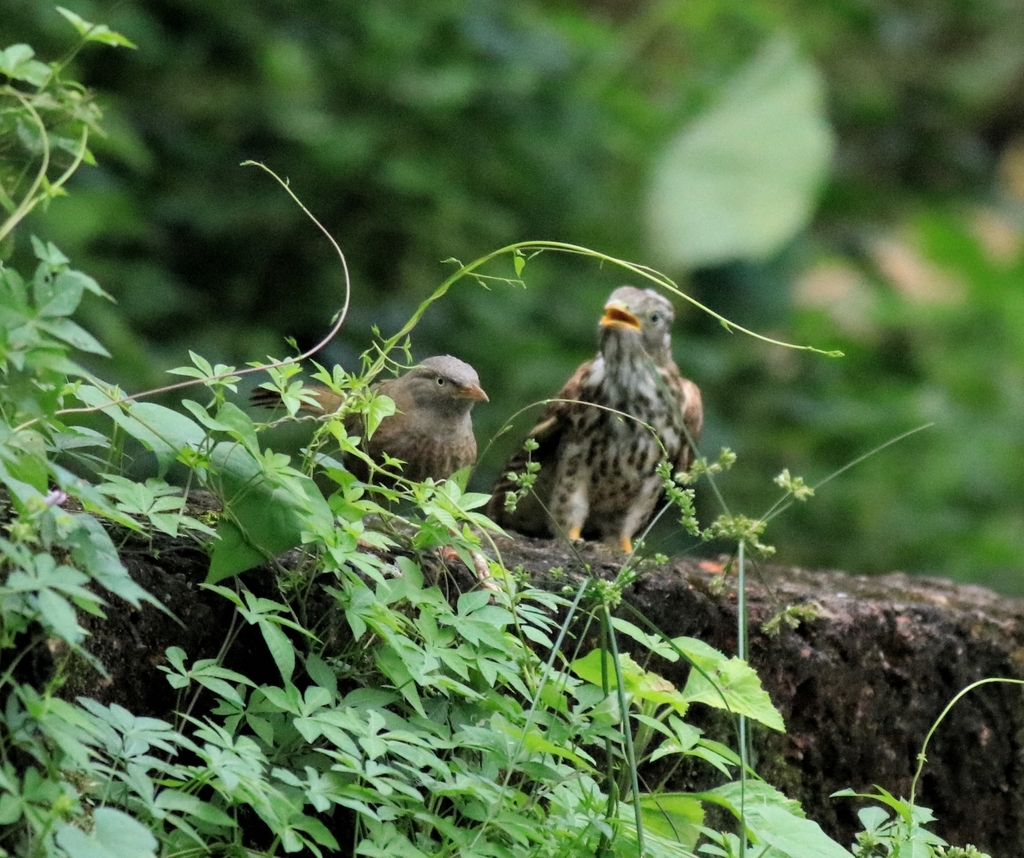
Jungle Babbler
Photo © Afsar Nayakkan
Photo © Afsar Nayakkan — CC BY 4.0 — Source: iNaturalist #257769615Identification
The jungle babbler is a drably coloured bird in brownish grey with a distinctive yellow bill. The upper parts are usually slightly darker than the underparts, with some mottling visible on the throat and breast. Sexes are identical in plumage. The species can be distinguished from the similar-looking white-headed babbler by its dark loreal zone (the area between the bill and eye) and lack of a contrasting light crown; however, their calls are entirely distinct, with jungle babblers producing harsh nasal calls compared to the high-pitched calls of white-headed babblers. The large grey babbler, another urban species, is easily separated by its distinctive long tail with white outer feathers. Regional subspecies show plumage shade variations, with some forms displaying more rufous coloration.
Range & Habitat
The jungle babbler is a common resident breeding bird across most of the Indian subcontinent. Different subspecies occupy distinct geographical regions: the nominate form ranges over northern India south of the Himalayan foothills, extending through Himachal Pradesh, Uttar Pradesh, Bhutan, Assam, Odisha and northeastern Andhra Pradesh; the paler desert form is found in the Indus River plains of Pakistan, Rajasthan and the Rann of Kutch; and separate subspecies inhabit the Western Ghats and peninsular India. The species is non-migratory and inhabits both forested areas and cultivated land, frequently seen in gardens within large cities.
Behaviour & Diet
Jungle babblers are highly gregarious birds, living in flocks of seven to ten or more individuals. They are remarkably noisy, and their presence is often announced from a distance by harsh mewing calls, continual chattering, squeaking and chirping. When foraging, some birds act as sentinels from high vantage points while others feed on insects, grains, nectar and berries. The groups maintain and defend territories, sometimes forming the core of mixed-species foraging flocks. Interestingly, these birds show behavioural similarities to social primates, and they are known to mob potential predators such as snakes.
Jungle babblers are long-lived for their size, with recorded lifespans of up to 16.5 years in captivity. Young birds possess a dark iris which gradually becomes pale and creamy with age. They breed year-round, with peak breeding in northern India occurring between March–April and July–September. Nests are built halfway up trees in dense foliage, typically containing three or four eggs (up to seven). Helpers assist parents in feeding young, and post-fledging survival rates are very high. Females typically leave their natal group after about two years.
Best Time & Places to See It
Jungle babblers are common and conspicuous residents throughout the Indian subcontinent, making them highly accessible to travellers. They are particularly abundant in urban gardens and parks of cities across northern India, as well as in forested habitats. The birds are very vocal and active during daylight hours, making them relatively easy to locate by sound. Peak breeding activity in northern India occurs between March–April and July–September, periods when birds may be especially vocal and visible as families forage together.
Photography Tips
Photograph jungle babblers in their characteristic flocking behaviour, capturing multiple birds interacting within a single frame. The yellow bill provides good colour contrast against their brownish-grey plumage and should be highlighted in your composition. Capture their social behaviours such as allopreening, play chases, and mock fights for dynamic and engaging images. Urban gardens provide accessible opportunities with good lighting; shoot during morning hours when birds are most active. The dark loreal zone and lack of a contrasting crown are key field marks to render clearly. Take advantage of their vocal nature by visiting locations where flocks are audibly active, increasing your chances of encountering and photographing these entertaining and sociable birds.
Orang National Park
Rangagarapathar, India
+298 birds+1 mammals
Where the Brahmaputra's floodplains meet the foothills of Assam, Orang National Park unfolds across a mosaic of riverine grasslands, forests and wetlands that pulse with the…
VIEW NATIONAL PARKIndravati National Park
Bijapur, India
+41 birds
Where the Indravati River cuts through the elevated plateaus of central India, a landscape of deciduous forest and open woodland unfolds across Bijapur district in Chhattisgarh.…
VIEW NATIONAL PARKRanthambhore National Park
Sawai Madhopur, India
+294 birds+20 mammals
Granite ridges and ravines carved through the Aravalli Range frame this protected landscape in eastern Rajasthan, where deciduous forest mingles with open scrubland and seasonal water…
VIEW NATIONAL PARKKhangchendzonga National Park
Sakkyong, India
+290 birds+1 mammals
Where the eastern Himalayas surge toward their crowning peaks, Khangchendzonga National Park embraces a landscape of almost overwhelming vertical drama. Rising from subtropical river valleys into…
VIEW NATIONAL PARKEravikulam National Park
Devikulam, India
+192 birds+7 mammals
High in the Western Ghats of Kerala, where monsoon mists cling to slopes that rise above 2,000 metres, Eravikulam National Park preserves one of South India's…
VIEW NATIONAL PARKKanha Tiger Reserve
Kanha Kisli F.V., India
+321 birds+23 mammals
Where sal forests give way to emerald meadows and crystalline streams carve through ancient valleys, one of India's finest wilderness reserves unfolds across the Maikal Range.…
VIEW NATIONAL PARKTadoba National Park
Palasgaon Singru, India
+270 birds+20 mammals
Where sal forests meet open grasslands and rocky outcrops rise from red laterite soil, central India's landscape unfolds in raw, untamed beauty. Ancient teak woodlands and…
VIEW NATIONAL PARKBandhavgarh National Park
Garhpuri, India
+285 birds+17 mammals
Where granite ridges rise dramatically above sal and bamboo forests, one of India's most pristine tiger reserves unfolds across the Vindhyan plateau. Ancient rock formations tower…
VIEW NATIONAL PARKPanna National Park
Badgadi Kalan, India
+271 birds+17 mammals
Where granite gorges slice through central India's Vindhyan plateau, a landscape of stark beauty unfolds across nearly six hundred square kilometers. The Ken River carves through…
VIEW NATIONAL PARKKaziranga National Park
Kohora, India
+422 birds+26 mammals
Dawn breaks over the floodplains of the Brahmaputra, where tall grasslands stretch endlessly beneath monsoon-heavy skies. This sprawling wilderness of northeastern Assam is a mosaic of…
VIEW NATIONAL PARKNanda Devi National Park
Garpak, India
+218 birds+5 mammals
Where the Himalayas surge into their most dramatic alpine amphitheater, a wilderness of raw geological power unfolds across 624 square kilometers of pristine terrain. Nanda Devi,…
VIEW NATIONAL PARKPeriyar National Park
Mlappara, India
+232 birds+4 mammals
Dawn breaks over mist-shrouded ridges where the Western Ghats tumble toward Kerala's spice-scented lowlands. Here, ancient tropical forests envelope a glittering artificial lake, creating a mosaic…
VIEW NATIONAL PARKPampadum Shola National Park
Vattavada, India
+258 birds+14 mammals
Where misty shola forests cling to the high plateaus of the Nilgiri Mountains, ancient evergreen remnants create a world apart. This 2,316-hectare reserve protects one of…
VIEW NATIONAL PARKBandipur National Park
Hirehalli, India
+302 birds+19 mammals
Where the Western Ghats descend into the Deccan plateau, ancient deciduous forests blanket a landscape carved by the Nugu River. Bandipur unfolds across 880 square kilometres…
VIEW NATIONAL PARKNagarahole Tiger Reserve
Nalkeri Forest, India
+323 birds+23 mammals
Where granite escarpments rise above dense deciduous forests and the Kabini River carves through pristine wilderness, one of India's most biodiverse landscapes unfolds across the Western…
VIEW NATIONAL PARKGir National Park
Asundrali, India
+258 birds+13 mammals
Dry deciduous forests cloak the rolling hills of western Gujarat where the Gir landscape rises as a final sanctuary for one of the world's rarest felids:…
VIEW NATIONAL PARKNo community photos yet. Log in to add the first one.
No community observations of this species yet.