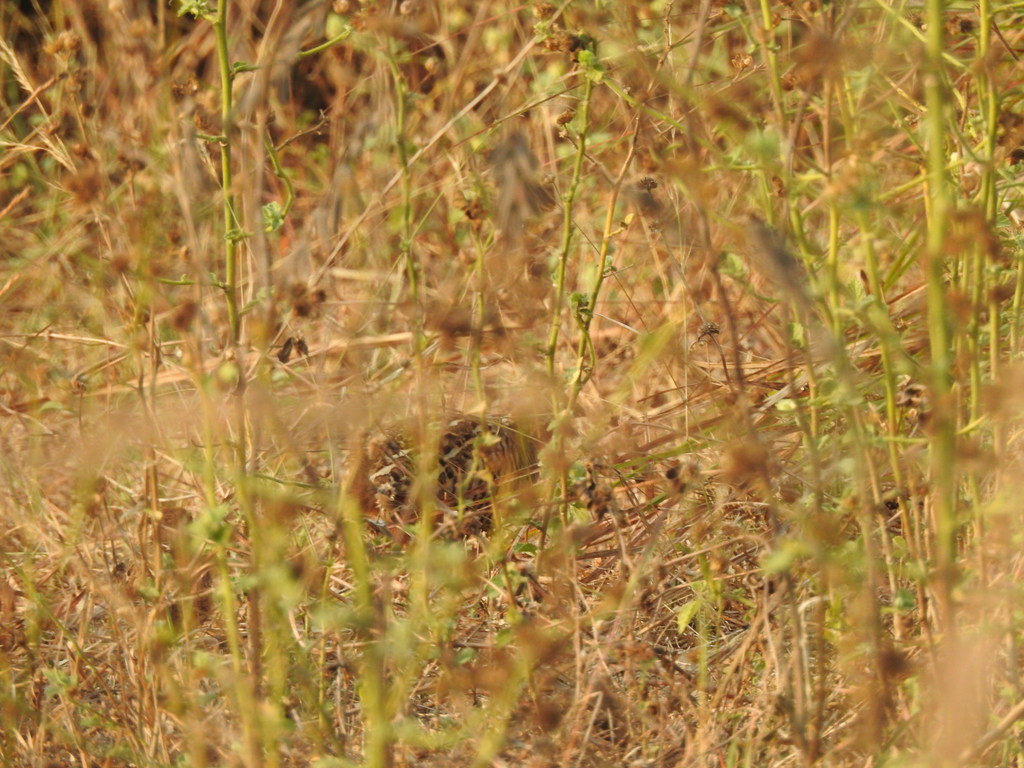
Jungle Bush Quail
Photo © Hopeland
Photo © Hopeland — CC BY 4.0 — Source: iNaturalist #69810155Identification
The jungle bush quail is a diminutive member of the pheasant family, measuring just 15–18 cm in length and weighing a mere 57–82 g. The species displays striking sexual dimorphism that aids identification. Males feature brown upperparts with blackish and buff markings, offset by whitish underparts with bold black barring. The face is distinctively dark reddish-brown with a prominent buffy-white moustachial stripe and a supercilium that turns whitish toward the back of the neck. Females present a softer appearance with pinkish-brown underparts, more uniform wings, and duller moustachial stripes. Juveniles resemble females but bear whitish streaks on the head and breast. The jungle bush quail is unlikely to be confused with other quail genera, though it may occasionally be mistaken for the rock bush quail, which shows less sexual dimorphism and has a shorter, whiter eyestripe.
Range & Habitat
Native to the Indian subcontinent, the jungle bush quail is found throughout peninsular India, from Gujarat and Odisha in the north to the Kashmir foothills, as well as across Sri Lanka. An introduced population exists on the island of Réunion. The species historically occurred in Nepal but has not been recorded there since the 19th century. It inhabits dry areas with shrubby or rocky cover, thriving in habitats ranging from thin grasslands to dense deciduous forests. The species occurs at elevations up to 1,200 m, though in the Western Ghats and southern India it reaches elevations up to 1,500 m.
Behaviour & Diet
The jungle bush quail is a gregarious species, typically foraging in small flocks of 6–25 birds. It feeds primarily on seeds and small insects. The species is generally non-migratory across most of its range. Its advertising call is a harsh, rhythmic chee-chee-chuck, chee-chee-chuck, reminiscent of a quarrelling black drongo. When flocks become separated, birds reassemble using low whistling calls of tiri-tiri-tiri or whi-whi-whi-whi-whi. Groups may also produce burbling or grating notes that quicken into a frenzy, along with low chuckles when flushed and harsh alarm calls.
Best Time & Places to See It
Breeding occurs from the end of the rains through the cold season, with timing varying across the species' range. Birds nest in shallow scrapes among cover, laying clutches of 4–8 eggs. The female alone incubates the eggs. Look for jungle bush quails in dry, scrubby habitats throughout peninsular India and Sri Lanka. Early morning or late afternoon visits to suitable grassland or deciduous forest edges offer the best chance of encountering small flocks. The species' large range and stable population mean it is relatively widespread throughout its native range.
Photography Tips
Photographing jungle bush quails presents a rewarding challenge. These small, ground-dwelling birds are most active during early morning and late afternoon hours. Focus on dry, open areas with scattered shrubby cover where flocks are likely to forage. The striking sexual dimorphism makes this species particularly photogenic—males' bold black barring and distinctive facial markings contrast beautifully with females' softer coloration. Be patient and move slowly to avoid flushing birds. The species' tendency to remain in small groups means that locating one flock increases the likelihood of multiple photo opportunities. Overcast conditions can help reveal the subtle plumage details that distinguish this quail from similar species.
Ranthambhore National Park
Sawai Madhopur, India
+294 birds+20 mammals
Granite ridges and ravines carved through the Aravalli Range frame this protected landscape in eastern Rajasthan, where deciduous forest mingles with open scrubland and seasonal water…
VIEW NATIONAL PARKKanha Tiger Reserve
Kanha Kisli F.V., India
+321 birds+23 mammals
Where sal forests give way to emerald meadows and crystalline streams carve through ancient valleys, one of India's finest wilderness reserves unfolds across the Maikal Range.…
VIEW NATIONAL PARKTadoba National Park
Palasgaon Singru, India
+270 birds+20 mammals
Where sal forests meet open grasslands and rocky outcrops rise from red laterite soil, central India's landscape unfolds in raw, untamed beauty. Ancient teak woodlands and…
VIEW NATIONAL PARKBandhavgarh National Park
Garhpuri, India
+285 birds+17 mammals
Where granite ridges rise dramatically above sal and bamboo forests, one of India's most pristine tiger reserves unfolds across the Vindhyan plateau. Ancient rock formations tower…
VIEW NATIONAL PARKPanna National Park
Badgadi Kalan, India
+271 birds+17 mammals
Where granite gorges slice through central India's Vindhyan plateau, a landscape of stark beauty unfolds across nearly six hundred square kilometers. The Ken River carves through…
VIEW NATIONAL PARKKeoladeo National Park
Shreenagar Rural, India
+326 birds+14 mammals
Where shallow wetlands shimmer beneath vast Rajasthani skies, one of Asia's finest bird sanctuaries pulses with extraordinary life. This former maharaja's hunting reserve, now spanning 29…
VIEW NATIONAL PARKPampadum Shola National Park
Vattavada, India
+258 birds+14 mammals
Where misty shola forests cling to the high plateaus of the Nilgiri Mountains, ancient evergreen remnants create a world apart. This 2,316-hectare reserve protects one of…
VIEW NATIONAL PARKBandipur National Park
Hirehalli, India
+302 birds+19 mammals
Where the Western Ghats descend into the Deccan plateau, ancient deciduous forests blanket a landscape carved by the Nugu River. Bandipur unfolds across 880 square kilometres…
VIEW NATIONAL PARKNagarahole Tiger Reserve
Nalkeri Forest, India
+323 birds+23 mammals
Where granite escarpments rise above dense deciduous forests and the Kabini River carves through pristine wilderness, one of India's most biodiverse landscapes unfolds across the Western…
VIEW NATIONAL PARKGir National Park
Asundrali, India
+258 birds+13 mammals
Dry deciduous forests cloak the rolling hills of western Gujarat where the Gir landscape rises as a final sanctuary for one of the world's rarest felids:…
VIEW NATIONAL PARKNo community photos yet. Log in to add the first one.
No community observations of this species yet.