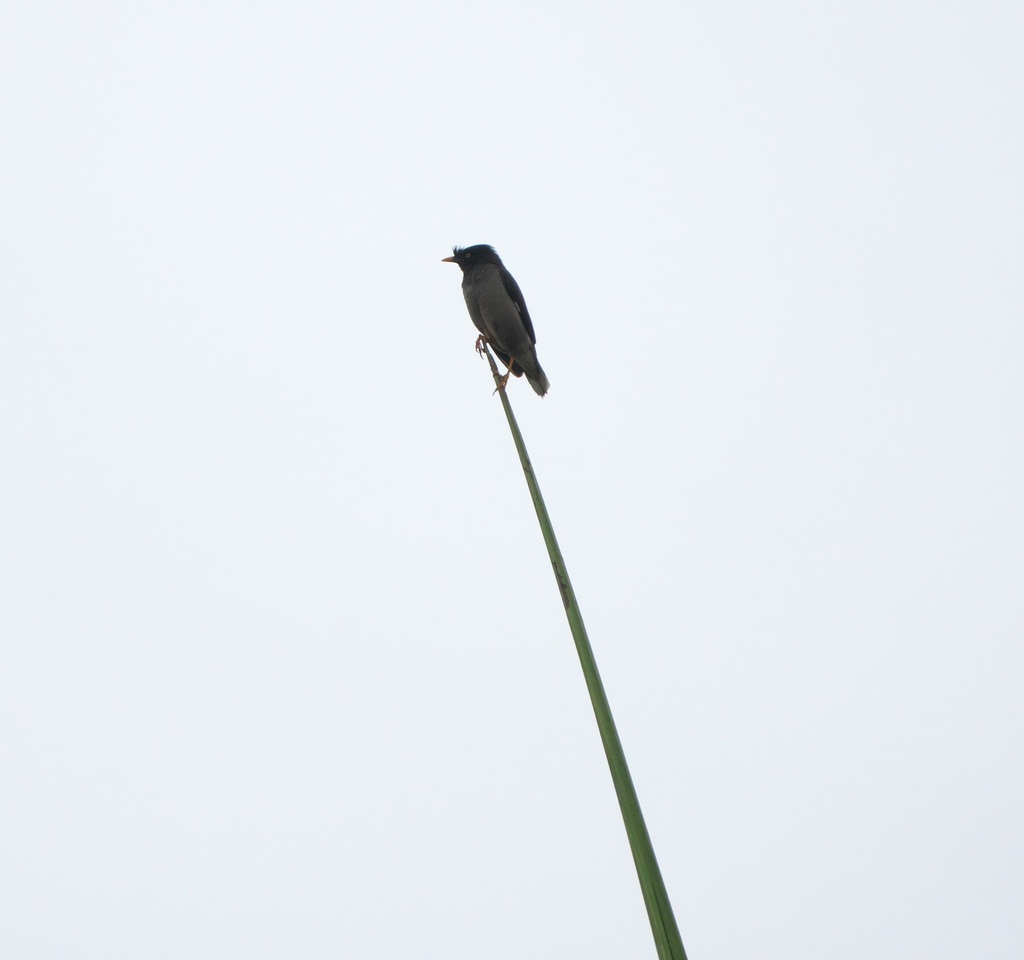
Jungle Myna
Photo © Robert Webster
Photo © Robert Webster — CC BY-SA 4.0 — Source: iNaturalist #148171505Identification
The jungle myna is a 23-centimetre starling with distinctive grey plumage, darker on the head and wings. Its most striking feature is a tuft of feathers on its forehead that forms a frontal crest, arising from the base of the bill. The bird has bright yellow bill and legs, with a dark base to the bill and a shade of blue at the base of the lower mandible. The eyes are pale yellow or blue depending on the population—notably, the southern Indian population has a blue iris, while northeastern populations show a smoky dark belly and vent.
In flight, a large white wing patch on the base of the primaries becomes conspicuous, and the tail feathers are broadly tipped in white. Unlike related species such as the common myna and bank myna, the jungle myna has no bare skin around the eye. The sexes are indistinguishable in plumage, though juveniles are browner with a pale throat and underside. The bird's calls are higher-pitched than those of the common myna, with foraging flocks producing clipped cheeping contact calls.
Range & Habitat
The jungle myna is a common resident breeder found across tropical southern Asia, with a patchy distribution throughout much of mainland India, Nepal, and Bangladesh, but notably absent from arid zones. The nominate population extends from Mount Abu in the west to Puri in Orissa in the east, while other subspecies are found across northern India, the Malay Peninsula, and neighboring regions. The species has also been introduced—both intentionally and accidentally—to many other parts of the world, including Fiji (around 1890 to control insect pests in sugarcane), Taiwan, the Andaman Islands, and parts of Japan, with breeding populations now established in Western Samoa.
These birds typically inhabit forests and cultivated areas, often close to open water. They are adaptable birds that may disperse outside their normal range, particularly after the breeding season, and have naturally expanded into some Pacific islands where they now compete with native species for resources and nesting sites.
Behaviour & Diet
Jungle mynas are omnivorous, feeding mainly on insects, fruit, and seeds, which they forage for primarily on the ground, often in the company of other myna species. They take berries from low bushes such as Lantana and nectar from large flowers borne on trees like Erythrina, where they may act as pollinators with their frontal crest feathers serving as brushes. They also perch on large grazing mammals to pick off ectoparasites and capture disturbed insects, and have been observed following farmers in ploughed fields and foraging on kitchen waste in urban areas. When feeding young, they may take larger prey including small mice.
Breeding occurs during summer and before the rains—February to May in southern India and April to July in northern India. These are secondary cavity nesters, using holes in trees and man-made structures such as walls and houses between 2 and 6 metres above the ground, sometimes lining nests with sloughed snake skins or dry pine needles. Clutches typically consist of 4 to 6 turquoise blue eggs, with both parents participating in nest building, incubation, and feeding the young. Outside breeding season, jungle mynas roost communally with other mynas in sugarcane fields and reed beds.
Best Time & Places to See It
The best season to observe jungle mynas is during their breeding period—February to May in southern India and April to July in northern India—when they are most active and visible. Look for them in their typical habitats of forests and cultivated areas near open water throughout the Indian Subcontinent. The species is a common resident, so sightings are generally reliable within its range, though absent from arid zones of India.
For international travellers, introduced populations offer additional opportunities. Fiji's established population, dating from around 1890, provides a tropical setting for observation, while recent breeding populations in Japan and Western Samoa offer Pacific locations. Urban and agricultural areas are particularly good for viewing, as these adaptable birds readily forage on farmland and around human settlements.
Photography Tips
The jungle myna's distinctive frontal crest and bright yellow bill and legs provide excellent photographic subjects. The large white wing patch and white-tipped tail are particularly striking in flight, so capture birds in aerial images when possible. The pale yellow or blue eye—depending on population—makes a compelling detail shot, especially for the blue-eyed southern Indian population.
Photograph birds on the ground where they spend much time foraging, or perched on grazing animals where they hunt ectoparasites. During breeding season, nest sites in trees and man-made structures offer behavioural photography opportunities. Communal roosting sites in sugarcane fields and reed beds can provide images of flocking behaviour. The contrast between the grey body plumage and bright yellow bill makes these birds visually striking in virtually any lighting condition, particularly in the warm light of early morning or late afternoon.
Langtang National Park
Helambu, Nepal
+364 birds+14 mammals
Where the southern slopes of the Himalayan highlands descend toward the subtropical valleys of central Nepal, Langtang National Park sprawls across one of the subcontinent's most…
VIEW NATIONAL PARKOrang National Park
Rangagarapathar, India
+298 birds+1 mammals
Where the Brahmaputra's floodplains meet the foothills of Assam, Orang National Park unfolds across a mosaic of riverine grasslands, forests and wetlands that pulse with the…
VIEW NATIONAL PARKGangotri National Park
Bhatwari, India
+119 birds+1 mammals
Where the Bhagirathi River carves through the western Himalayas in northern Uttarakhand, Gangotri National Park rises across steep alpine terrain that defines the boundary between temperate…
VIEW NATIONAL PARKEravikulam National Park
Devikulam, India
+192 birds+7 mammals
High in the Western Ghats of Kerala, where monsoon mists cling to slopes that rise above 2,000 metres, Eravikulam National Park preserves one of South India's…
VIEW NATIONAL PARKHat Noppharat Thara-Mu Ko Phi Phi National Park
Ao Nang, Thailand
+253 birds+9 mammals
Where limestone karsts rise dramatically from turquoise waters, Hat Noppharat Thara-Mu Ko Phi Phi National Park unfolds across a mosaic of beach, mangrove forest, and island…
VIEW NATIONAL PARKKanha Tiger Reserve
Kanha Kisli F.V., India
+321 birds+23 mammals
Where sal forests give way to emerald meadows and crystalline streams carve through ancient valleys, one of India's finest wilderness reserves unfolds across the Maikal Range.…
VIEW NATIONAL PARKBandhavgarh National Park
Garhpuri, India
+285 birds+17 mammals
Where granite ridges rise dramatically above sal and bamboo forests, one of India's most pristine tiger reserves unfolds across the Vindhyan plateau. Ancient rock formations tower…
VIEW NATIONAL PARKKaziranga National Park
Kohora, India
+422 birds+26 mammals
Dawn breaks over the floodplains of the Brahmaputra, where tall grasslands stretch endlessly beneath monsoon-heavy skies. This sprawling wilderness of northeastern Assam is a mosaic of…
VIEW NATIONAL PARKPeriyar National Park
Mlappara, India
+232 birds+4 mammals
Dawn breaks over mist-shrouded ridges where the Western Ghats tumble toward Kerala's spice-scented lowlands. Here, ancient tropical forests envelope a glittering artificial lake, creating a mosaic…
VIEW NATIONAL PARKBandipur National Park
Hirehalli, India
+302 birds+19 mammals
Where the Western Ghats descend into the Deccan plateau, ancient deciduous forests blanket a landscape carved by the Nugu River. Bandipur unfolds across 880 square kilometres…
VIEW NATIONAL PARKNagarahole Tiger Reserve
Nalkeri Forest, India
+323 birds+23 mammals
Where granite escarpments rise above dense deciduous forests and the Kabini River carves through pristine wilderness, one of India's most biodiverse landscapes unfolds across the Western…
VIEW NATIONAL PARKTaman Negara National Park
Kampong Samas, Malaysia
+393 birds+48 mammals
Where ancient rainforest meets limestone peaks, one of Southeast Asia's oldest protected wilderness preserves sprawls across 4,343 square kilometers of primordial landscape. Dipterocarp giants tower overhead,…
VIEW NATIONAL PARKNational Park of American Samoa
Leusoaliʻi, United States
+31 birds+1 mammals
The volcanic ridges of American Samoa rise steeply from the Pacific, their slopes cloaked in tropical rainforest that cascades down to a coast where reef systems…
VIEW NATIONAL PARKNo community photos yet. Log in to add the first one.
No community observations of this species yet.