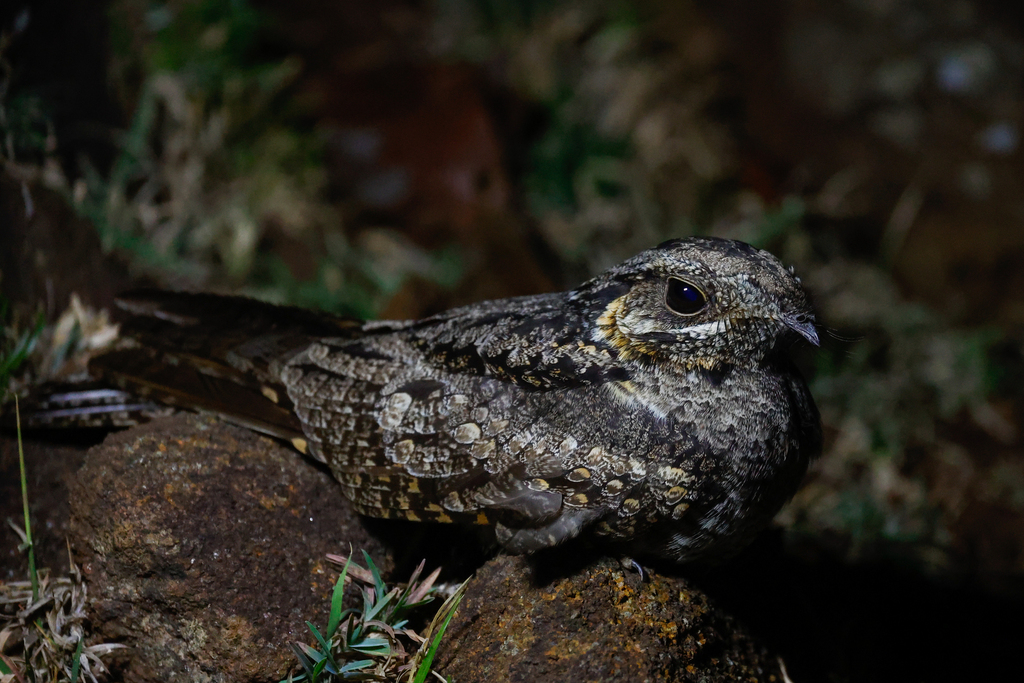
Jungle Nightjar
Photo © Tom Field
Photo © Tom Field — CC BY 4.0 — Source: iNaturalist photo #404424162Identification
The jungle nightjar is a compact bird measuring 21–24 cm in length, though Sri Lankan birds are noticeably smaller. Its plumage is predominantly grey with black streaks adorning the crown, creating subtle but effective camouflage in forest-edge habitats. Unlike many nightjar species, it lacks a conspicuous wing patch, though the wing coverts show rufous tones. The tail is greyish with well-separated narrow black bars. Sexual dimorphism is evident: males display a distinctive white throat patch broken at the centre, while females have a rufous throat patch with submoustachial streaks. The bird's voice is highly characteristic—a rapid series of thacoo or chuck notes delivered at about five per two seconds, reminiscent of a distant engine. The song consists of slow, regular FWik-m notes repeated for up to 10 seconds, sometimes finishing with quick whistling foo-foo sounds resembling air blown over a bottle mouth.
Range & Habitat
The jungle nightjar is endemic to the Indian subcontinent, with populations in India and Sri Lanka forming distinct subspecies. The Indian nominate form and the smaller Sri Lankan subspecies (kelaarti) represent the currently recognized populations of this species following taxonomic revision. The bird favours forest edges, scrubland, and hilly grassland, where it hunts at dusk. It is most active during twilight hours, making it a challenging species to locate and observe during daylight.
Behaviour & Diet
This nightjar is crepuscular, becoming active as darkness falls. It typically hunts over hilly grassland and scrub, regularly returning to favourite prominent perches such as bare posts or rocks where it waits for aerial insects. By day, the bird roosts lengthwise along branches in trees, a posture that aids its cryptic camouflage. The breeding season extends from January to June in India and March to July in Sri Lanka. The species nests minimally, simply laying two eggs in a bare patch on the ground. Both parents share incubation duties for approximately 16 to 17 days, demonstrating the biparental care typical of many nightjar species.
Best Time & Places to See It
Dusk is the optimal time to locate the jungle nightjar, when it becomes vocally active and begins hunting. Forest edges, scrubland, and hilly grassland offer the best chances of encounter, particularly in areas with prominent bare rocks or posts where birds regularly perch. Patience and stillness are essential; listening for the distinctive engine-like call sequence is often more productive than visual searching. The breeding season (January–June in India, March–July in Sri Lanka) may offer increased activity and calling rates.
Photography Tips
Photographing jungle nightjars demands low-light capability and fast lenses, as the species is most active during dusk when light levels are minimal. A headlamp with a red filter will help locate roosting birds without causing disturbance. Position yourself near known perching sites before dusk and remain motionless; the bird's reliance on camouflage means sudden movement will cause it to flush. High ISO and image stabilization are essential given the dim conditions. Avoid using flash, which can cause alarm and habituation problems. Pre-focus on likely perching branches to avoid focus delays in low light.
Kanha Tiger Reserve
Bandhavgarh National Park
Bandipur National Park
Keoladeo National Park
Nagarahole Tiger Reserve
Panna National Park
Periyar National Park
Tadoba National Park
Nothing matches these filters.
No community photos yet. Log in to add the first one.
No community observations of this species yet.