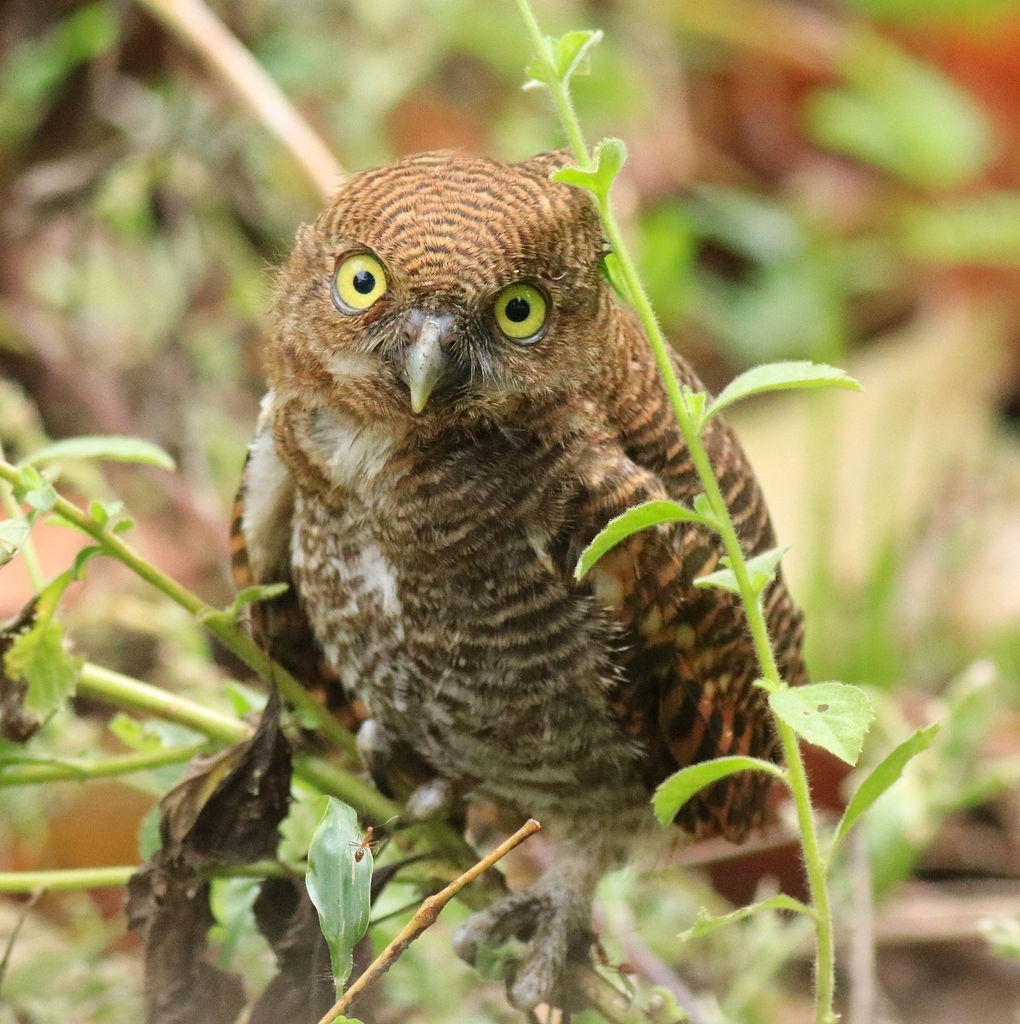
Jungle Owlet
Photo © Afsar Nayakkan
Photo © Afsar Nayakkan — CC BY 4.0 — Source: iNaturalist #260582903Identification
The Jungle Owlet is a small owlet with a distinctive rounded head and finely barred plumage throughout. It lacks a clear facial disk, distinguishing it from many other owl species. The upperparts are dark black-brown barred with white, while the wings are brownish with white and rufous patches on the coverts. The primaries and secondaries are dark brown and barred with pale chestnut. The underparts are whitish or pale rufous, heavily barred with black, with a characteristic whitish patch on the chin, upper breast, and centre of the abdomen. The tail is narrowly barred in white. The bird has a yellow iris, greenish bill and tarsi, and black claws.
Two subspecies exist: the nominate form found in the plains of India and Sri Lanka, and G. r. malabaricum from the Western Ghats, which is shorter-tailed and shows more brown on the head. The latter subspecies has been suggested as potentially warranting full species status. Note that in Sri Lanka, the similar chestnut-backed owlet (Glaucidium castanonotum) was once considered a subspecies but is now recognized as a separate species, found in wetter forest zones.
Range & Habitat
Native to the Indian Subcontinent, the Jungle Owlet is found south of the Himalayas and in some parts of the Himalayas itself, reaching elevations up to 2,000 m. Its range extends from Dalhousie in the west to Bhutan in the east. The species occupies a variety of habitats including scrub forest, deciduous forest, and moist deciduous forest, preferring drier forest zones in Sri Lanka compared to other owlet species.
Behaviour & Diet
Jungle Owlets are mainly active at dawn and dusk, though they are known to call and fly during daylight hours as well. They are often found singly, in pairs, or in small groups, and are usually detected by their distinctive calls—a rapid series of "prao..prao.prao-prao-prao" that increases and then fades in volume before ending abruptly. During the day, young nestlings produce tick calls similar to those of a pale-billed flowerpecker.
These owlets roost in tree cavities and employ a remarkable camouflage strategy, freezing to resemble a dead tree stump when disturbed. At their daytime roosts, they may be mobbed by drongos, treepies, and sunbirds. They sometimes perch prominently on wires or bask in the morning sun before retiring. Their diet consists of insects, small birds, reptiles, and rodents, with peak foraging occurring an hour before sunrise and after sunset, though they occasionally capture small warblers during daylight hours. Breeding occurs from March to May in India, with nests in tree hollows at heights of 3 to 5 m; clutches typically contain four eggs (three in G. r. malabaricum).
Best Time & Places to See It
The Jungle Owlet is best observed during dawn and dusk when it is most active and vocal. Listen carefully for its distinctive call, which is the most reliable way to locate this cryptic species. The bird is found throughout suitable habitat across the Indian Subcontinent, from the plains to the foothills and lower montane regions. Visiting scrub and deciduous forests during the breeding season (March to May in India) increases the likelihood of encounters, as owlets are more vocal during this period.
Photography Tips
Photographing Jungle Owlets requires patience and attention to their calling patterns. Dawn and dusk sessions offer the best opportunities when the birds are most active. Look for them perching on wires or at the entrance to their tree cavity roosts during morning basking sessions. Since they sometimes freeze when disturbed, remaining still and quiet improves your chances of capturing images. Their small size and cryptic plumage mean that getting close requires careful stalking. Overcast conditions during early morning or late evening will provide softer light that complements their subtle barred patterns.
Lunugamvehera National Park
Sri Lanka
+204 birds+14 mammals
Dry scrubland and shallow wetlands converge in Sri Lanka's southeastern lowlands, where Lunugamvehera National Park anchors one of the island's most ecologically vital landscapes. The park's…
VIEW NATIONAL PARKKanha Tiger Reserve
Kanha Kisli F.V., India
+321 birds+23 mammals
Where sal forests give way to emerald meadows and crystalline streams carve through ancient valleys, one of India's finest wilderness reserves unfolds across the Maikal Range.…
VIEW NATIONAL PARKTadoba National Park
Palasgaon Singru, India
+270 birds+20 mammals
Where sal forests meet open grasslands and rocky outcrops rise from red laterite soil, central India's landscape unfolds in raw, untamed beauty. Ancient teak woodlands and…
VIEW NATIONAL PARKPanna National Park
Badgadi Kalan, India
+271 birds+17 mammals
Where granite gorges slice through central India's Vindhyan plateau, a landscape of stark beauty unfolds across nearly six hundred square kilometers. The Ken River carves through…
VIEW NATIONAL PARKPeriyar National Park
Mlappara, India
+232 birds+4 mammals
Dawn breaks over mist-shrouded ridges where the Western Ghats tumble toward Kerala's spice-scented lowlands. Here, ancient tropical forests envelope a glittering artificial lake, creating a mosaic…
VIEW NATIONAL PARKPampadum Shola National Park
Vattavada, India
+258 birds+14 mammals
Where misty shola forests cling to the high plateaus of the Nilgiri Mountains, ancient evergreen remnants create a world apart. This 2,316-hectare reserve protects one of…
VIEW NATIONAL PARKBandipur National Park
Hirehalli, India
+302 birds+19 mammals
Where the Western Ghats descend into the Deccan plateau, ancient deciduous forests blanket a landscape carved by the Nugu River. Bandipur unfolds across 880 square kilometres…
VIEW NATIONAL PARKNagarahole Tiger Reserve
Nalkeri Forest, India
+323 birds+23 mammals
Where granite escarpments rise above dense deciduous forests and the Kabini River carves through pristine wilderness, one of India's most biodiverse landscapes unfolds across the Western…
VIEW NATIONAL PARKNo community photos yet. Log in to add the first one.
No community observations of this species yet.