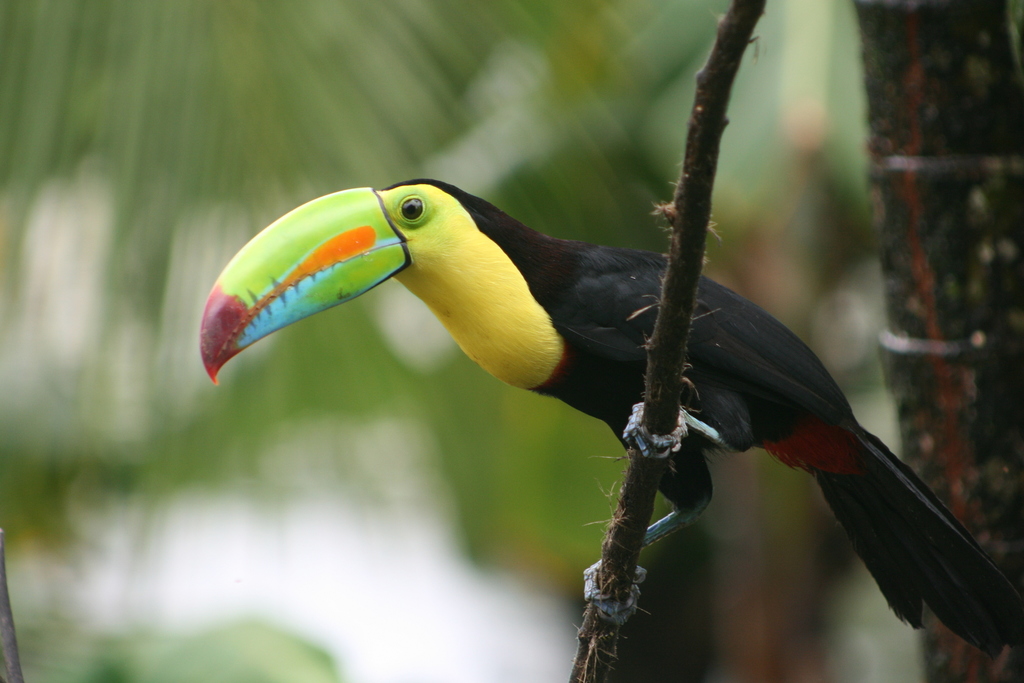
Keel-billed Toucan
Photo © Étienne Lacroix-Carignan
Photo © Étienne Lacroix-Carignan — CC0 1.0 — Source: iNaturalist photo #30116383Identification
The keel-billed toucan is unmistakable, with a length of 42 to 55 cm (including bill) and a wingspan of 189.4 to 208.4 mm, weighing 380–500 g. Its most striking feature is the enormous, brightly coloured bill, which accounts for about one third of the bird's total length and averages 12–15 cm. The bill is primarily green with a red tip and orange sides. Despite its imposing appearance, the bill is remarkably light—a spongy, hollow bone covered in keratin. The bill's coloration may also help regulate the bird's body temperature through blood vessels running through it.
The plumage is predominantly black, with a yellow neck and chest separated by a narrow red band. Red under-tail coverts and red feathers at the tail tip provide additional colour. The feet are blue and distinctive. Males and females look virtually identical except for size differences. Like all birds in the order Piciformes, keel-billed toucans possess zygodactyl feet—two toes facing forward and two backward—which aid their movement through tree branches.
Range & Habitat
The keel-billed toucan ranges from southern Mexico through Central America to Venezuela and Colombia, including Belize, where it is the national bird. The species inhabits tropical, subtropical, and lowland rainforests at altitudes up to 1,900 m (6,200 ft). While primarily forest dwellers that roost in the canopy, they also venture into neighbouring plantations, pastures, and second-growth forests.
These toucans are highly social and communal, roosting together in tree cavities—often with five or six individuals sharing a single hole. They seek holes positioned 3–27 m above ground with small entrances. Inside, they fold their tails over their bodies and tuck their large beaks along their backs to fit the cramped spaces and maintain normal body temperature.
Behaviour & Diet
Keel-billed toucans are gregarious birds, typically seen in small flocks of six to twelve individuals. Their flight is distinctive: slow and undulating, combining rapid wing beats with gliding phases in which the beak extends forward and dips downward. Flight distances are usually short. These birds are highly interactive, engaging in bill-dueling, throwing fruit into each other's mouths, and playing with fruits as though playing ball. They communicate through vocalizations including "grr," "trrii," and "rrrk" sounds—louder males can be heard from a kilometre away—as well as non-vocal communication through bill-clacking and wing-beating.
Keel-billed toucans are omnivorous, feeding primarily on a wide range of fruits, including Cymbopetalum mayanum and gumbo-limbo, supplemented with insects, invertebrates, lizards, snakes, small birds, and their eggs. Their remarkably dexterous bills allow them to reach and dissect fruits unavailable to other species. They typically feed from mid-storey to the forest canopy, rarely descending to the forest floor. Their feeding habits benefit forest regeneration, as large seeds they digest and regurgitate have higher sprouting rates than undigested seeds.
Best Time & Places to See It
Belize is the prime destination for observing the national bird, though keel-billed toucans can be found throughout their range from southern Mexico through Central America to northwestern South America. These highly social birds are rarely solitary, making them relatively conspicuous when present. They inhabit tropical rainforest canopies and adjacent second-growth areas, meaning they are most readily observed during daylight hours when they are active and moving between fruiting trees.
Look for them in flocking behaviour and listen for their distinctive vocalizations, which carry considerable distances through the forest. Fruiting trees attract feeding groups, providing excellent viewing and photographic opportunities.
Photography Tips
The keel-billed toucan's vibrant plumage and extraordinary bill make it a photographer's delight. The bird's striking colour palette—the emerald, orange, and red bill contrasting with black plumage and yellow underparts—photographs exceptionally well in natural light. Position yourself in the forest canopy or at mid-storey height where these birds typically forage for fruit.
Capture their distinctive flight behaviour, including the characteristic posture with beak extended and dipping forward. Their social interactions—bill-dueling, fruit exchanges, and group dynamics at roosting holes—provide compelling narrative moments. Early morning and late afternoon light enhances the iridescence and colours of the plumage and bill. Since they fly in small flocks, patience and positioning near fruiting trees will reward you with multiple subjects and varied behavioural sequences.
Manuel Antonio National Park
Quepos, Costa Rica
+426 birds+22 mammals
Where tropical rainforest descends steeply to a rocky Pacific coastline, Manuel Antonio National Park distills Central American biodiversity into one of Costa Rica's most compressed and…
VIEW NATIONAL PARKArenal Volcano National Park
Peñas Blancas, Costa Rica
+551 birds+21 mammals
Straddling the border between Alajuela and Guanacaste in northwestern Costa Rica, this national park rises dramatically around one of Central America's most active volcanic systems. The…
VIEW NATIONAL PARKTortuguero National Park
Roxana, Costa Rica
+420 birds+23 mammals
Canals and lagoons thread through a labyrinth of lowland rainforest where the Caribbean coast of Costa Rica meets the wetland frontier. This is terrain shaped by…
VIEW NATIONAL PARKBraulio Carrillo National Park
Las Horquetas, Costa Rica
+547 birds+18 mammals
Where the Caribbean slope descends from the central volcanic cordillera toward the humid lowlands of Heredia, Braulio Carrillo National Park preserves one of Costa Rica's most…
VIEW NATIONAL PARKSanta Rosa National Park
Santa Elena, Costa Rica
+359 birds+30 mammals
Where Pacific-facing slopes descend from volcanic uplands toward the Guanacaste lowlands, Santa Rosa National Park unfolds across a mosaic of tropical dry forest, gallery woodland, and…
VIEW NATIONAL PARKGuanacaste National Park
Santa Elena, Costa Rica
+461 birds+17 mammals
Where the Pacific slopes of northwestern Costa Rica rise toward the Continental Divide, dry tropical forest gives way to cloud-laden peaks and misty ridges—a landscape that…
VIEW NATIONAL PARKGeneral de División Omar Torrijos Herrera National Park
La Pintada, Panama
+401 birds+2 mammals
Across the highlands of central Panama, where the continental divide funnels moisture-laden trade winds into steep river valleys, the terrain rises and falls in a landscape…
VIEW NATIONAL PARKSoberanía National Park
Cristóbal, Panama
+495 birds+34 mammals
Rainforest and riverine woodland blanket the rolling terrain of this 714-square-kilometre national park in Colón Province, where the Caribbean watershed feeds a maze of streams and…
VIEW NATIONAL PARKChagres National Park
Caimitillo, Panama
+486 birds+19 mammals
Where the Chagres River carves through the humid tropics of central Panama, a vast montane and lowland forest sprawls across more than 2,300 square kilometers, anchoring…
VIEW NATIONAL PARKDarién National Park
Tucutí, Panama
+534 birds+13 mammals
Where the spine of Central America crumbles into wetland and rainforest, Darién National Park sprawls across more than 20,000 square kilometres of some of the tropics'…
VIEW NATIONAL PARKPortobelo National Park
Portobelo, Panama
+366 birds+9 mammals
Where the Caribbean's turquoise waters meet the Darién's verdant shore, Portobelo National Park sprawls across 570 square kilometers of coastal forest, mangrove wetland, and coral-fringed islands…
VIEW NATIONAL PARKParque Internacional la Amistad
Teribe, Panama
+325 birds+11 mammals
Where the continental divide rises between the Caribbean and Pacific watersheds, a wilderness of extraordinary biological richness unfolds across the Talamanca Range and into lowland rainforest—a…
VIEW NATIONAL PARKSian Ka’an
Chunyaxché, Mexico
+350 birds+16 mammals
Where the Yucatán Peninsula dissolves into wetland and mangrove, a vast mosaic of forest, lagoon, and coastal margin creates one of Mexico's most biodiverse strongholds. Across…
VIEW BIOSPHERE RESERVETikal National Park
Tikal, Guatemala
+399 birds+16 mammals
Dense rainforest canopy rises above the limestone plateau of Petén, where archaeological wonder and ecological richness merge seamlessly across one of Central America's most biodiverse landscapes.…
VIEW NATIONAL PARKLaguna del Tigre National Park
Petén, Guatemala
+399 birds+29 mammals
Where the Petén lowlands dissolve into wetland and forest, Laguna del Tigre National Park protects one of Guatemala's most ecologically vital landscapes. This sprawling reserve encompasses…
VIEW NATIONAL PARKSierra del Lacandón National Park
Petén, Guatemala
+348 birds+7 mammals
Where the Petén rainforest rises into limestone ridges and deep ravines, Sierra del Lacandón National Park protects one of Central America's most intact tropical wilderness zones.…
VIEW NATIONAL PARKCarara National Park
Tárcoles, Costa Rica
+397 birds+19 mammals
Where the Pacific coastal plain meets transitional forest, Carara National Park straddles one of Central America's most dynamic ecological boundaries. The park's landscape encompasses lowland deciduous…
VIEW NATIONAL PARKPalo Verde National Park
Bagaces, Costa Rica
+318 birds+24 mammals
Dry forest spreads across Palo Verde's low-lying terrain in northwestern Guanacaste, where seasonal rivers and lagoons etch through deciduous woodland that sheds its canopy each winter.…
VIEW NATIONAL PARKRincón de la Vieja National Park
Liberia, Costa Rica
+451 birds+30 mammals
Where volcanic slopes rise abruptly from the Guanacaste lowlands, Rincón de la Vieja National Park sprawls across a landscape shaped by geothermal drama and seasonal extremes.…
VIEW NATIONAL PARKTapantí Macizo de la Muerte National Park
Orosi, Costa Rica
+503 birds+18 mammals
Where montane cloud forest rises steeply from the Orosi Valley, Tapantí Macizo de la Muerte National Park enfolds a landscape of perpetual moisture and emerald complexity.…
VIEW NATIONAL PARKLa Amistad International Park
Crorina, Costa Rica
+532 birds+20 mammals
Where the Caribbean slopes of Costa Rica's Talamanca Mountains rise steeply inland from Limón, the boundary between two nations dissolves into an unbroken expanse of rainforest.…
VIEW NATIONAL PARKBarbilla National Park
Chirripó, Costa Rica
+226 birds
Where the Caribbean slope of Costa Rica's eastern cordillera plunges into perpetual moisture, Barbilla National Park rises as one of Central America's most water-rich ecosystems. Fed…
VIEW NATIONAL PARKVolcán Tenorio National Park
Guatuso, Costa Rica
+480 birds+12 mammals
Where volcanic slopes rise through Costa Rica's northwestern borderlands, Volcán Tenorio National Park sprawls across terrain shaped by ancient lava flows and mineral-rich springs. The park's…
VIEW NATIONAL PARKMarino Las Baulas National Park
Santa Cruz, Costa Rica
+246 birds+9 mammals
Where the Pacific meets a mosaic of dry forest and mangrove estuary, this coastal national park protects one of Central America's most dynamic wildlife theatres. The…
VIEW NATIONAL PARKCaño Negro National Wildlife Refuge
Caño Negro District, Costa Rica
+486 birds+16 mammals
Where the San Juan River's seasonal floodplain opens into expansive wetlands, Caño Negro Wildlife Sanctuary sprawls across one of Central America's most productive freshwater ecosystems. This…
VIEW WILDLIFE SANCTUARYGandoca-Manzanillo National Wildlife Refuge
Manzanillo, Costa Rica
+394 birds+18 mammals
Where the Caribbean coastal plain surrenders to water-logged forest and mangrove tangles, Gandoca-Manzanillo Wildlife Sanctuary shelters one of Costa Rica's most biodiverse lowland wetland ecosystems. The…
VIEW WILDLIFE SANCTUARYBarra del Colorado National Wildlife Refuge
Tortuguero, Costa Rica
+462 birds+36 mammals
Where the Caribbean's restless waters meet the Limón Province coastline, Barra del Colorado National Wildlife Sanctuary unfolds across a landscape of extraordinary ecological complexity. This equatorial…
VIEW WILDLIFE SANCTUARYCurú National Wildlife Refuge
Paquera, Costa Rica
+249 birds+8 mammals
Where the Pacific coast of Puntarenas dissolves into dry deciduous forest and mangrove fringe, Curú Wildlife Sanctuary holds one of Costa Rica's most ecologically vital yet…
VIEW WILDLIFE SANCTUARYNo community photos yet. Log in to add the first one.
No community observations of this species yet.