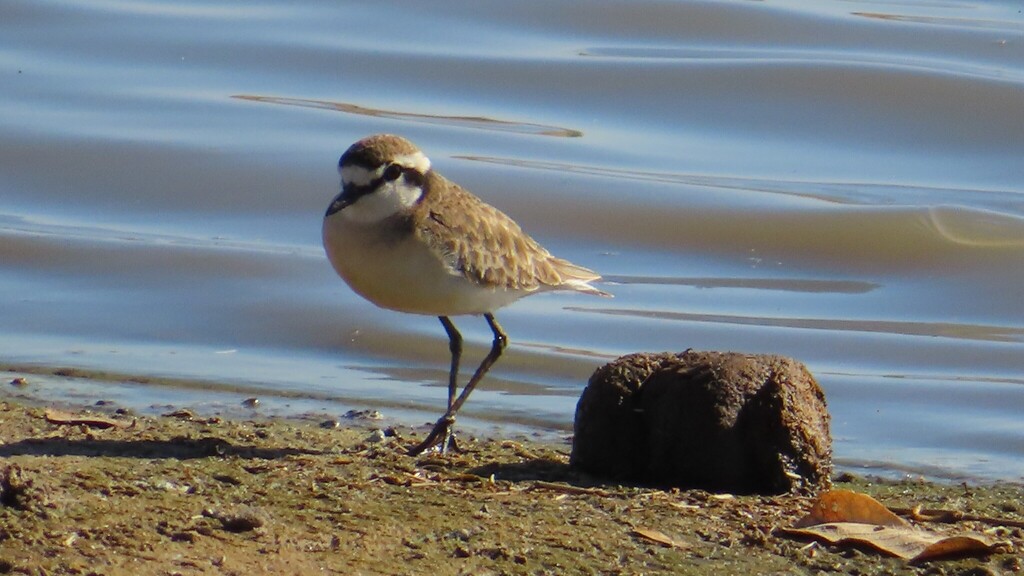
Kittlitz’s Plover
Photo © Nicola Crockford
Photo © Nicola Crockford — CC BY 4.0 — Source: iNaturalist photo #551451998Identification
Kittlitz's Plover is a diminutive shorebird weighing only 35–40 grams, with a distinctive appearance that varies subtly between breeding and non-breeding seasons. During breeding season, males display a striking pattern: a white forehead with a blackish bar followed by a narrow white bar on the forecrown, a brown crown with sandy-tipped feathers, and a bold black eye-stripe running from the bill through the eye to the neck, forming a dark collar across the upper mantle. Females are similar but with a narrower forecrown bar. Both sexes share black bills, dark brown eyes framed by black eyelids, and black legs (occasionally greenish or grey). The mantle is dark grey-brown, while the sooty-brown upperparts feature sandy rufous margins. The face, chin and upper throat are white, with the underparts taking on a yellowish hue and pale belly. The tail shows blackish central feathers progressively lightening towards the edges, with the outer pairs completely white. Non-breeding plumage is paler, with a browner eye-stripe and absent frontal bar. Juveniles lack the distinctive black face marks, appearing predominantly brown and buff above with white underparts.
Range & Habitat
Kittlitz's Plover is distributed throughout much of sub-Saharan Africa, the Nile Delta, and Madagascar, though it is common in South Africa and rarer in arid regions of Botswana and Namibia. In Namibia, populations favour coastal regions, highlands and Ovamboland, while in South Africa they are scarce in the southern lowveld and patchy in KwaZulu-Natal and the eastern Cape, generally avoiding mountains and densely wooded areas. Madagascar birds are notably smaller than continental populations. The species favours open habitats at low elevations with dry ground, very short grass, and close proximity to water, breeding at lakes, alkaline grasslands, lagoons, rivers, tidal mudflats, inland saltmarshes, and artificial water bodies such as salt pans, but avoiding sandy or rocky beaches. These plovers are strictly terrestrial, feeding, nesting, preening and roosting entirely on the ground.
Behaviour & Diet
Kittlitz's Plover is thought to be mainly polygamous with monomorphic plumage between sexes. The species is partially sedentary in coastal areas but mostly nomadic or migratory in mainland Africa, with movements varying between years in response to rainfall. In Madagascar, birds are resident or intra-island migrants, typically recorded below 950 metres, though occasionally reaching 1,400 metres. Ringed adults have been documented moving considerable distances, such as 113 kilometres between locations.
These plovers forage using a characteristic run-stop-search pattern, running around before stopping suddenly to peck at prey items. They may also stand erect with one foot vibrating on the surface (foot-trembling) to attract prey before lunging forward to catch it—a behaviour not reported in Madagascar. They feed day and night on moonlit nights until 11PM, often in groups of 2–5 individuals or small mixed flocks. Their vocabulary includes various calls: 'pipip', 'towhit', 'tit-peep', and rapid 'trit-tritritritrit', with alarm calls including sharp 'chirrt', hard 'trip', and plaintive 'pip-ip'.
Best Time & Places to See It
Kittlitz's Plover is common in South Africa, making it a reliable species for birders in that region. In Namibia, concentrate your search in coastal regions, highlands and Ovamboland where populations are stable. In eastern and western Cape, winter visits to estuarine mudflats increase sighting chances as inland populations move to avoid harsh conditions. Madagascar offers opportunities to observe the smaller subspecific population, particularly in lowland areas below 950 metres near lakes and alkaline grasslands. Search open habitats with short grass and dry mud near water bodies, especially artificial salt pans and inland saltmarshes where the species regularly congregates.
Photography Tips
Photograph during breeding season to capture the male's striking facial pattern and forecrown bars, which disappear in non-breeding plumage. Position yourself near shallow water bodies, mudflats, and alkaline grasslands where the bird's terrestrial habits make it predictable. The species' small size (wing length 100–110 mm) requires moderate telephoto lenses and patience; use fast shutter speeds to freeze the characteristic run-stop-search foraging behaviour. Early morning and late afternoon light will accentuate the plover's subtle plumage details, particularly the sandy margins on the crown and the striking white superciliary stripe. When photographing groups, capture the social behaviour of 2–5 birds foraging together, and watch for the distinctive foot-trembling hunting technique—a unique behavioural moment on mainland Africa populations.
Serengeti National Park
Tanzania
+558 birds+57 mammals
Across Tanzania's northern plateau, where volcanic soils meet acacia woodland and open grassland, unfolds one of Earth's most dynamic ecosystems. The Serengeti National Park sprawls across…
VIEW NATIONAL PARKChobe National Park
Botswana
+446 birds+45 mammals
Where the Chobe River cuts a sinuous path through northern Botswana, the landscape transforms into one of Africa's most dynamic wetland-savanna mosaics. This national park encompasses…
VIEW NATIONAL PARKNxai Pan National Park
Botswana
+226 birds+16 mammals
Across the northwestern reaches of Botswana stretches a landscape of profound seasonal transformation—a sprawling pan system where shallow depressions fill and empty with the rains, creating…
VIEW NATIONAL PARKMurchison Falls National Park
Uganda
+608 birds+33 mammals
Where the Victoria Nile compresses through a narrow gorge and explodes across a 45-meter precipice, the landscape speaks in thunder. Murchison Falls National Park sprawls across…
VIEW NATIONAL PARKAmboseli National Park
Etonet/Lenkism ward, Kenya
+501 birds+43 mammals
Where the Amboseli basin opens toward the Tanzanian frontier, a shallow alkaline lake mirrors vast skies across one of East Africa's most iconic savanna landscapes. The…
VIEW NATIONAL PARKNgorongoro Conservation Area
Tanzania
+626 birds+55 mammals
Volcanic calderas and open grassland dominate this high plateau in northern Tanzania, where the landscape rises above 2,000 metres and ancient geological forces have shaped both…
VIEW WILDLIFE MANAGEMENT AREAQueen Elizabeth National Park
Uganda
+672 birds+30 mammals
Across the southwestern escarpment of Uganda, where the Western Rift Valley descends through ancient volcanic terrain, Queen Elizabeth National Park sprawls across more than 8,300 square…
VIEW NATIONAL PARKGarden Route National Park
George, South Africa
+353 birds+54 mammals
Sweeping across the Western Cape's coastal and mountainous terrain, this sprawling national park encompasses over five thousand square kilometers of extraordinarily diverse landscape—from coastal limestone cliffs…
VIEW NATIONAL PARKKruger National Park
Ba-Phalaborwa Local Municipality, South Africa
+540 birds+91 mammals
Across the low-lying savanna of northeastern South Africa unfolds one of Africa's largest and most ecologically intact protected areas, where acacia woodlands merge into mopane scrub…
VIEW NATIONAL PARKAgulhas National Park
Cape Agulhas Local Municipality, South Africa
+224 birds+13 mammals
Where the Atlantic and Indian Oceans meet at Africa's southernmost tip, Agulhas National Park stretches across 892 square kilometres of windswept coastal landscape and rugged limestone…
VIEW NATIONAL PARKTankwa-Karoo National Park
Hantam Local Municipality, South Africa
+201 birds+20 mammals
Across the semi-arid heartland of the Northern Cape, where winter rains carve ephemeral watercourses through endless ochre plains, Tankwa-Karoo National Park sprawls across more than 3,100…
VIEW NATIONAL PARKAddo Elephant National Park
Sundays River Valley Local Municipality, South Africa
+388 birds+55 mammals
Where the Eastern Cape's semi-arid scrublands meet transitional woodland, Addo sprawls across 13,478 square kilometres of one of southern Africa's most biodiverse landscapes. The terrain rises…
VIEW NATIONAL PARKCamdeboo National Park
Camdeboo Local Municipality, South Africa
+272 birds+24 mammals
Granite ridges and weathered sandstone cliffs rise across a semi-arid landscape where the Karoo transitions into the eastern escarpment of South Africa, creating Camdeboo National Park's…
VIEW NATIONAL PARKDorob National Park
Henties Bay, Namibia
+230 birds+13 mammals
Where the Skeleton Coast meets the Namib Desert's inland reaches, Dorob National Park sprawls across 34,021 square kilometres of one of southern Africa's most austere and…
VIEW NATIONAL PARKBwabwata National Park
Namibia
+377 birds+35 mammals
Where the Kavango River winds through northeastern Namibia, vast floodplains and dense riparian woodland create one of southern Africa's most ecologically dynamic protected landscapes. Spanning 14,249…
VIEW NATIONAL PARKEtosha National Park
Namibia
+356 birds+58 mammals
Across northern Namibia's stark semi-arid plateau, a vast shallow depression transforms seasonally into one of Africa's most dramatic wildlife theaters. Etosha National Park, encompassing more than…
VIEW NATIONAL PARKAbijata-Shalla Lakes National Park
Ethiopia
+438 birds+7 mammals
Two crater lakes of contrasting chemistry define this remote corner of Ethiopia's Rift Valley, where soda lakes and freshwater basins create a mosaic of distinct aquatic…
VIEW NATIONAL PARKMakgadikgadi Pans National Park
Gucta, Botswana
+272 birds+27 mammals
Where salt-crusted flatlands stretch endlessly toward a shimmering horizon, one of Africa's most extraordinary ecosystems awakens with the rains. The Makgadikgadi Pans comprise vast mineral-rich basins…
VIEW NATIONAL PARKLake Nakuru National Park
Nakuru West, Kenya
+494 birds+32 mammals
Alkaline waters ringed by acacia woodland and grassland create one of East Africa's most distinctive wetland ecosystems, where the interplay of geology and climate sustains a…
VIEW NATIONAL PARKNo community photos yet. Log in to add the first one.
No community observations of this species yet.