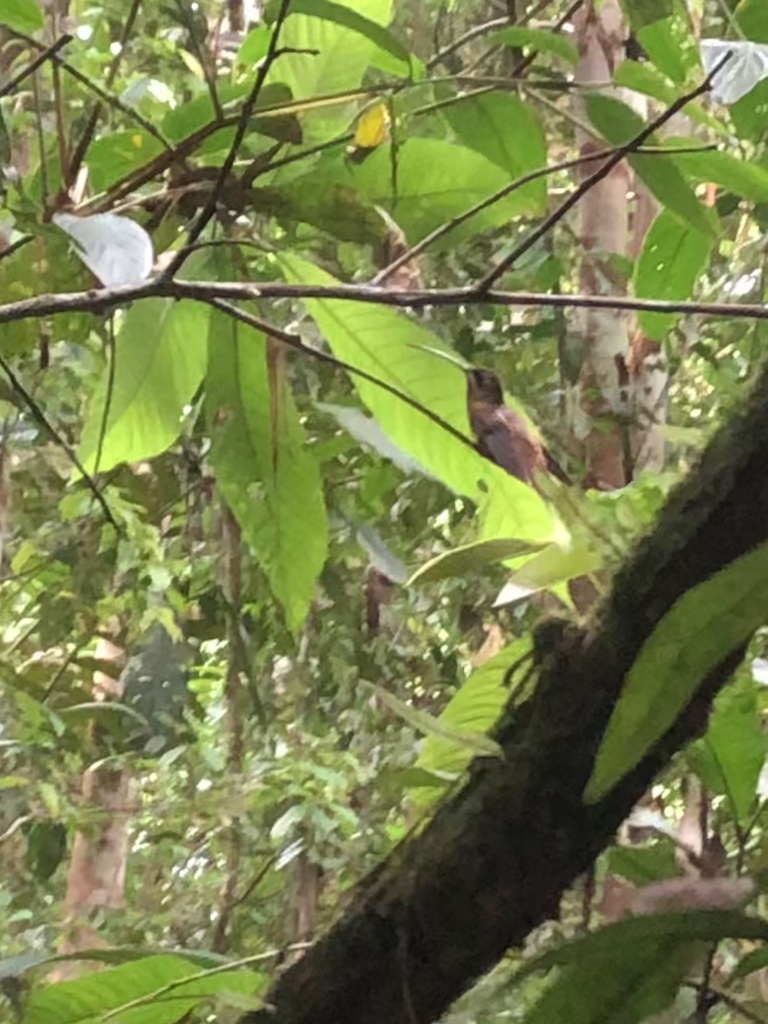
Koepcke’s Hermit
Photo © Jared Shorma
Photo © Jared Shorma — CC BY 4.0 — Source: iNaturalist #126615811Koepcke's hermit (Phaethornis koepckeae) is a species of hummingbird in the family Trochilidae. It is endemic to Peru. == Taxonomy and systematics == Koepcke's hermit is monotypic. It and the needle-billed hermit (P. philippii) are sister species and may form a superspecies. == Description == Koepcke's hermit is 14 to 15 cm (5.5 to 5.9 in) long. Males weigh 4.7 to 5.8 g (0.17 to 0.20 oz) and females 4.5 to 4.9 g (0.16 to 0.17 oz). It is one of the few hermit hummingbirds with a nearly straight bill. It has a blackish crown glossed with greenish, a glossy greenish bronze nape, a glossy bronze back, and a rufous rump. The tail is mostly dark glossy green. The innermost pair of tail feathers are longer than the others and have white tips; the others have broad buffy rufous tips. The face has a black "mask" bordered with narrow white streaks. The chin and throat are white, the center of the breast pale reddish buff with grayer sides, and the belly and flanks a rich reddish buff. == Distribution and habitat == Koepcke's hermit is found on the eastern foothills of the Peruvian Andes from just south of the Marañón…
Yanachaga–chemillén National Park
Palcazu, Peru
+639 birds+6 mammals
Where the eastern slopes of Peru's central cordillera plunge into cloud forest, Yanachaga–Chemillén National Park protects nearly three thousand square kilometres of montane wilderness that few…
VIEW NATIONAL PARKManu National Park
Manu, Peru
+892 birds+26 mammals
Across the eastern slopes of the Peruvian Andes, tropical rainforest descends into the Amazon basin with a complexity that few terrestrial ecosystems match. Manu National Park…
VIEW NATIONAL PARKTingo Maria National Park
Mariano Dámaso Beraún, Peru
+423 birds
Where the eastern slopes of the Peruvian Andes descend toward the Amazon basin, the landscape fractures into a maze of limestone ridges, humid gorges, and cloud-wrapped…
VIEW NATIONAL PARKNo community photos yet. Log in to add the first one.
No community observations of this species yet.