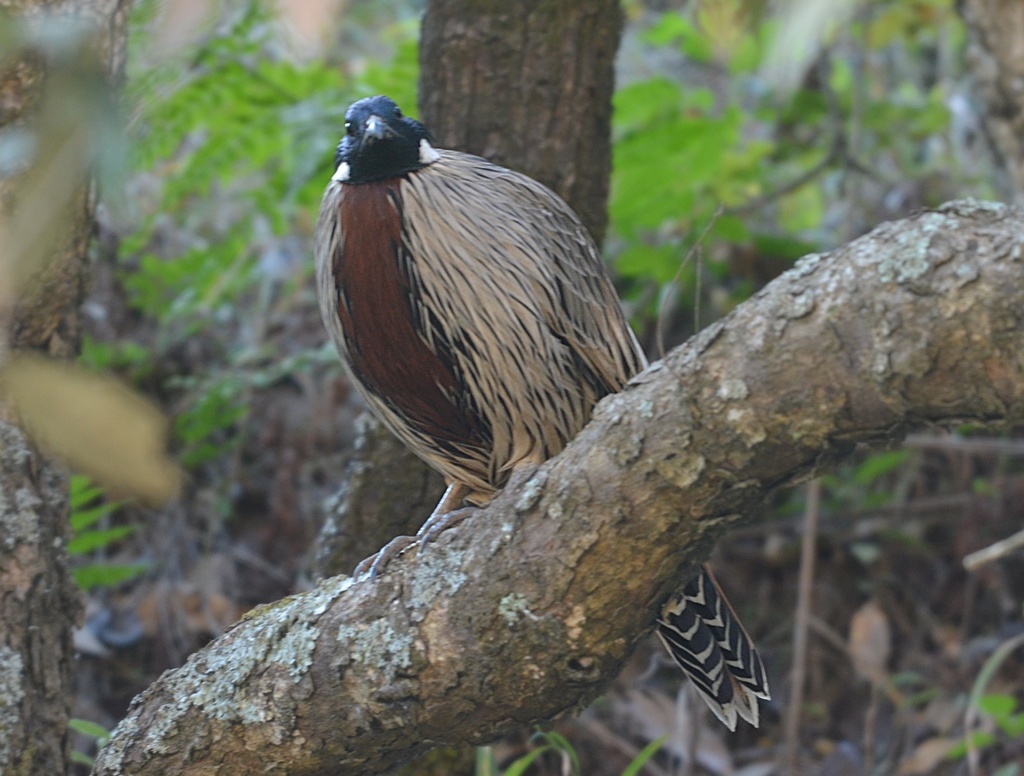
Koklass Pheasant
Photo © premchand
Photo © premchand — CC BY-SA 4.0 — Source: iNaturalist #128291200Identification
The koklass pheasant is a medium-sized gamebird measuring 58 to 64 cm in body length, with males weighing approximately 1135–1415 g and females 1025–1135 g. Males display distinctive plumage: silver-grey upper parts streaked with velvety-black down the centre of each feather, combined with a striking black head, chestnut breast, and prominent white patches on the sides of the neck. Females are considerably duller, with pale brown upper parts instead of the male's silvery tones. Both sexes share an identifying feature in their elongated tails tipped with pale feathers. Immature birds and juveniles resemble adult females in their plumage patterns.
Range & Habitat
The koklass pheasant is confined to high-altitude forests across a wide geographic range stretching from Afghanistan to central Nepal, and from northeastern Tibet to northern and eastern China. The species comprises nine recognized subspecies distributed across this vast territory. The subspecies P. m. biddulphi ranges from Kashmir to Kullu in India, while other subspecies occupy different regions from the Himalayas to China and Mongolia. Like the western tragopan, the koklass does not extend its range above the tree line, preferring the shelter and resources of montane forest environments.
Behaviour & Diet
Koklass pheasants are boreal-adapted birds that remain in pairs or small family groups throughout the year. They are monogamous with a slight tendency toward social polyandry, and both parents cooperate in rearing chicks. These birds nest on the ground and roost at night in trees or under rock overhangs. One of their remarkable abilities is their capacity for sustained flight over many miles, and they are among the few gamebirds that regularly fly uphill.
The koklass is largely vegetarian, consuming pine nuts, pine shoots, bamboo shoots, and seeds for much of the year. However, during warmer months coinciding with nesting and chick-rearing, they become highly insectivorous, living almost exclusively on ants while also consuming catkins, pollen, and fruit. Though they skulk beneath bushes making direct sighting challenging, they reveal their presence through loud chorus and predawn calls during the breeding season and autumn.
Best Time & Places to See It
The breeding season and autumn are the best times to locate koklass pheasants, as they produce loud chorus and predawn calls during these periods, allowing observers to pinpoint their presence. The Kashmir subspecies (P. m. biddulphi) can be found in the region from Kashmir to Kullu in India. To encounter this elusive bird, focus on high-altitude forest habitats within its range, listening carefully for its distinctive vocalizations that reveal the bird's location even when direct visual sighting proves difficult.
Photography Tips
Photographing koklass pheasants presents a rewarding challenge due to their elusive nature and preference for skulking under bushes. Use the bird's own vocalizations to your advantage: locate calling birds during breeding season or autumn by listening for their loud chorus and predawn calls, then approach carefully and quietly. Position yourself near roosting trees or likely feeding areas in high-altitude forest, and remain patient and still to avoid disturbing the birds. Early morning light during the calling season will provide optimal conditions for capturing both the striking plumage of males and the more subtle coloration of females and juveniles.
Gangotri National Park
Bhatwari, India
+119 birds+1 mammals
Where the Bhagirathi River carves through the western Himalayas in northern Uttarakhand, Gangotri National Park rises across steep alpine terrain that defines the boundary between temperate…
VIEW NATIONAL PARKGiant Panda National Park
Mianyang, China
+447 birds+47 mammals
Where the eastern slopes of China's Sichuan plateau descend into cloud-wrapped valleys, one of Asia's most biodiverse landscapes unfolds across more than 350,000 square kilometres. This…
VIEW NATIONAL PARKJiuzhai Valley
Jiuzhaigou County, China
+226 birds+7 mammals
Where crystalline alpine streams cascade through limestone gorges and karst terrain rises in dramatic vertical walls, Jiuzhai Valley unfolds across nearly 1,300 square kilometers of southwestern…
VIEW NATURAL MONUMENTNanda Devi National Park
Garpak, India
+218 birds+5 mammals
Where the Himalayas surge into their most dramatic alpine amphitheater, a wilderness of raw geological power unfolds across 624 square kilometers of pristine terrain. Nanda Devi,…
VIEW NATIONAL PARKNo community photos yet. Log in to add the first one.
No community observations of this species yet.