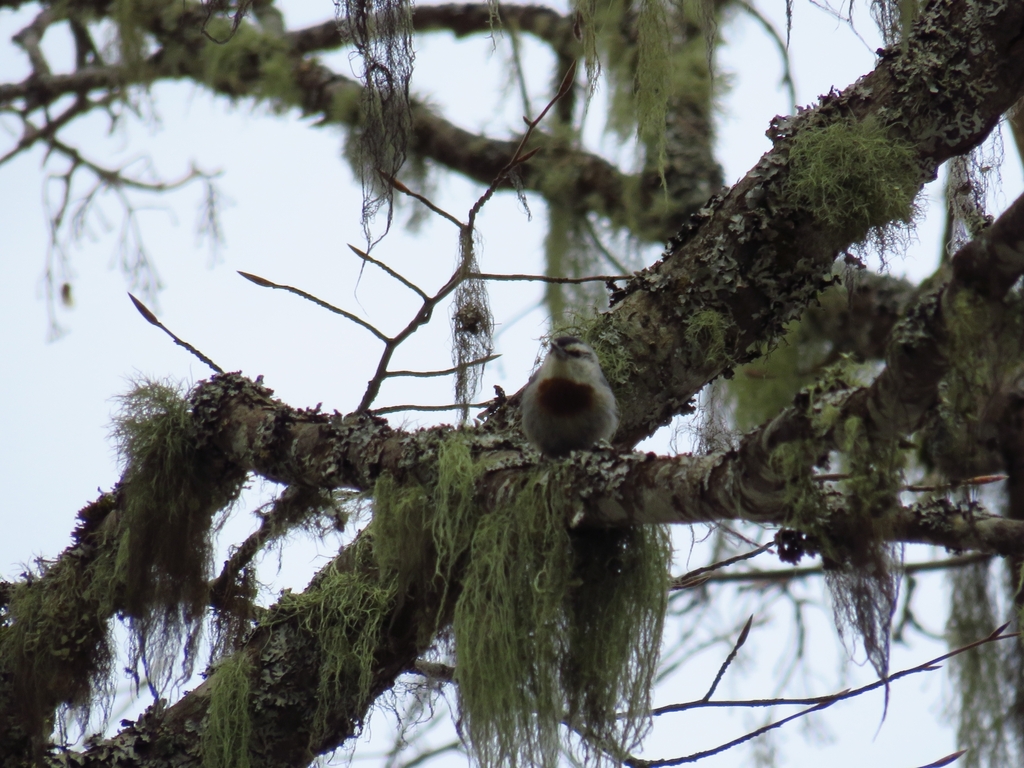
Krüper’s Nuthatch
Photo © Сергей Грабчак
Photo © Сергей Грабчак — CC BY 4.0 — Source: iNaturalist #156742333Identification
Krüper's nuthatch is a small to medium-sized nuthatch, measuring 12.5 centimetres in length. Both males and females display distinctive blue-grey upperparts with a striking black front crown, though this marking is less pronounced in females towards the rear. The species is characterized by a prominent white supercilium (eyebrow stripe) underlined by a black or grey eyestripe, and a white throat. Perhaps most notably, it bears a large, crescent-shaped rufous pectoral patch on the breast. Males have blue-grey underparts, while females show buff-grey underparts. The undertail coverts are rufous with white tips, and the species has a dark horn-grey bill and an eye ring of thin white feathering.
Krüper's nuthatch is one of the smallest members of the nuthatch family and is most closely related to the Algerian nuthatch, with which it shares the distinctive characteristic of a black half-crown—a feature unique among most nuthatch species. Sexual dimorphism is subtle, particularly in summer plumage, making careful observation necessary for accurate identification in the field.
Range & Habitat
This species is found exclusively in the eastern Mediterranean and southern Russian regions, occurring in pine and other coniferous forests across Turkey, the Greek island of Lesbos, and the western Caucasus mountains in Georgia and southern Russia (Krasnodar Krai and Karachay-Cherkessia). The bird's distribution closely follows that of Turkish pine forests. Krüper's nuthatch inhabits elevations from sea level up to 2,500 metres, adapting to various altitudes within its coniferous forest range.
The species faces significant conservation challenges due to habitat loss caused by forestry practices and, particularly along Turkish coasts, by tourist development. Though its numbers are declining, it remains classified as "Least Concern" by the International Union for Conservation of Nature.
Behaviour & Diet
Like other nuthatches, Krüper's nuthatch is an active forager, though its diet varies seasonally. During summer months, it feeds primarily on insects, gleaning them from bark and foliage. As autumn and winter approach, the species shifts its diet to seeds, with a particular preference for pine seeds, which become a staple food source during the colder months.
Breeding occurs between March and May, with nests typically placed in tree holes. Females lay clutches of five to seven eggs, which they incubate alone. Males provision females during incubation, and both parents participate in feeding the young once they hatch, demonstrating cooperative parental care typical of the nuthatch family.
Best Time & Places to See It
The breeding season from March to May offers excellent opportunities to observe Krüper's nuthatch, as birds are more active and vocal during courtship and nesting activities. The species is resident throughout its range, so it can be found year-round, though autumn and winter months may reveal increased activity as birds forage intensively for pine seeds.
Prime locations for encountering this species include Turkish pine forests throughout Turkey, particularly in less developed areas, as well as the coniferous forests of the western Caucasus in Georgia and southern Russia. The Greek island of Lesbos represents the species' only stronghold in the European Union. Visitors should focus on mature coniferous forest stands where Turkish pine predominates, particularly at mid-elevations where the habitat remains least disturbed by development.
Photography Tips
The small size of Krüper's nuthatch—just 12.5 centimetres—demands a telephoto lens of at least 300–400mm to capture satisfying frame-filling images. The bird's characteristic behaviour of foraging on tree trunks and branches, often moving in typical nuthatch fashion, provides dynamic shooting opportunities. The striking black crown, white supercilium, and rufous breast patch offer excellent contrast and should be your focus when composing shots.
Early morning light during the breeding season will best illuminate the bird's subtle plumage details. Since the species favors coniferous forests, be prepared for dappled, shadowy conditions and adjust your exposure accordingly. Patient waiting near nest sites during March to May may reward you with family group images, though always maintain a respectful distance to avoid disturbing nesting birds. The white supercilium and eye-ring are key features to keep sharp for compelling portraits.
No community photos yet. Log in to add the first one.
No community observations of this species yet.