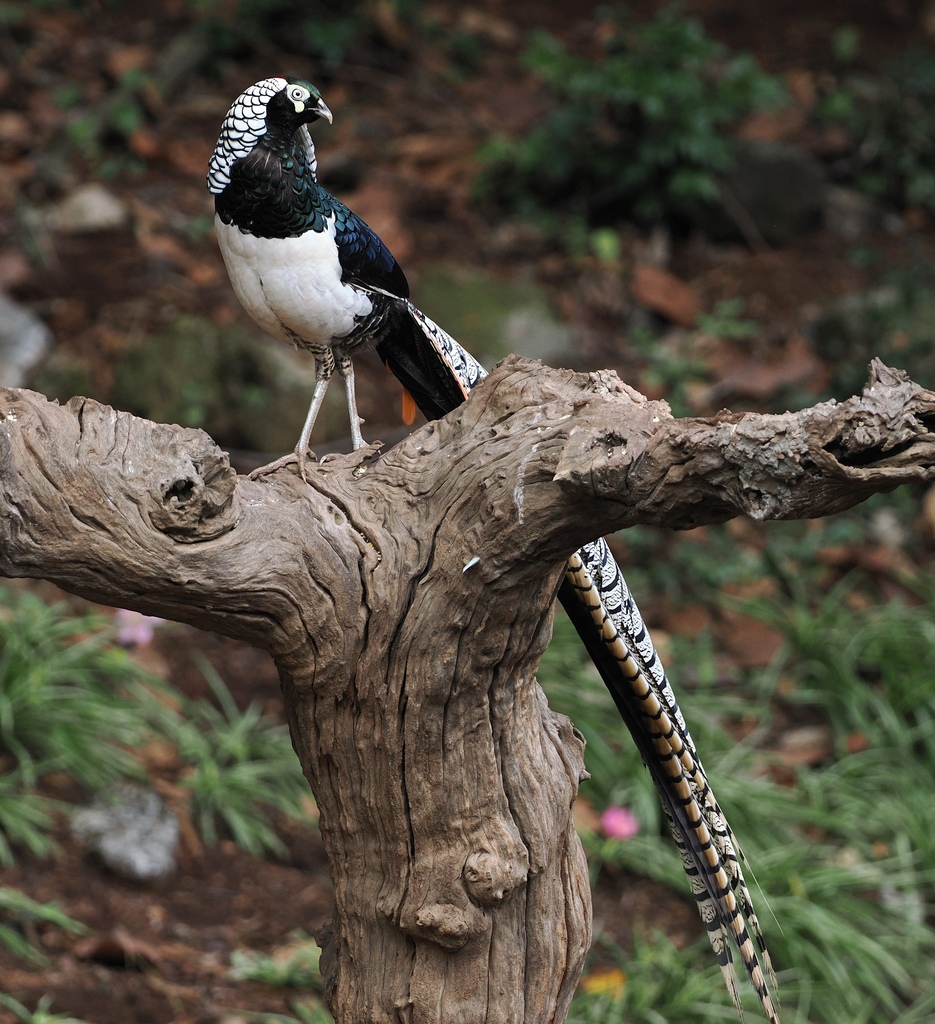
Lady Amherst’s Pheasant
Photo © desertnaturalist
Photo © desertnaturalist — CC BY 4.0 — Source: iNaturalist #282646883Identification
Lady Amherst's pheasant is unmistakable in its male plumage, one of the most striking birds in the pheasant family. Males measure 100–120 cm in length, with the tail accounting for 80 cm of that impressive total. The signature feature is the white and black nuchal cape, which can be raised during display, topped with a distinctive red crest. The long tail is greyish white with black bars and red streaks at the base. The chest and belly are white, the throat is scaled green, the back is dark green, the wings are blue and brown, and the rump is yellow. Additional distinguishing features include a yellow eye surrounded by blue-green bare skin, a horn-coloured bill, and blue-gray legs. The female is far less conspicuous, wearing overall mottled brown plumage with fine barring similar to a female common pheasant, though with a darker head and cleaner underparts than the female golden pheasant.
Range & Habitat
Lady Amherst's pheasant is native to southwestern China and far northern Myanmar. The species inhabits dense, dark forests with thick undergrowth, an environment that makes these birds remarkably difficult to observe despite the male's showy appearance. Historically, the species was introduced to England by Lady Amherst near Woburn Abbey in Bedfordshire, where a self-supporting feral population became established. However, British populations are believed to have been locally extinct since 2015, though occasional sightings continue to occur throughout the UK, likely from escapees of private collections. The decline in introduced English populations resulted from multiple factors: predation by Eurasian goshawks, destruction of woodland understory by browsing Reeves's muntjac, loss of habitat through hardwood forest felling and replacement with commercial softwoods, and isolation of remaining populations from one another.
Behaviour & Diet
Little is known about the behaviour of Lady Amherst's pheasants in their natural habitat, a consequence of their preference for dense, dark forests. These birds are primarily ground feeders, foraging on grain, leaves, and invertebrates. They roost in trees at night for safety. Although capable of flight, they prefer to run and spend much of their time in heavy cover. When startled, however, they can suddenly burst upwards at great speed, accompanied by a distinctive wing sound that alerts observers to their presence. During the breeding season, males emit a metallic call. Despite their elaborate appearance, their cryptic behaviour and forest habitat make them challenging to locate and observe.
Best Time & Places to See It
For nature travellers and photographers, Lady Amherst's pheasants are best sought in their native range of southwestern China and far northern Myanmar, where they inhabit montane forests with dense understory vegetation. The breeding season, when males become more vocal, may offer the best opportunity to locate birds through their metallic calls. Early morning hours are typically most productive for pheasant observation. However, visitors should be prepared for challenging viewing conditions: these birds favour dark, dense forest habitats where visibility is limited and photography opportunities are rare. Patience, careful stalking, and local guides familiar with the species' behaviour will significantly improve chances of encounter.
Photography Tips
Photographing Lady Amherst's pheasants presents considerable challenges due to their preference for dense forest understory and cryptic behaviour. Fast film speeds and sensitive camera settings are essential for capturing images in the dark forest environment where these birds are found. The male's vibrant plumage—with its white cape, red crest, and colourful tail—offers striking photographic potential when birds are visible, but extended patience will be required. Early morning light offers the best conditions for working in forest interiors. A telephoto lens is recommended to maintain distance and avoid disturbing birds. Listening for the male's metallic breeding call will help locate birds; once located, slow, deliberate movements and careful positioning downwind increase the likelihood of close approach for photography.
Giant Panda National Park
Mianyang, China
+447 birds+47 mammals
Where the eastern slopes of China's Sichuan plateau descend into cloud-wrapped valleys, one of Asia's most biodiverse landscapes unfolds across more than 350,000 square kilometres. This…
VIEW NATIONAL PARKWolong National Nature Reserve
Wenchuan County, China
+333 birds+17 mammals
Where the Qingyi River cuts through the eastern flanks of the Minshan Range, a temperate montane forest cloaks steep valleys in dense canopy that thins dramatically…
VIEW NATURE RESERVEGaoligong Mountain National Nature Reserve
Nujiang Lisu Autonomous Prefecture, China
+443 birds+13 mammals
VIEW NATURE RESERVEBaima Snow Mountain National Nature Reserve
Diqing Tibetan Autonomous Prefecture, China
+204 birds+3 mammals
High-altitude ridges and steep-sided valleys define this reserve in northwestern Yunnan, where elevations surge from around 3,000 metres to peaks above 4,100 metres. The terrain supports…
VIEW NATURE RESERVENo community photos yet. Log in to add the first one.
No community observations of this species yet.