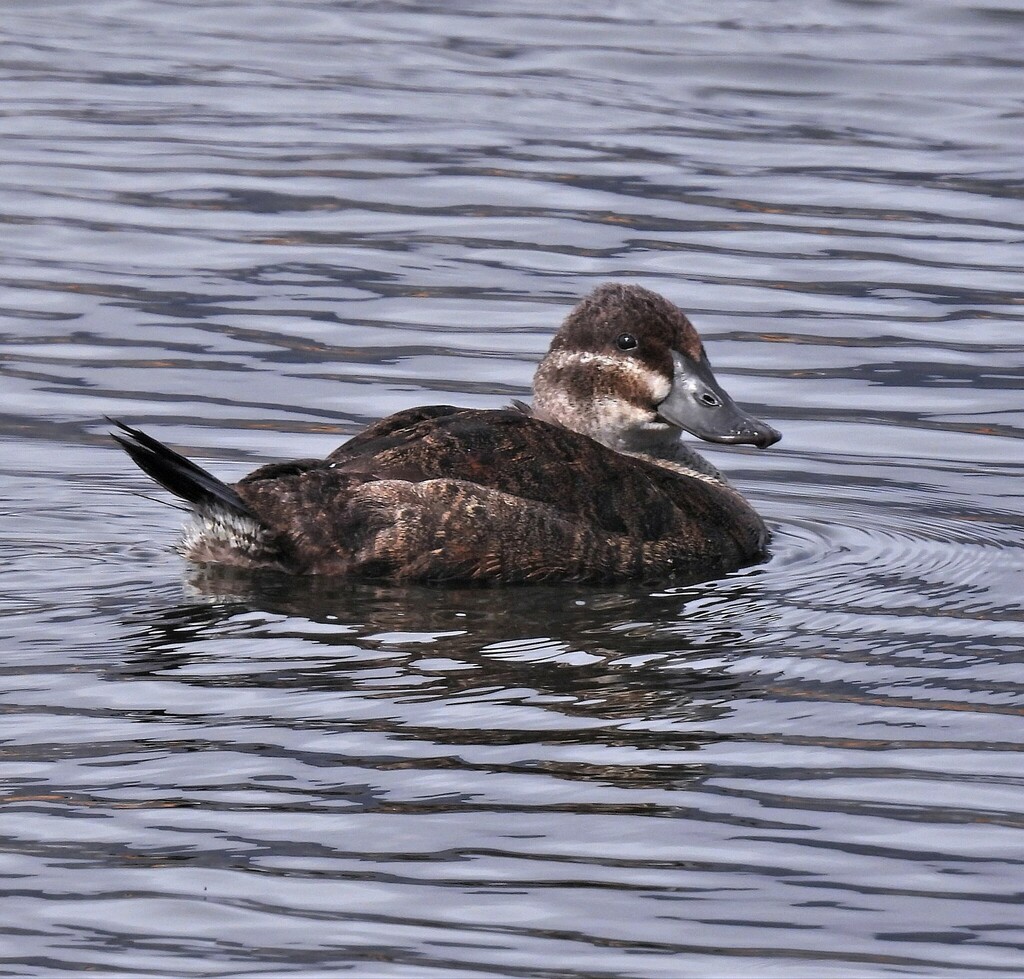
Lake Duck
Photo © Hugo Hulsberg
Photo © Hugo Hulsberg — CC0 1.0 — Source: iNaturalist #150775346Identification
The lake duck is a small, compact waterfowl measuring 36–46 centimetres in length, with females weighing 510–700 grams and males slightly heavier at 600–850 grams. Males can be distinguished from the similar Andean duck by their smaller size and noticeably flatter head profile. This stiff-tailed duck, also known as the Argentine blue-bill, is endemic to South America and represents one of the continent's most unusual avian species.
Beyond its modest external appearance, the lake duck is famous in the animal kingdom for an extraordinary biological distinction: males possess the largest avian penis relative to body size on record. This reproductive organ, typically coiled when flaccid, can extend to nearly the bird's full body length when erect—a remarkable adaptation theorized to result from intense sexual competition among these highly promiscuous birds, functioning somewhat like a bottle brush to remove sperm from previous matings.
Range & Habitat
The lake duck is naturally distributed across much of southern South America, occurring in Argentina, Brazil, Chile, Paraguay, and Uruguay. The species has also been introduced to the Falkland Islands. As a partially migratory species, it shows varying breeding patterns depending on location, with the Argentine population breeding between October and January.
This duck favours freshwater environments rich in aquatic vegetation, particularly wetlands and lakes where dense plant growth provides both food and cover. The species maintains a stable population estimated between 6,700 and 67,000 individuals, with no major conservation threats identified. It is listed as a species of least concern on the IUCN Red List as of 2016.
Behaviour & Diet
The lake duck's diet remains poorly documented but is believed to comprise small invertebrates, seeds, and plant remains, likely gleaned from the vegetated wetland habitats it frequents. Males are notably vocal during breeding season, producing distinctive popping noises and "mechanical rustling noises" as part of their courtship display.
The species exhibits a complex mating system involving forced copulation attempts by males. However, females possess a remarkable counter-adaptation: their reproductive tract spirals in the opposite direction to the male's corkscrew penis, allowing them to retain control over fertilization. This sophisticated reproductive geometry means that most forced copulation attempts do not result in successful breeding, effectively giving females the final say in reproduction despite male aggression.
Best Time & Places to See It
The breeding season from October to January in Argentina offers the best opportunity to observe males in display, when their vocal activity peaks. Lake ducks are very widespread across their South American range, making them accessible to travellers visiting wetland systems throughout Argentina, Brazil, Chile, Paraguay, and Uruguay.
Look for this species in vegetated freshwater lakes and extensive wetland complexes where emergent and aquatic plants are abundant. The stable population and lack of major threats mean sightings are relatively consistent throughout the year in suitable habitat.
Photography Tips
The lake duck's small size and preference for vegetated habitats can make photography challenging. Position yourself quietly near lake margins where vegetation is less dense, allowing clearer sightlines to feeding birds. Early morning and late afternoon often provide the best lighting and greatest activity levels.
During breeding season, patient observers may be rewarded with shots of males displaying with their distinctive popping and mechanical sounds—look for animated posturing and head movements that accompany these vocalizations. A telephoto lens will be essential to capture detail while maintaining distance from these wary waterfowl.
Peixe National Park Lagoon
Brazil
+293 birds+4 mammals
Where the coastal plains of Rio Grande do Sul meet the Atlantic, Peixe National Park Lagoon sprawls across nearly 2,200 square kilometres of shallow waters, reed…
VIEW NATIONAL PARKChiloé National Park
Dalcahue, Chile
+122 birds+6 mammals
Temperate rainforest cloaks the Chiloé archipelago's northwestern reaches, where granite ridges thrust through dense, moisture-laden canopy and freshwater streams carve ravines toward the Pacific. Across approximately…
VIEW NATIONAL PARKTorres del Paine National Park
Torres del Paine, Chile
+143 birds+10 mammals
Where granite spires pierce the Patagonian sky, Torres del Paine commands one of South America's most dramatic landscapes. Across 4,106 square kilometres of southern Chile, jagged…
VIEW NATIONAL PARKPuyehue National Park
Puyehue, Chile
+110 birds+4 mammals
Across the volcanic spine of the Los Lagos Region, where the Andes descend toward temperate rainforest, Puyehue National Park encompasses nearly 2,600 square kilometers of one…
VIEW NATIONAL PARKVicente Pérez Rosales National Park
Puerto Varas, Chile
+109 birds+8 mammals
Where the Andes descend toward the temperate rainforests of Chile's Lake District, nearly 4,641 square kilometers of pristine wilderness unfolds across Vicente Pérez Rosales National Park.…
VIEW NATIONAL PARKPatagonia National Park
Cochrane, Chile
+133 birds+8 mammals
Where the Andes meet the Patagonian steppe, vast grasslands and shrublands sweep across rolling terrain carved by ancient glaciation, their contours softened by distance and dramatic…
VIEW NATIONAL PARKParque Provincial Península de Magallanes
Argentina
+125 birds+4 mammals
Granite peaks and windswept steppe converge across this 415-square-kilometre peninsula jutting into the cold Atlantic waters of southern Patagonia, where the Magallanes landscape embodies the raw,…
VIEW NATIONAL PARKLos Glaciares National Park
Argentina
+121 birds+3 mammals
Where granite peaks and sprawling ice fields dominate the landscape, Los Glaciares National Park encompasses over ten thousand square kilometres of Patagonian wilderness in southern Argentina.…
VIEW NATIONAL PARKCampos del Tuyú National Park
Argentina
+169 birds+5 mammals
Subtropical forest graces the borderlands where Misiones Province meets Paraguay, a landscape shaped by the Paraná Plateau's weathered topography and the warm, humid climate of northeastern…
VIEW NATIONAL PARKEl Rey National Park
Municipio de Las Lajitas, Argentina
+317 birds+4 mammals
Where the eastern slopes of the Andes descend into northwestern Argentina's subtropical transition zone, El Rey National Park unfolds across 841 square kilometers of dramatically varied…
VIEW NATIONAL PARKNahuel Huapi National Park
Argentina
+124 birds+11 mammals
Where the Andes descend toward Patagonia, vast glacial lakes cut through a landscape of southern beech forest and granite peaks, creating one of South America's most…
VIEW NATIONAL PARKLanín National Park
Argentina
+128 birds+7 mammals
Where the volcanic spine of the Andes plunges into Patagonian steppe, Lanín National Park sprawls across nearly 4,700 square kilometers of one of Argentina's most visually…
VIEW NATIONAL PARKSierra de las Quijadas National Park
Argentina
+168 birds+5 mammals
Sandstone cliffs and deeply incised canyons define this 1,137-square-kilometre expanse in San Luis Province, where the dry Chacoan landscape of central Argentina reveals an unexpected ecological…
VIEW NATIONAL PARKLos Alerces National Park
Argentina
+84 birds+3 mammals
Where the temperate rainforests of southern Patagonia sweep down towards crystalline lakes, Los Alerces National Park unfolds across nearly 3,000 square kilometres of one of South…
VIEW NATIONAL PARKNo community photos yet. Log in to add the first one.
No community observations of this species yet.