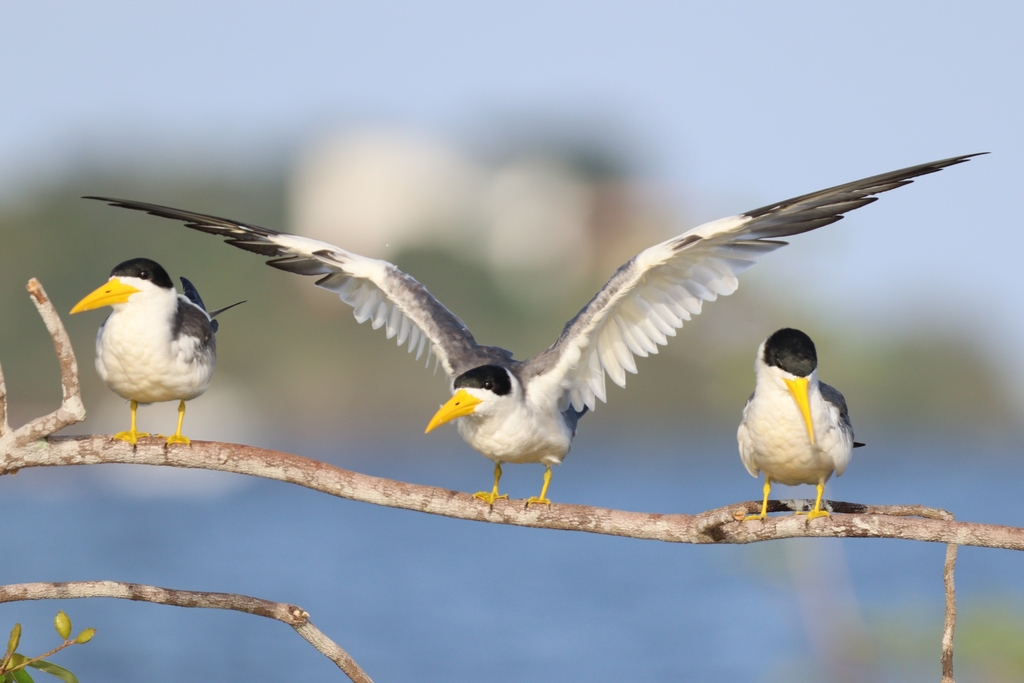
Large-billed Tern
Photo © Conrado Pável de Oliveira
Photo © Conrado Pável de Oliveira — CC BY 4.0 — Source: iNaturalist photo #526039101Identification
The Large-billed Tern is a distinctive and aptly named species, immediately recognizable by its strikingly large yellow bill—a feature that sets it apart from most other terns in its range. This large, short-tailed tern measures around 38 cm (15 in) in length and weighs between 208–247 g (7.3–8.7 oz). The plumage pattern is clean and straightforward: a black crown and ear-coverts contrast sharply with grey upperparts, while the secondaries, primary coverts, lores, and underparts are pure white. Bright yellow legs and feet complete the striking appearance. In non-breeding plumage, the crown and forehead become noticeably paler, providing a useful field mark for identifying birds outside the breeding season.
Range & Habitat
The Large-billed Tern is found across most of South America, with its range extending east of the Andes and north of the Pampas. This distribution gives it access to the continent's extensive river systems and freshwater lake networks. The species is primarily a bird of inland waterways rather than coastal regions, favoring rivers and freshwater lakes where it has adapted to hunt in continental waters. Though rare elsewhere, the species has occurred as a vagrant in several Caribbean and North American locations, including Aruba, Bermuda, Cuba, Panama, and the United States, indicating occasional dispersal beyond its core South American range.
Behaviour & Diet
As a tern, the Large-billed Tern is an active and dynamic hunter, plucking fish from the water surface and shallow depths of rivers and lakes. Its large bill is a specialized adaptation that likely enables it to handle larger prey items than smaller-billed tern species. Like other terns, it is probably an accomplished flier, capable of hovering and making precise diving maneuvers to capture fish. The species is found in its freshwater habitats where it exploits the rich food resources of South America's river systems, from the Amazon basin and its tributaries to isolated freshwater lakes across the continent.
Best Time & Places to See It
To encounter the Large-billed Tern, focus on inland waterways in South America east of the Andes and north of the Pampas—particularly along major river systems and at freshwater lakes. The most reliable locations would be in countries like Brazil, Peru, Colombia, and Venezuela, where suitable river and lake habitats are abundant. While specific seasonal information is limited, the species' presence year-round in its range suggests it may not be strongly migratory, though local movements between waterbodies may occur. Patient observation from riverbanks and lake shores during daylight hours offers the best chance of sightings.
Photography Tips
The Large-billed Tern's striking yellow bill and clean white-and-grey plumage make it a rewarding photographic subject. The bright yellow bill and feet provide excellent color contrast that will stand out in images, particularly in soft morning or late afternoon light. Photograph from riverbanks or boat positions on calm water to capture the bird in flight or perched, focusing on the distinctive head pattern and bill profile. Overcast days reduce harsh shadows, while golden-hour light will emphasize the brilliant yellow coloration of the bill and feet.
Yasuní National Park
Aguarico, Ecuador
+601 birds+43 mammals
Where the western Amazon basin converges with Ecuador's Orellana Province, lowland rainforest reaches toward the horizon in an unbroken canopy of staggering botanical density. Yasuní National…
VIEW NATIONAL PARKMorrocoy National Park
Municipio Silva
+290 birds
Where the Caribbean coast of northwestern Venezuela meets protected coastal waters, a mosaic of mangrove forests, sandy beaches, and coral reef systems defines Morrocoy National Park.…
VIEW NATIONAL PARKNatural Bahía Portete Kaurrele National Park
Colombia
+80 birds
Where the Caribbean coast of La Guajira rises to meet arid scrubland and seasonal wetlands, Natural Bahía Portete Kaurrele National Park spans 251 square kilometres of…
VIEW NATIONAL PARKNatural Sierra de la Macarena National Park
Vista Hermosa, Colombia
+566 birds+15 mammals
Across nearly 20,000 square kilometres of Colombia's Meta Department, the terrain rises from lowland savanna into Andean foothills through a mosaic of gallery forests, palm-fringed wetlands,…
VIEW NATIONAL PARKAmacayacu National Park
Leticia, Colombia
+567 birds+25 mammals
Where the Rio Amazonas curves through the tri-border region where Colombia, Peru, and Brazil converge, Amacayacu National Park sprawls across more than 5,250 square kilometres of…
VIEW NATIONAL PARKPeixe National Park Lagoon
Brazil
+293 birds+4 mammals
Where the coastal plains of Rio Grande do Sul meet the Atlantic, Peixe National Park Lagoon sprawls across nearly 2,200 square kilometres of shallow waters, reed…
VIEW NATIONAL PARKViruá National Park
Brazil
+389 birds+6 mammals
Across the northern frontier of Roraima, where the forest canopy rises from ancient Amazonian lowlands, Viruá National Park protects nearly 3,700 square kilometres of terra firme…
VIEW NATIONAL PARKIguaçu National Park
Brazil
+387 birds+17 mammals
Where the Paraná Plateau plunges toward the Atlantic watershed, six thousand square kilometers of subtropical rainforest cling to steep gorges and river valleys in this corner…
VIEW NATIONAL PARKIlha Grande National Park
Brazil
+233 birds
Across the subtropical plateaus and Atlantic forest remnants of southern Brazil, a vast protected landscape spanning nearly 4,600 square kilometers safeguards one of the continent's most…
VIEW NATIONAL PARKChapada dos Guimarães National Park
Brazil
+450 birds+1 mammals
Where weathered sandstone plateaus rise above the cerrado grasslands of central Brazil, Chapada dos Guimarães National Park protects 624 square kilometres of ecological transition zone that…
VIEW NATIONAL PARKPantanal Matogrossense National Park
Brazil
+322 birds+17 mammals
Where the flooded forests of central Brazil meet vast seasonally inundated grasslands, Pantanal Matogrossense National Park sprawls across nearly 2,900 square kilometers of one of the…
VIEW NATIONAL PARKLençóis Maranhenses National Park
Brazil
+98 birds+2 mammals
Where white sand dunes rise in dramatic ridges across a coastal lowland, Lençóis Maranhenses National Park reveals one of Brazil's most otherworldly landscapes. Spanning 3,670 square…
VIEW NATIONAL PARKBrasília National Park
Plano Piloto, Brazil
+338 birds+15 mammals
Cerrado grassland and scattered woodland sweep across the central Brazilian plateau where this national park sprawls across more than a thousand square kilometres of the Federal…
VIEW NATIONAL PARKAmazônia National Park
Brazil
+439 birds+6 mammals
Where the Rio Amazonas and its tributaries weave through the heart of Pará state, a vast tapestry of rainforest stretches across 23,611 square kilometers of unbroken…
VIEW NATIONAL PARKMapinguari National Park
Brazil
+354 birds
Vast tracts of western Amazonian rainforest blanket the remote terrain of this 56,827 square kilometre national park in Amazonas state, where seasonal rivers wind through dense…
VIEW NATIONAL PARKJaú National Park
Brazil
+354 birds+3 mammals
Vast floodplain forests and blackwater rivers define this remote corner of western Amazonas, where the Rio Negro and its tributaries have carved an intricate mosaic of…
VIEW NATIONAL PARKAnavilhanas National Park
Brazil
+468 birds+8 mammals
Across the Rio Negro in central Amazonas, an archipelago of over a thousand islands rises from the world's largest rainforest river system, creating a labyrinth of…
VIEW NATIONAL PARKCampos Amazónicos National Park
Amazonas, Brazil
+434 birds+7 mammals
Sprawling across the southwestern Amazon basin in Amazonas state, this 27,263-square-kilometre national park encompasses some of the region's most pristine lowland rainforest, where terra firme forest…
VIEW NATIONAL PARKSerra do Divisor National Park
Brazil
+448 birds+10 mammals
Where the western Amazon meets the Andes foothills, Serra do Divisor National Park sprawls across one of South America's most biodiverse and least accessible frontiers. Spanning…
VIEW NATIONAL PARKPico da Neblina National Park
Brazil
+103 birds
Where the Amazon's western rampart rises into perpetual mist, Pico da Neblina National Park sprawls across more than 33,000 square kilometres of some of Earth's least…
VIEW NATIONAL PARKManu National Park
Manu, Peru
+892 birds+26 mammals
Across the eastern slopes of the Peruvian Andes, tropical rainforest descends into the Amazon basin with a complexity that few terrestrial ecosystems match. Manu National Park…
VIEW NATIONAL PARKBahuaja Sonene National Park
San Pedro de Putina Punco, Peru
+602 birds+8 mammals
Where the Madre de Dios and Heath rivers converge in southeastern Peru rises one of South America's most biodiverse wilderness regions: a vast protected realm of…
VIEW NATIONAL PARKSoberanía National Park
Cristóbal, Panama
+495 birds+34 mammals
Rainforest and riverine woodland blanket the rolling terrain of this 714-square-kilometre national park in Colón Province, where the Caribbean watershed feeds a maze of streams and…
VIEW NATIONAL PARKEl Palmar National Park
Distrito Sexto, Argentina
+244 birds+14 mammals
Across the Paraná River floodplain in northeastern Argentina, palms rise from wetland and grassland in a landscape shaped by water and time. El Palmar National Park…
VIEW NATIONAL PARKRío Pilcomayo National Park
Argentina
+271 birds+13 mammals
Where the Río Pilcomayo cuts through northeastern Argentina's subtropical lowlands, a sprawling mosaic of wetlands, grasslands, and seasonally flooded forests creates one of South America's most…
VIEW NATIONAL PARKChaco National Park
Municipio de Presidencia de la Plaza, Argentina
+258 birds+7 mammals
Across the humid subtropical lowlands of northeastern Argentina, where the Paraná River basin feeds vast seasonal wetlands and gallery forests, Chaco National Park protects one of…
VIEW NATIONAL PARKNo community photos yet. Log in to add the first one.
No community observations of this species yet.