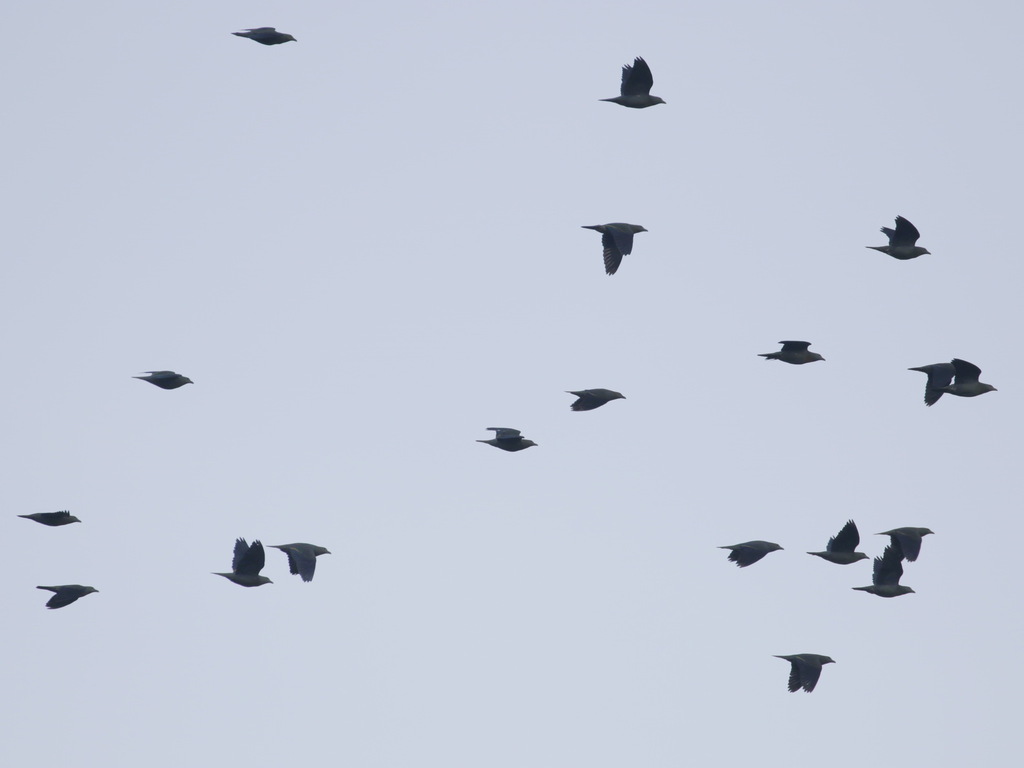
Large Green Pigeon
Photo © Ian Dugdale
Photo © Ian Dugdale — CC BY 4.0 — Source: iNaturalist #303705422The large green pigeon (Treron capellei) is a species of bird in the family Columbidae. It is found in Brunei, Indonesia, Malaysia, Myanmar, and Thailand. Its natural habitat is subtropical or tropical moist lowland forests. It is threatened by habitat loss. == Population == The population of the large green pigeon is estimated to be at approximately 15,000 to 30,000 individuals across its range in Southeast Asia. == Ecology == This bird inhabits primary and secondary evergreen rainforests, almost always in the lowland but may inhabit foothills of up to 1,500 metres (4,900 ft) high. Small flocks generate in the high canopies of the rainforest in search of fruiting trees. Although this bird is primarily active during the day, nocturnal movements have been noticed. == Threats == The largest threat to the large green pigeon is the deforestation of its forest home. Large amounts of its original habitat have been cut down due to illegal logging and making way for palm oil plantations which have also had a devastating effect on other species.
Bako National Park
Kuching, Malaysia
+210 birds+17 mammals
Weathered sandstone cliffs rise dramatically from the South China Sea, their ochre faces sculpted by millennia of wind and tide into a landscape of extraordinary geological…
VIEW NATIONAL PARKTaman Negara National Park
Kampong Samas, Malaysia
+393 birds+48 mammals
Where ancient rainforest meets limestone peaks, one of Southeast Asia's oldest protected wilderness preserves sprawls across 4,343 square kilometers of primordial landscape. Dipterocarp giants tower overhead,…
VIEW NATIONAL PARKGunung Mulu National Park
Long Seridan, Malaysia
+280 birds+39 mammals
Where granite monoliths pierce the rainforest canopy of Sarawak, an ancient limestone karst landscape reveals one of Southeast Asia's most biodiverse strongholds. Soaring peaks cloaked in…
VIEW NATIONAL PARKNo community photos yet. Log in to add the first one.
No community observations of this species yet.