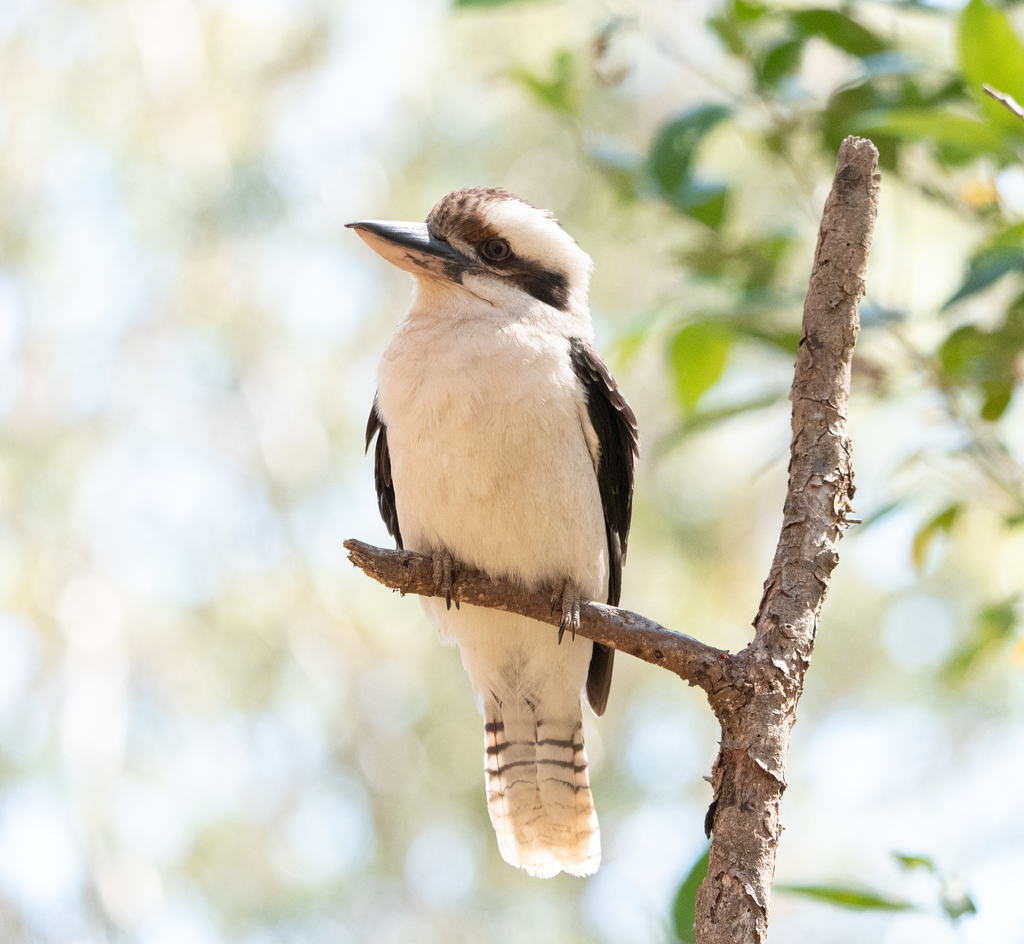
Laughing Kookaburra
Photo © Philipp Hoenle
Photo © Philipp Hoenle — CC0 1.0 — Source: iNaturalist photo #333649901Identification
The laughing kookaburra is the largest species of kingfisher, a stout and stocky bird measuring 41–47 cm in length. It has a distinctive whitish head and prominent brown eyes, with a dark brown stripe running across each eye. The upperparts are mostly dark brown, but a mottled light-blue patch adorns the wing coverts, while the underparts are cream-white and the tail is barred with rufous and black. The bird sports a long and robust bill suited to its hunting lifestyle. Male and female plumage are similar, though females are usually slightly larger.
Range & Habitat
Native to eastern mainland Australia, the laughing kookaburra has been introduced to parts of New Zealand, Tasmania, and Western Australia. The species favours dry eucalypt forest and woodland, but has adapted well to human-modified landscapes, commonly inhabiting city parks and gardens. This is a sedentary bird that maintains the same territory throughout the year, never undertaking long migrations.
Behaviour & Diet
Famous for its distinctive cackling laugh—often delivered simultaneously by multiple birds—the laughing kookaburra uses this territorial call so recognisably that it has become a stock sound effect for jungle scenes in films and media. The bird is monogamous, retaining the same partner for life. Breeding pairs are often accompanied by up to five fully grown non-breeding offspring from previous years who assist in defending territory and raising new chicks. Birds typically nest in unlined tree holes or excavated holes in arboreal termite mounds, laying clutches of three white eggs.
A versatile predator, the laughing kookaburra hunts by perching on a branch until spotting prey on the ground, then swooping down to pounce. Its diet includes lizards, insects, worms, snakes, and mice, and it is notably bold enough to snatch goldfish from garden ponds. Young chicks remain dependent on their parents and helpers for six to ten weeks after fledging.
Best Time & Places to See It
The laughing kookaburra's year-round residency means it can be observed in suitable habitat at any season. Look for it in eucalypt woodlands, parks, and gardens across eastern Australia and introduced populations elsewhere. Early morning is often the best time to hear its iconic laughing call, which carries considerable distances and signals territorial activity.
Photography Tips
Photograph this species perched on open branches where it hunts, as it often sits motionless while scanning for prey—ideal for capturing sharp detail of its striking head markings and eye-stripe. The blue wing patches and rufous-barred tail are worth highlighting. Early morning light enhances the subtle blue tones on the wings. Since laughing kookaburras are relatively bold in parks and gardens, these modified habitats can offer excellent photographic opportunities with manageable approach distances.
Alpine National Park
Bald Rock National Park
Barrington Tops National Park
Belair National Park
Ben Boyd National Park
Blue Mountains National Park
Bouddi National Park
Bribie Island National Park
Budawang National Park
Nothing matches these filters.
No community photos yet. Log in to add the first one.
No community observations of this species yet.