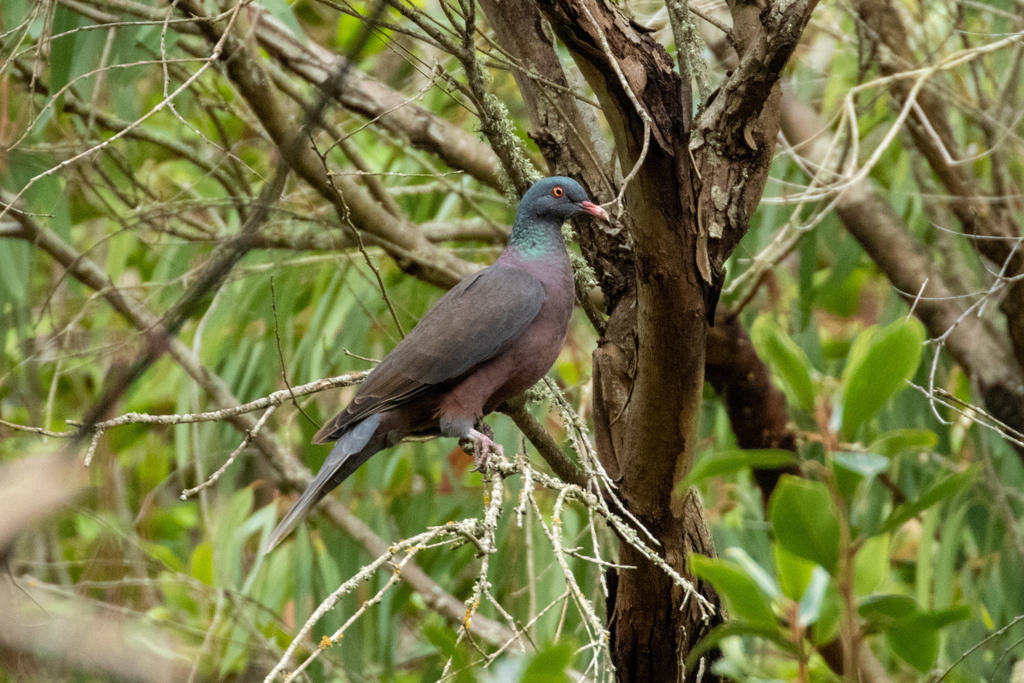
Laurel Pigeon
Photo © Thibaud Aronson
Photo © Thibaud Aronson — CC BY-SA 4.0 — Source: iNaturalist photo #163958122Identification
The laurel pigeon is a stocky 40 cm bird with distinctive plumage that sets it apart from other Canarian pigeons. It is predominantly dark brown and grey with reddish underparts and a characteristic pale grey tail featuring a broad whitish terminal band. Look for the extensive green gloss on the rear crown and hindneck, transitioning to pink on the upper mantle. The bill is pink with a white tip, and the eye is strikingly orange. In flight, you may notice an occasional sharp wing flick and hear a loud clattering takeoff. The call is a hoarse, hiccuped cooing sound. The similar Bolle's pigeon can be distinguished by its pale grey subterminal tail band and blackish terminal band.
Range & Habitat
This species is endemic to the mountainous subtropical Atlantic west Canary Islands, occurring on La Palma, La Gomera, Tenerife, and El Hierro. The largest subpopulation inhabits much of the northern half of La Palma, while it is common on La Gomera, particularly in the north. On Tenerife, it occurs patchily on the northern slopes. The species favors steep slopes, escarpments, and gullies within laurel forest, Canary pine forests, and dry forest habitats, as well as cultivated areas. Birds prefer steep, rocky, shady areas with abundant shrubby vegetation, often nesting in fissures and holes at the bases of trees or under rocks.
Behaviour & Diet
The laurel pigeon is exclusively herbivorous, with nearly 60% of its diet consisting of fruit, primarily from til, Azores laurel, Persea indica, and small-leaved holly. Leaves comprise most of the remainder, with flowers making up just 1%. Fruit dominates the diet in autumn and winter, while leaves become more important in spring and summer when fruits are scarce. The birds will venture into agricultural areas to feed on cabbage when forest fruit crops are poor. Male display behavior mirrors that of the common wood pigeon: males climb rapidly in flight with a loud wing-clap, then glide down with wings and tail spread, or perform bowing displays on the ground with inflated necks to show iridescent patches.
Best Time & Places to See It
The breeding season varies between islands but extends from January to September, with peak activity between April and June. However, February to March offers better viewing opportunities, as nest predation is lower during this period. La Palma offers the most reliable sightings, with birds distributed across much of the northern half. La Gomera provides consistent encounters, especially in northern areas, while Tenerife's northern slopes host smaller populations. Early morning visits to laurel forest areas with steep terrain will increase your chances of locating these endemic pigeons.
Photography Tips
Photograph laurel pigeons in their steep mountain habitat during early morning or late afternoon light to capture the iridescent green and pink gloss on the head and neck. The pale tail with its distinctive white terminal band is a key identifying feature—position yourself to capture this in profile. Patience is essential, as these are forest birds that may remain hidden in dense vegetation. Use a telephoto lens (at least 300mm) to maintain distance and avoid disturbance during the sensitive breeding season. Capturing their characteristic takeoff with the loud clattering wing beats requires anticipation and quick reflexes.
Caldera de Taburiente National Park
Garajonay National Park
Teide National Park
Teide Natural Monument
Nothing matches these filters.
No community photos yet. Log in to add the first one.
No community observations of this species yet.