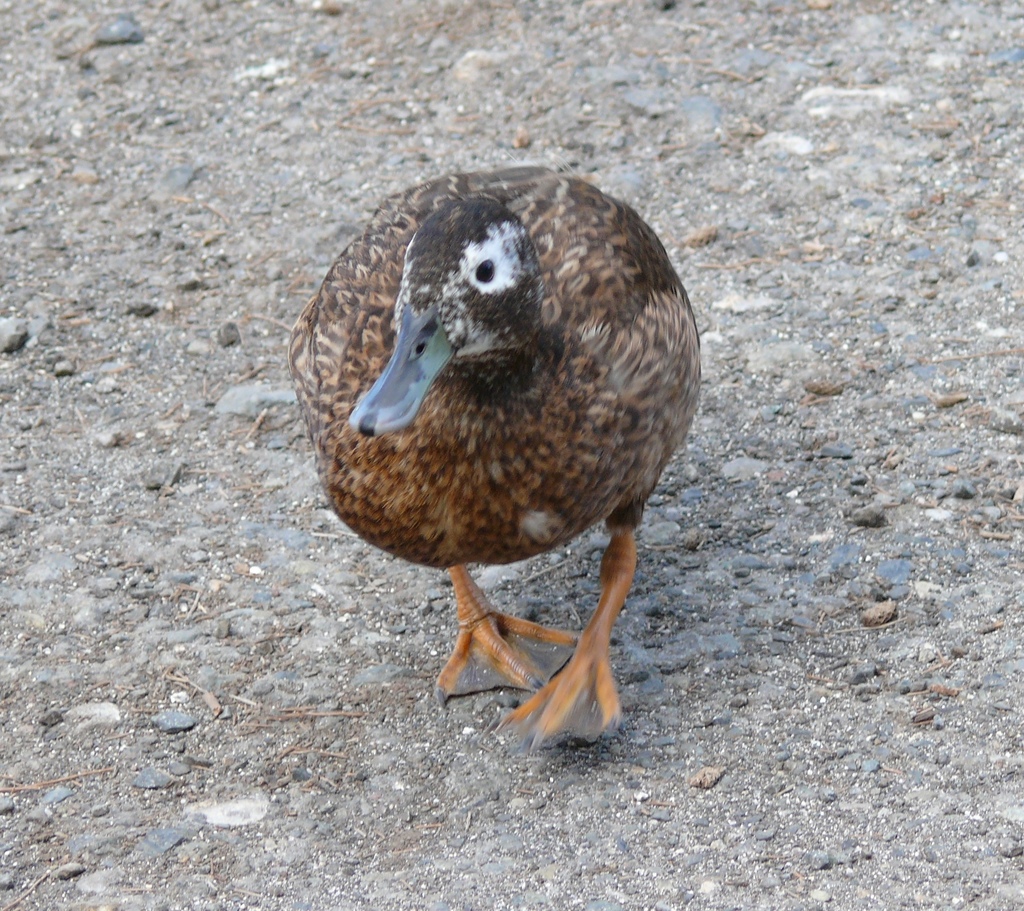
Laysan Duck
Photo © Robert Webster
Photo © Robert Webster — CC BY-SA 4.0 — Source: iNaturalist #35866350Identification
The Laysan duck is a teal-sized dabbling duck with distinctive features that make it recognizable in its limited Hawaiian range. It is dark brown overall, marked by a prominent white eye-ring that stands out against its face. The bill is short and spatulate; in males it is dark green with variable black blotching, while females have a dull orange bill with similar dark markings. Both sexes display an iridescent purplish-green patch on the wing (speculum feathers). Most Laysan ducks have a characteristic ring of fat around the neck, and some males show faint iridescence on the head or neck with slightly upturned central tail feathers. The legs and feet are orange, typically brighter in males. Leucistism—extensive white feathering on the head and neck—is common in older birds.
Range & Habitat
The Laysan duck is endemic to the Hawaiian Islands, surviving today only on Laysan Island and two atolls, though fossil evidence reveals the species once inhabited the entire archipelago. This represents a dramatic range reduction; by 1860 the duck had disappeared from all Hawaiian locations except Laysan Island itself. The bird occupies the smallest geographic range of any duck species worldwide, restricted to just 415 hectares (1.60 square miles) on Laysan Island, though translocation efforts beginning in 2002 have established populations at Midway Atoll National Wildlife Refuge and Kure Atoll. The duck favors shallow lakes, mudflats, and areas with dense vegetation including Eragrostis variabilis bunchgrass.
Behaviour & Diet
The Laysan duck is a poor flyer with reduced wings and wing muscles, preferring to walk and run well on land with a pelvic girdle adapted for terrestrial foraging. When threatened, it typically freezes in place rather than attempting flight—a defensive strategy effective against native avian predators but disadvantageous against ground predators. The duck displays energetic and distinctive foraging behavior, including fly-snapping sprints through swarms of brine flies. With necks outstretched and bills near the ground, the ducks run along mudflats, snapping up flies as they rise in clouds. They also dabble and filter feed along lake shallows and in upland vegetation for macroinvertebrates, algae, leaves, and seeds. During the day, especially in breeding season, they hide among grass and shrub vegetation to avoid avian predators such as frigatebirds, though they venture into open areas to feed from dusk until dawn, with variation depending on food availability.
Best Time & Places to See It
Laysan ducks can be encountered on Laysan Island and at Midway Atoll National Wildlife Refuge and Kure Atoll, though access to these remote Northwestern Hawaiian Islands locations is restricted and typically available only to authorized researchers and limited permitted visitors. The breeding season extends from April to August, with pair formation beginning in autumn and nest-building in spring. To maximize sighting opportunities, visitors should focus on observation during dusk and dawn hours when the ducks are most active in feeding. The birds prefer to hide in dense vegetation during the day, particularly in breeding season, so patience and careful scanning of grassy and shrubby areas will improve chances of observation.
Photography Tips
Photographing Laysan ducks requires patience and attention to their activity patterns. Since the birds are most active during dusk and dawn, plan photography sessions around these low-light periods, bringing appropriate equipment for challenging lighting conditions. The ducks' preference for hiding in dense vegetation during daylight means that midday photography may be less productive. Look for them along mudflats and lake edges where the distinctive fly-snapping behavior can be observed and captured. The prominent white eye-ring and iridescent wing patch provide good focal points for close-up photography. Remember that these are wild birds in protected habitats with restricted access; maintain appropriate distances and follow all regulations of the wildlife refuges where they are found.
No community photos yet. Log in to add the first one.
No community observations of this species yet.