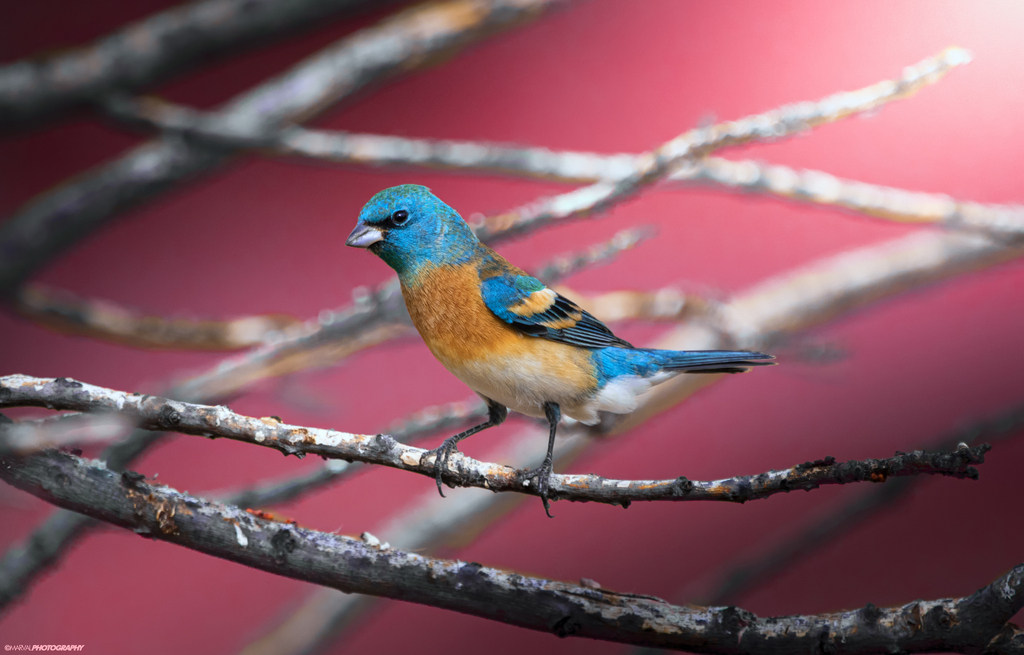
Lazuli Bunting
Photo © MarvalPhotography19
Photo © MarvalPhotography19 — CC BY 4.0 — Source: iNaturalist photo #665320808Identification
The male lazuli bunting is unmistakable: bright blue head and back (lighter than the closely related indigo bunting), conspicuous white wingbars, light rusty breast, and white belly. Though the colour pattern may superficially suggest eastern and western bluebirds, the lazuli bunting's smaller size (13–15 cm or 5–5.9 inches long), prominent wingbars, and short, conical bunting bill quickly distinguish it. Females are brown, grayer above and warmer underneath, differentiated from female indigo buntings by two thin, pale wingbars and other subtle plumage details. Adults weigh 13–18 g with a wingspan of 22 cm.
Range & Habitat
Lazuli buntings breed mostly west of the 100th meridian, from southern Canada south to northern Texas, central New Mexico and Arizona, and southern California. On the Pacific coast, their breeding range extends to extreme northwestern Baja California. These birds migrate to southeastern Arizona and Mexico for winter. They favour brushy areas and sometimes weedy pastures, typically in well-watered locations, and occasionally inhabit towns and settled areas.
Behaviour & Diet
The male's song is a high, rapid, strident warble, similar to the indigo bunting's but longer and with less repetition. Lazuli buntings eat mostly seeds and insects. They may feed conspicuously on the ground or in bushes, but singing males are often very elusive, spending much time in the treetops. They breed in loose cup nests of grasses and rootlets placed in a bush, laying three or four pale blue eggs. In the eastern and southern parts of their range, they frequently hybridize with indigo buntings.
Best Time & Places to See It
The breeding season offers the best opportunity to locate lazuli buntings, when males are singing. Look for them in brushy habitat and weedy pastures across the western United States and into Canada. Their migratory populations move through southeastern Arizona and into Mexico, making these regions excellent for viewing during migration periods. Early morning often yields better sightings, as males are more vocal at dawn.
Photography Tips
The brilliant blue plumage of males offers striking photographic opportunities, particularly in strong morning light. Position yourself near brushy vegetation where buntings forage, and listen for the distinctive warbling song to locate males. While males often perch openly while singing, they can be elusive in treetops; patience and careful stalking through suitable habitat will reward you with images. Females are more subtle and require careful scanning of weedy areas and brush. Capture both the striking wingbars and the diagnostic colour contrasts that make this species so distinctive.
Arches National Park
Badlands National Park
Banff National Park
Bear River Migratory Bird Refuge
Big Bend National Park
Bitter Lake National Wildlife Refuge
Black Canyon of the Gunnison National Park
Bosque del Apache National Wildlife Refuge
Bryce Canyon National Park
Nothing matches these filters.
No community photos yet. Log in to add the first one.
No community observations of this species yet.