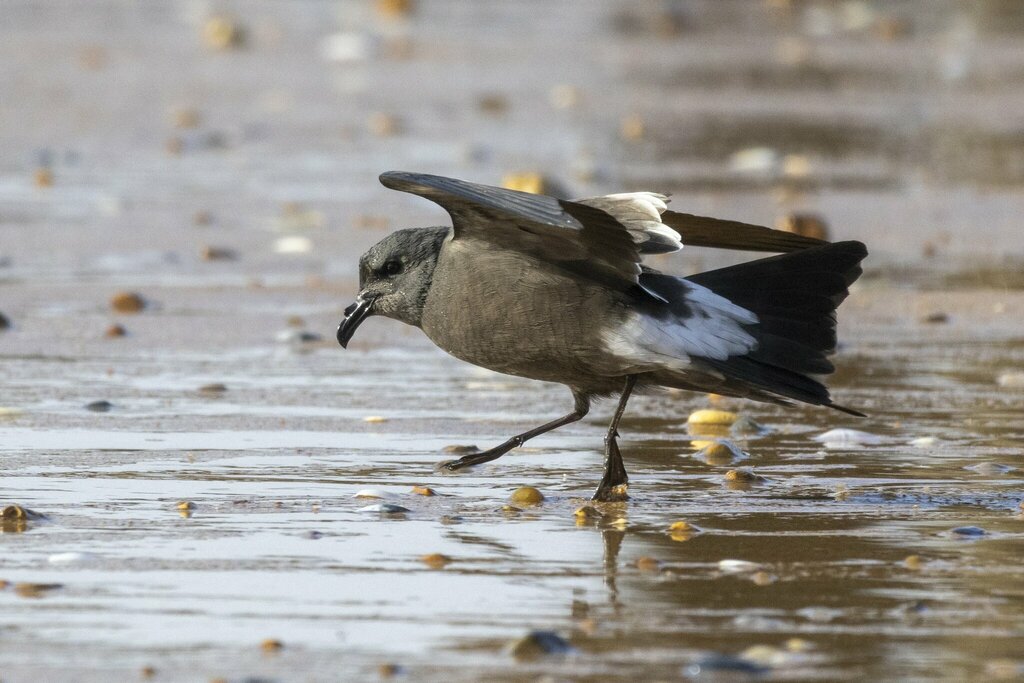
Leach’s Storm Petrel
Photo © Alexis Lours
Photo © Alexis Lours — CC BY 4.0 — Source: iNaturalist photo #332925168Identification
Leach's storm petrel is a diminutive seabird measuring 18–21 cm in length with a 43–48 cm wingspan. It is predominantly black with distinctive field marks: a paler grey-brown bar on the secondary wing coverts, a slightly paler face, and characteristically a white rump, often with a hint of a dark divide down the middle. However, dark-rumped individuals occur on the west coast of North America, becoming increasingly common towards the United States-Mexico border where 90–100% of breeding birds display this variation.
In the Atlantic, Leach's petrel is readily distinguished from European storm petrel and Wilson's storm petrel by its larger size, forked tail, different rump pattern, and distinctive flight behaviour. The species exhibits a fluttering flight and characteristic pattering on the water as it feeds. Separation from band-rumped storm petrels requires careful attention to rump extent and flight pattern, while Pacific identification demands close observation of wingbeats and overall coloration, particularly in dark-rumped populations.
Range & Habitat
Leach's petrel breeds on inaccessible islands in colder northern regions of the North Atlantic and North Pacific Oceans, with a single Southern Hemisphere breeding colony on Dassen Island in South Africa. The largest known colony inhabits Baccalieu Island off eastern Canada, which supported approximately 1.95 million pairs at the last 2013 estimate. Birds nest in colonies close to the sea in well-concealed locations such as rock crevices, shallow burrows, or logs, typically laying a single white egg with a faint purple-spot ring at the large end.
Outside the breeding season, the species is strictly pelagic and difficult to observe from land. Only during storms may individuals be pushed towards headlands. In Europe, autumn offers the best viewing opportunities in Liverpool Bay between north Wales and northwest England, where strong north-westerly gales funnel migrating birds into the bay. The species does not follow ships, distinguishing it from some congeners.
Behaviour & Diet
Leach's petrel is strictly nocturnal at breeding sites, avoiding predation by gulls and skuas and even refraining from landing on clear, moonlit nights. Birds breeding at the Arctic Circle in Norway must delay breeding until autumn to avoid continuous daylight. The species exhibits an unusually long lifespan for its size, averaging 13 years with a maximum recorded age exceeding 38 years, and uniquely shows telomere lengthening with age.
The petrel feeds primarily on plankton including euphausiids, copepods, and parasitic amphipods, supplemented extensively with myctophids (lantern fish) that surface only at night over continental slopes. Individuals forage up to 1000 km from their breeding colony. During incubation and chick-rearing, parents utilize energy-rich lipid reserves. Chicks fledge in late September at reduced weight after reaching nearly double that mass, then migrate to waters associated with the North Equatorial or Benguela Currents. Fall storms occasionally wreck young fledglings on mainland coasts.
Best Time & Places to See It
Leach's petrel presents significant challenges for land-based observation due to its remote island breeding sites and strictly pelagic non-breeding behaviour. The most accessible opportunity in Europe occurs in autumn in Liverpool Bay between north Wales and northwest England, particularly following strong north-westerly gales that funnel migrating birds into coastal waters. Historical observations documented substantial communities on remote Scottish islands including North Rona and Sula Sgeir, with the species first photographed at the nest in 1958 on Eilean Mor in the Flannan Isles.
For dedicated observers, pelagic seabird trips during migration periods offer the best chance of encounter. Storm-driven events may push birds closer to accessible headlands, providing rare land-based sightings. The species' strictly nocturnal behaviour at colonies makes visiting breeding islands particularly challenging and requires specialized access permissions to remote, protected sites.
Photography Tips
Photographing Leach's petrel demands patience and appropriate conditions. The species' pelagic habits necessitate seabird-watching trips or coastal storm-watching during migration periods. The bird's small size, dark plumage, and swift, erratic flight present technical challenges requiring fast shutter speeds and tracking ability. Storm conditions that push birds closer to shore offer enhanced opportunities but demand careful safety precautions.
Key diagnostic features to capture include the white rump pattern (or dark variation on western populations), the pale secondary wing-covert bar, and the characteristic forked tail. The species' fluttering, erratic flight behaviour and water-pattering feeding technique are distinctive photographic subjects. Early morning or evening light during pelagic trips may provide optimal conditions for documenting plumage details and behaviour on the open ocean.
Gulf Islands National Park Reserve
Southern Gulf Islands Electoral Area, Canada
+268 birds+26 mammals
Scattered across the Salish Sea in British Columbia's southwestern corner, this national park reserve stitches together a fragmented archipelago of forested islands and rocky outcrops where…
VIEW NATIONAL PARKLower Saxon Wadden Sea National Park
Norderney, Germany
+193 birds+12 mammals
Where the North Sea meets the German coast, a vast expanse of tidal mudflats, salt marshes, and shallow waters creates one of Europe's most dynamic estuarine…
VIEW NATIONAL PARKHamburgisches Wattenmeer National Park
Hamburg, Germany
+206 birds+6 mammals
Where the North Sea exhales across the Elbe estuary, the tidal mudflats of Hamburgisches Wattenmeer National Park emerge twice daily in a landscape of extraordinary ecological…
VIEW NATIONAL PARKSchleswig-Holsteinisches Wattenmeer National Park
Germany
+378 birds+49 mammals
Where the North Sea ebbs and flows across a vast expanse of exposed mud and sand, the Schleswig-Holsteinisches Wattenmeer National Park reveals one of Europe's most…
VIEW NATIONAL PARKDoñana National Park
Hinojos, Spain
+300 birds+13 mammals
Where the Guadalquivir River delta spreads into the Atlantic, vast marshes, cork woodlands, and coastal dunes converge to create one of southwestern Europe's most biodiverse wetland…
VIEW NATIONAL PARKPembrokeshire Coast National Park
Pembrokeshire, United Kingdom
+250 birds+41 mammals
Where the Cambrian coastline meets the Celtic Sea, cliff-top moorland and hidden coves define a landscape carved by 300 million years of geological drama. Pembrokeshire Coast…
VIEW NATIONAL PARKSouth Downs National Park
Chichester, United Kingdom
+298 birds+45 mammals
Chalk downland ridges rise and fall across the South Downs, their open grasslands and beech hangers creating a mosaic of habitats that has shaped human settlement…
VIEW NATIONAL PARKL’Île-Bonaventure-Et-Du-Rocher-Percé National Park
Le Rocher-Percé, Canada
+214 birds+3 mammals
A dramatic thrust of russet sandstone pierces the Gulf of Saint Lawrence, its weathered arch framing a seascape where cool Atlantic currents sweep past cliffs alive…
VIEW NATIONAL PARKKenai Fjords National Park
Kenai Peninsula Borough, United States
+164 birds+19 mammals
Granite peaks and tidewater glaciers dominate Alaska's Kenai Peninsula, where nearly 7,900 square kilometers of pristine coastal wilderness descend from the Harding Icefield toward the Gulf…
VIEW NATIONAL PARKGlacier Bay National Park
Unorganized Borough, United States
+221 birds+15 mammals
Tidewater glaciers calving into fjords of impossible blue, where temperate rainforest rises steeply from the water's edge and alpine peaks pierce the clouds—this is the ecological…
VIEW NATIONAL PARKOlympic National Park
Jefferson County, United States
+263 birds+35 mammals
Where temperate rainforest meets alpine wilderness, Olympic National Park sprawls across nearly 11,000 square kilometers of the Pacific Northwest's most pristine landscape. The park's three distinct…
VIEW NATIONAL PARKParque Nacional de Galápagos
Santo Tomás, Ecuador
+139 birds+23 mammals
Volcanic peaks and weathered lava fields dominate this remote archipelago in the Pacific, where the interplay of cold ocean currents and tropical latitude creates an ecological…
VIEW ISLAND & ARCHIPELAGOGros Morne National Park
Canada
+180 birds+19 mammals
Where glacier-carved fjords pierce the interior of Newfoundland, Gros Morne National Park unfolds across nearly four thousand square kilometres of some of Canada's most dramatic coastal…
VIEW NATIONAL PARKGwaii Haanas National Park Reserve and Haida Heritage Site
Area E (Moresby Island), Canada
+98 birds+8 mammals
Where temperate rainforest meets the Pacific's edge, the islands of southern Haida Gwaii rise as one of North America's most pristine coastal wilderness areas. Spanning approximately…
VIEW NATIONAL PARKForillon National Park
Gaspé, Canada
+258 birds+16 mammals
Where the Gaspésie Peninsula juts into the Gulf of Saint Lawrence, granite cliffs and coastal headlands frame one of eastern Canada's most dramatic marine-terrestrial boundaries. Forillon…
VIEW NATIONAL PARKUrdaibai Biosphere Reserve
Txatxarramendi, Spain
+268 birds+8 mammals
Where the Pyrenean foothills surrender to the Bay of Biscay, tidal estuaries carve through Basque limestone, creating one of Europe's most ecologically vital wetland complexes. Salt…
VIEW BIOSPHERE RESERVEEstrecho Natural Park
Pedro Valiente, Spain
+281 birds+20 mammals
Where Mediterranean pine forests meet wind-sculpted coastal cliffs, one of Europe's most dynamic ecological crossroads unfolds across the Strait of Gibraltar. Spanning 686 square kilometers of…
VIEW NATURAL PARKSt. Paul Island
Saint Paul, United States
+255 birds+8 mammals
Windswept tundra rolls across this remote Pribilof island, where volcanic basalt cliffs plunge into the Bering Sea and fog rolls in thick enough to erase the…
VIEW PROTECTED LANDSCAPEEl Vizcaíno
Laguna San Ignacio, Mexico
+317 birds+29 mammals
Where the Baja California peninsula thins into a tapestry of salt lagoons and coastal desert, one of Mexico's most biodiverse reserves sprawls across half a million…
VIEW BIOSPHERE RESERVESkomer Island
Haverfordwest, United Kingdom
+177 birds+5 mammals
Where the Irish Sea crashes against the Welsh coast, wind-scoured cliffs rise dramatically from churning waters, creating one of Britain's most pristine island sanctuaries. Skomer Island's…
VIEW ISLAND & ARCHIPELAGOCabo Peñas
Susacasa, Spain
+303 birds+21 mammals
Where sea cliffs rise sheer from the Bay of Biscay, Susacasa's observation point commands one of Asturias's most dramatic coastal vistas. The landscape here is defined…
VIEW OBSERVATION POINTAcadia National Park
Bar Harbor, United States
+291 birds+27 mammals
Where the Maine coast rises in granite cliffs and spruce-clad headlands, Acadia National Park unfolds across Mount Desert Island and its surrounding waters, a landscape carved…
VIEW NATIONAL PARKChannel Islands National Park
Santa Barbara County, United States
+330 birds+15 mammals
A chain of eight volcanic islands rises from the cold Pacific waters off the California coast, their rugged sea cliffs and windswept terrain shaped by millions…
VIEW NATIONAL PARKKodiak National Wildlife Refuge
United States
+221 birds+22 mammals
Where temperate rainforest meets subarctic coast, Kodiak National Wildlife Refuge sprawls across Alaska's largest island, a sanctuary defined by steep valleys carved by tidewater glaciers and…
VIEW WILDLIFE SANCTUARYAlaska Maritime National Wildlife Refuge
Alaska, United States
+391 birds+58 mammals
Where the North Pacific collides with Alaska's rugged coastline, a sprawling archipelago of islands, rocky outcrops, and coastal headlands forms one of North America's most remote…
VIEW WILDLIFE SANCTUARYIzembek National Wildlife Refuge
Cold Bay, United States
+138 birds+9 mammals
Where the Aleutian archipelago reaches westward into the Bering Sea, subarctic tundra and shallow coastal waters converge to create one of Alaska's most ecologically vital wildlife…
VIEW WILDLIFE SANCTUARYMerritt Island National Wildlife Refuge
Brevard County, United States
+341 birds+19 mammals
Brackish marshes and palmetto scrub define this wildlife sanctuary spanning the coastal lowlands of central Florida, where the Atlantic tide meets freshwater systems in a dynamic…
VIEW WILDLIFE SANCTUARYFarallon National Wildlife Refuge
San Francisco, United States
+384 birds+16 mammals
Windswept granite peaks rising abruptly from the Pacific, the Farallon Islands form a wildlife sanctuary of extraordinary seabird abundance and ecological significance just twenty-seven miles west…
VIEW WILDLIFE SANCTUARYPea Island National Wildlife Refuge
Dare County, United States
+356 birds+15 mammals
Where the Outer Banks taper toward the Atlantic, a sliver of barrier island creates a microcosm of coastal ecology. Pea Island National Wildlife Sanctuary spans over…
VIEW WILDLIFE SANCTUARYMidway Atoll National Wildlife Refuge
United States
+91 birds+1 mammals
Straddling the international date line roughly midway between North America and Asia, this atoll sanctuary rises from the North Pacific as a cluster of coral and…
VIEW WILDLIFE SANCTUARYNo community photos yet. Log in to add the first one.
No community observations of this species yet.