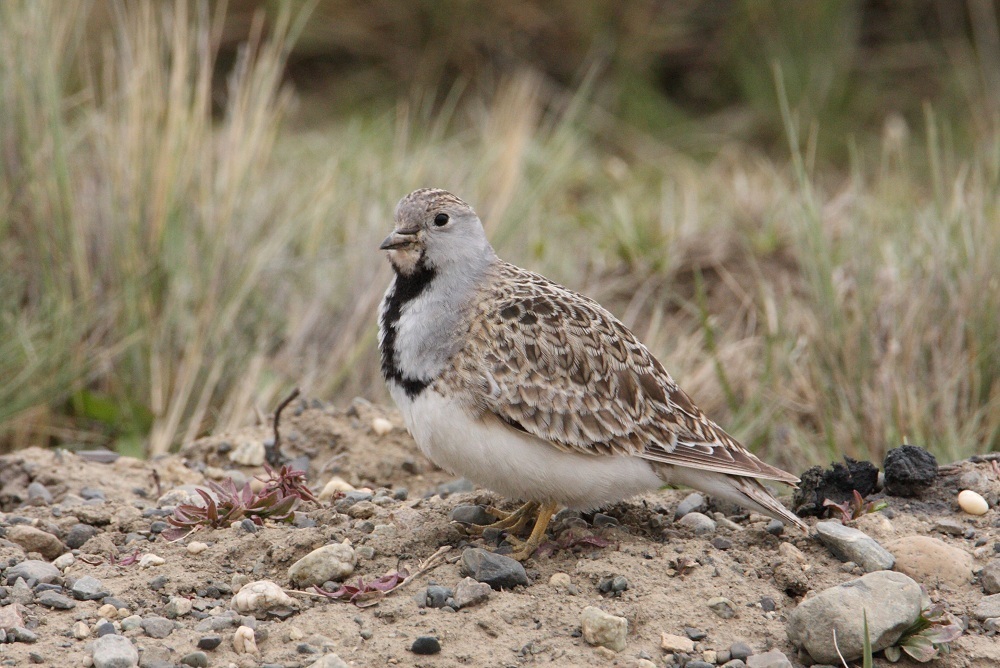
The least seedsnipe (Thinocorus rumicivorus) is a xerophilic species of bird in the Thinocoridae family. It breeds in Argentina, Bolivia, Chile, and Peru. They are common across South America and have been recorded in Ecuador, the Falkland Islands, Uruguay, Brazil, and as far away as Antarctica. The range of the least seedsnipe is estimated to be about 1,300,000 km2. Its natural habitats are temperate grassland, subtropical or tropical high-altitude grassland, and pastureland, but it can be found in habitats ranging from sandy beaches to the open steppe, and even some open deserts in northern Chile. == Etymology == The least seedsnipe was described in 1829 by Eschscholtz. The genus name comes from Greek thin-, thinos- (θινος) 'sand' or 'desert' and Latin 'corys' (from Greek κορυδος) 'lark'. The species name comes from Latin rumicis 'sorrel' and vorā 'eater'. == Taxonomy == There are three subspecies of the least seedsnipe: T. r. cuneicauda, (Peale, 1848): southwest Ecuador & coastal Peru T. r. bolivianus, (Lowe, 1921): southern Peru, western Bolivia, northern Chile & northwestern Argentina T. r. rumicivorus, (Eschscholtz, 1829): Patagonia to Tierra del Fuego == Description == The least seedsnipe is the smallest member of the Thinocoridae family. They have short tails…
Torres del Paine National Park
Torres del Paine, Chile
+143 birds+10 mammals
Where granite spires pierce the Patagonian sky, Torres del Paine commands one of South America's most dramatic landscapes. Across 4,106 square kilometres of southern Chile, jagged…
VIEW NATIONAL PARKLaja National Park Lagoon
Antuco, Chile
+123 birds+1 mammals
Where the Andes descend into the Biobío Region's temperate forests, a vast lagoon fills the caldera of the extinct Antuco volcano, cradled by steep native woodland…
VIEW NATIONAL PARKPatagonia National Park
Cochrane, Chile
+133 birds+8 mammals
Where the Andes meet the Patagonian steppe, vast grasslands and shrublands sweep across rolling terrain carved by ancient glaciation, their contours softened by distance and dramatic…
VIEW NATIONAL PARKMonte León National Park
Argentina
+100 birds+4 mammals
Where the Patagonian steppe meets the Atlantic, Monte León National Park protects a landscape of windswept coastal cliffs, rocky outcrops, and semi-arid grassland spanning over 1,200…
VIEW NATIONAL PARKPerito Moreno National Park
Argentina
+78 birds
Where the Patagonian steppe descends into a landscape carved by ancient ice, Perito Moreno National Park sprawls across nearly 1,590 square kilometres of some of South…
VIEW NATIONAL PARKLos Cardones National Park
Argentina
+193 birds+6 mammals
Where the Andes descend into northwestern Argentina, Los Cardones National Park sprawls across nearly 1,200 square kilometres of one of South America's most distinctive high-altitude desert…
VIEW NATIONAL PARKLanín National Park
Argentina
+128 birds+7 mammals
Where the volcanic spine of the Andes plunges into Patagonian steppe, Lanín National Park sprawls across nearly 4,700 square kilometers of one of Argentina's most visually…
VIEW NATIONAL PARKLago Puelo National Park
Argentina
+109 birds+1 mammals
Where temperate forests descend to crystalline waters in the foothills of the Andes, Lago Puelo National Park sprawls across nearly 300 square kilometers of pristine wilderness…
VIEW NATIONAL PARKNo community photos yet. Log in to add the first one.
No community observations of this species yet.