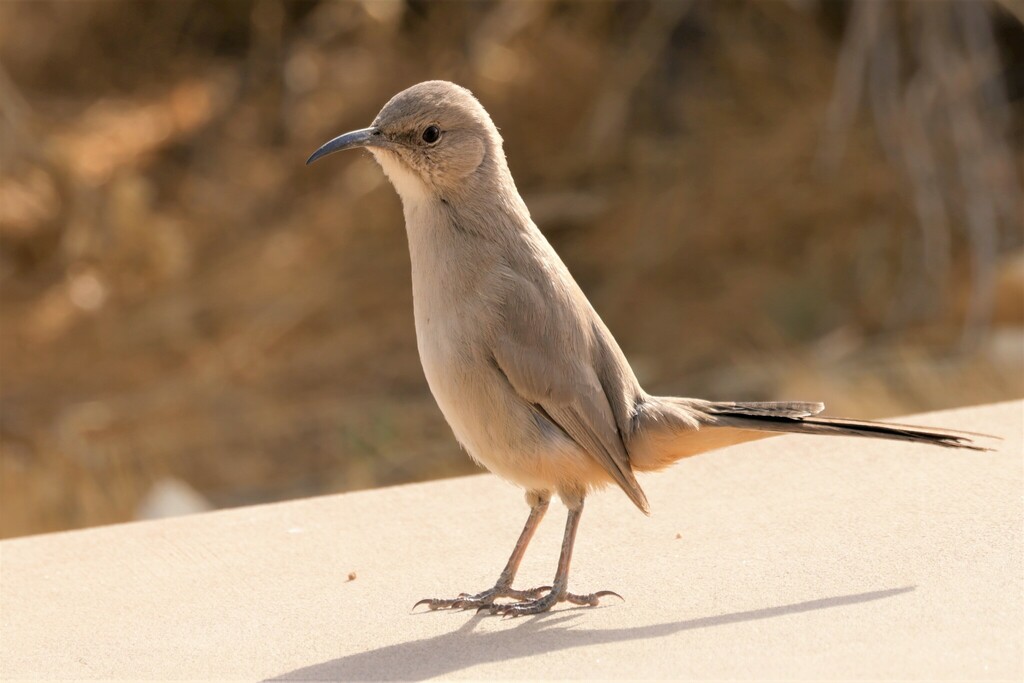
LeConte’s Thrasher
Photo © russnamitz
Photo © russnamitz — CC0 1.0 — Source: iNaturalist photo #446030158Identification
LeConte's Thrasher is a pale, sandy-colored bird weighing 55–75 g and measuring 24.5–29 cm in length. Both sexes are identical, with no sexual dimorphism. The crown, back, shoulders, and rump are sandy pale-gray, while the primaries and secondaries are grayish-brown. The darker gray-brown tail contrasts noticeably with the rest of the plumage. Look for the characteristic sickle-shaped black bill, nearly black legs, and brown-chestnut iris. The throat is off-whitish with a darker stripe, and the chest and belly are puffy gray. The vent and upper tail coverts show a warmer tone than the paler underparts. The bird's short, rounded wings are typical of sedentary species. Juvenile birds appear darker brown with looser, fluffier plumage.
Range & Habitat
LeConte's Thrasher is a non-migratory resident of the southwestern United States and northwestern Mexico, ranging from California's San Joaquin Valley through southern Nevada, southwestern Utah, central and southern Arizona, northeast Baja California, and northwest Sonora. This bird inhabits some of the harshest desert climates in North America, including the Sonoran Desert and San Joaquin Valley, where annual rainfall averages only 4–20 cm. Typical habitat consists of dunes, alluvial fans, and flat to gently rolling hills with sparse vegetation such as saltbush, creosote, cholla cacti, and Mojave yucca. The species occurs at elevations from 80 m below sea level (Death Valley) to 1,600 m, with an average of around 500 m. Populations have declined in certain regions, particularly the Coachella, Imperial, and San Joaquin valleys, due to urbanization, livestock cultivation, oil and gas development, and invasive grasses following fire.
Behaviour & Diet
LeConte's Thrasher is highly terrestrial, running at surprisingly fast speeds—even fast enough to outpace a trotting horse—with its tail held upward to expose its buffy crissum. It flies only occasionally, primarily when nest building or feeding young. The bird is a ground forager, digging small pits in leaf litter and soil to unearth prey. It is monogamous, generally seen in pairs, though juveniles may form small groups of two to eight birds. Both sexes actively participate in nest building, incubation, and brooding, alternating primary responsibility for these tasks. LeConte's Thrasher competes with northern mockingbirds, loggerhead shrikes, and greater roadrunners for resources, and may fall prey to the latter.
Best Time & Places to See It
As a year-round resident, LeConte's Thrasher can be encountered any time of year throughout its range. The most reliable locations are the open deserts of southern California, southern Nevada, southwestern Utah, and Arizona, particularly in areas with minimal human disturbance. Look for this bird in the Sonoran Desert, San Joaquin Valley, and surrounding desert regions. Visiting during breeding season may offer better opportunities to observe the bird, as it becomes more active when building nests and caring for young. Less disturbed desert areas tend to support more stable populations than regions affected by urbanization and development.
Photography Tips
Photographing LeConte's Thrasher requires patience and stealth, as this terrestrial bird spends most of its time on the ground. Early morning light is ideal for capturing the bird's subtle pale-gray plumage and sandy coloration against desert backgrounds. Position yourself low to the ground to photograph the bird at eye level as it forages or runs. The bird's characteristic upright tail posture and rapid running gait provide dynamic photo opportunities. Use a longer lens (400mm or more) to maintain distance without disturbing the bird. The sickle-shaped black bill, dark iris, and nearly black legs provide excellent focal points for close-up shots. Photographing pairs will help convey the bird's monogamous behavior, while capturing the contrasting darker tail feathers against the paler body plumage showcases key field marks.
Joshua Tree National Park
Riverside County, United States
+221 birds+23 mammals
Across 5,610 square kilometers of Riverside County's high desert, a landscape of geological drama unfolds where granite monoliths pierce through bajadas of creosote scrub and Joshua…
VIEW NATIONAL PARKDeath Valley National Park
Inyo County, United States
+339 birds+25 mammals
Across nearly 3.5 million acres of southeastern California's Inyo County, vast salt flats meet sculpted badlands and alluvial fans in a landscape so extreme it defines…
VIEW NATIONAL PARKEl Vizcaíno
Laguna San Ignacio, Mexico
+317 birds+29 mammals
Where the Baja California peninsula thins into a tapestry of salt lagoons and coastal desert, one of Mexico's most biodiverse reserves sprawls across half a million…
VIEW BIOSPHERE RESERVECabeza Prieta National Wildlife Refuge
United States
+155 birds+6 mammals
Across southwestern Arizona's harshest terrain, where the Colorado River marks the border with Mexico, lies a sanctuary shaped entirely by heat and aridity. Cabeza Prieta National…
VIEW WILDLIFE SANCTUARYKofa National Wildlife Refuge
Yuma County, United States
+142 birds+10 mammals
Desert mountains rise in sculptured ridges across northwestern Arizona, where the Colorado River's distant influence fades into some of the most austere terrain in the American…
VIEW WILDLIFE SANCTUARYNo community photos yet. Log in to add the first one.
No community observations of this species yet.