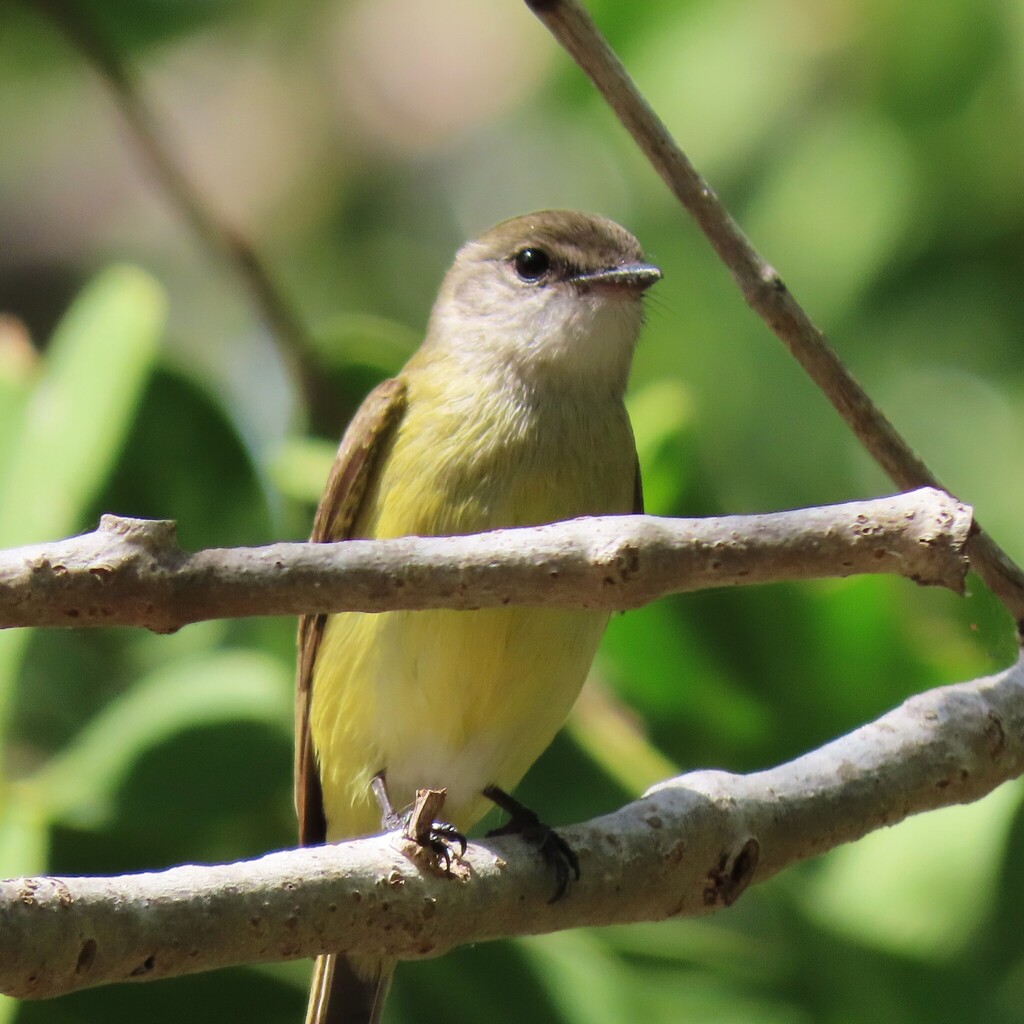
Lemon-bellied Flyrobin
Photo © pimelea
Photo © pimelea — CC BY 4.0 — Source: iNaturalist #297542152Identification
The lemon-bellied flyrobin is a small bird, around 11.5 centimetres long, belonging to the Australasian Robin family. The nominate subspecies displays distinctive lemon-yellow underparts with a white throat, grey face marked by a white eyebrow stripe, and olive-brown upperparts. Males and females have similar plumage. The species shows considerable variation across its range: subspecies flavissima has a more obvious yellow tinge to the upperparts and a shorter tail, while laetissima is larger with a shorter tail and bill. The unusual subspecies tormenti, known as the Kimberley flyrobin, lacks the characteristic yellow pigmentation, instead showing white underparts and greyish upperparts, with a longer bill and tail overall.
Range & Habitat
Found across northern Australia, Indonesia, and Papua New Guinea, the lemon-bellied flyrobin ranges from the Ord River in the west to coastal Queensland. The species inhabits subtropical and tropical moist lowland forests, with a strong preference for mangroves, paperbark swamp forests, and open woodlands. Different subspecies occupy distinct geographic ranges: flavigaster across the top of the Northern Territory, flavissima in Cape York and New Guinea, laetissima along the central-northern Queensland coast, and tormenti in the Kimberley region of northwestern Australia. The two Queensland subspecies are separated by the Atherton Tableland and Burdekin-Lynd Divide.
Behaviour & Diet
This is an insectivore that actively hunts prey within foliage and dead branches of trees and shrubs, only rarely foraging on the ground. The bird employs hawking and sallying techniques to catch insects, and research in Kakadu National Park has documented it occasionally capturing large insects exceeding 2 centimetres in length. Breeding occurs year-round throughout its range from August to February, with pairs typically raising one or two broods per season. The nest is a small, dish-shaped structure constructed from bark and grasses, positioned in the fork of a tree. Females lay a single pale blue egg marked with brownish spots, measuring approximately 19 by 14 millimetres.
Best Time & Places to See It
The breeding season from August to February offers excellent opportunities for observation, as birds are actively foraging and attending to nests and young. Key locations include Kakadu National Park in the Northern Territory, the mangrove systems and paperbark swamps of the tropical north, and coastal Queensland woodlands. The Kimberley region of northwestern Australia hosts the distinctive tormenti subspecies, while Cape York and the northeastern coast provide chances to encounter flavissima.
Photography Tips
The lemon-bellied flyrobin's small size and habit of foraging in foliage demands patience and a steady telephoto lens of at least 300mm. Position yourself quietly near mangroves or paperbark swamps during early morning hours when insectivores are most active. The bird's preference for sallying flights from branches offers dynamic shooting opportunities—anticipate movements and use continuous shooting mode. The yellow plumage of nominate subspecies provides good contrast against green foliage, while tormenti's subtle grey and white tones require careful exposure metering to preserve detail.
Kakadu National Park
Kakadu, Australia
+273 birds+46 mammals
Kakadu National Park is Australia’s largest national park and one of the world’s most remarkable protected areas, covering nearly 20,000 square kilometres in the tropical north…
VIEW NATIONAL PARKDaintree National Park
Dedin, Australia
+362 birds+37 mammals
Daintree National Park is one of the world’s oldest and most biologically diverse tropical rainforests, protecting an extraordinary landscape where ancient forests meet the Great Barrier…
VIEW NATIONAL PARKAnnan River (Yuku Baja-Muliku) National Park
Australia
+78 birds
Where the Annan River winds through northeastern Queensland's coastal hinterland, a compact national park of roughly 246 square kilometers protects a mosaic of subtropical rainforest, eucalypt…
VIEW NATIONAL PARKEndeavour River National Park
Philadelphia, Australia
+203 birds+1 mammals
Where the Endeavour River winds through northeastern Queensland's tropical lowlands, a compact mosaic of rainforest, open woodland, and riverine corridor creates one of Australia's most ecologically…
VIEW NATIONAL PARKRinyirru National Park
Lakefield, Australia
+258 birds+7 mammals
Where the savanna grasslands of far north Queensland meet seasonal wetlands and eucalypt woodlands, Rinyirru National Park sprawls across more than 12,500 square kilometres of rugged,…
VIEW NATIONAL PARKWhitsunday Islands National Park
Whitsundays, Australia
+163 birds+9 mammals
Crystalline waters lap against seventy-four islands where rainforest canopies tumble down to pristine beaches and coral gardens flourish in the shallows. This archipelago off Queensland's coast…
VIEW NATIONAL PARKLitchfield National Park
Australia
+175 birds+15 mammals
Where weathered sandstone plateaus rise above the savanna woodlands of Australia's Top End, Litchfield National Park unfolds as a landscape of dramatic contrasts shaped by a…
VIEW NATIONAL PARKNitmiluk National Park
Australia
+186 birds+27 mammals
Dramatic sandstone gorges carved by the Katherine River slice through the tropical savanna of Australia's Top End, creating a landscape where escarpments tower above crystalline pools…
VIEW NATIONAL PARKGirringun National Park
Australia
+231 birds+10 mammals
Where granite gorges cleave through subtropical woodland in North Queensland, Girringun National Park unfolds across rugged terrain shaped by millions of years of weathering and erosion.…
VIEW NATIONAL PARKWooroonooran National Park
Australia
+240 birds+28 mammals
Where the Great Dividing Range rises sharply inland from Queensland's tropical coast, Wooroonooran National Park encompasses a landscape of steep, forested gorges and cascading waterways carved…
VIEW NATIONAL PARKNo community photos yet. Log in to add the first one.
No community observations of this species yet.