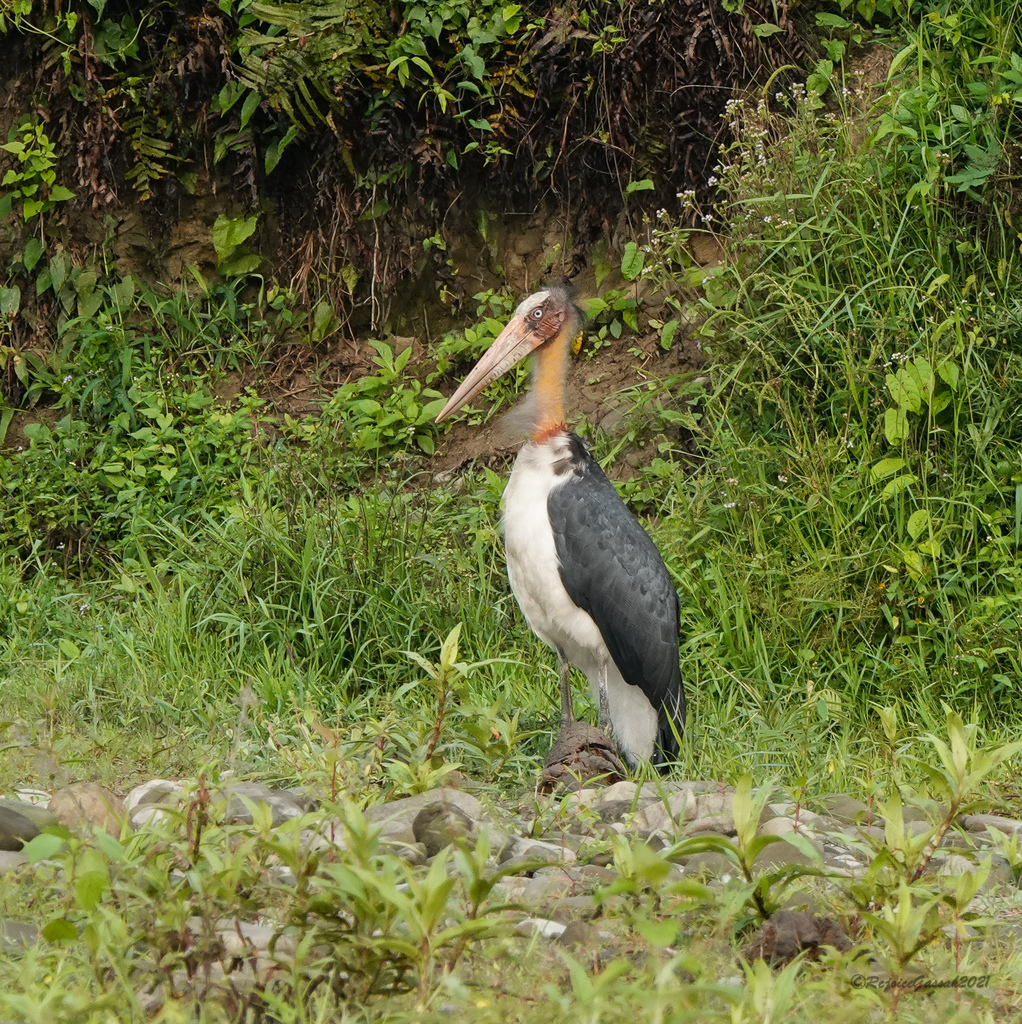
Lesser Adjutant
Photo © Rejoice Gassah
Photo © Rejoice Gassah — CC BY 4.0 — Source: iNaturalist #73920966Identification
The lesser adjutant is a large, upright stork standing 110–120 cm tall and measuring 87–93 cm from bill to tail, with a weight of 4–5.71 kg. Its most distinctive feature is a nearly naked head and neck with only scattered hair-like feathers, lacking the pendant pouch found on some relatives. The upper plumage is uniformly dark, almost entirely black, while the belly and undertail are white. During breeding season, the face becomes reddish and the neck turns orange. The bill is straight-edged and relatively pale at the base, measuring 25.8–30.8 cm long, and the upper leg (tibia) is grey rather than pink.
The lesser adjutant is most easily confused with the greater adjutant, but this species is generally smaller, trimmer, and less hunch-backed in appearance, with a paler skullcap. Males are typically larger and heavier-billed than females, though plumage is otherwise similar between the sexes. In flight, the bird retracts its neck, which can create a pouch-like appearance. Juveniles are duller versions of adults with more feathers on the nape.
Range & Habitat
The lesser adjutant is a widespread species found across India, Nepal, Sri Lanka, Bangladesh, Myanmar, Thailand, Vietnam, Malaysia, Laos, Singapore, Indonesia, and Cambodia, with Cambodia supporting the largest population. Within India, they are mainly distributed in eastern states including Assam, West Bengal, and Bihar, and are extremely rare in southern India. They may occasionally appear as vagrants on the southern edge of Bhutan.
These birds favour large rivers and lakes within well-wooded regions, freshwater wetlands in agricultural areas, and coastal wetlands including mudflats and mangroves. In Sri Lanka, they occupy lowland areas largely within protected areas, including forested wetlands and crop fields. Studies in Nepal have shown that breeding densities and success are actually higher on croplands than in forested patches with small wetlands.
Behaviour & Diet
The lesser adjutant is a solitary hunter that stalks around wetlands feeding primarily on fish, frogs, reptiles, large invertebrates, rodents, and small mammals, with carrion being taken only rarely. It locates prey entirely by sight, and has been observed perching on telegraph poles to scan marshes below. Unlike the greater adjutant, this species is less likely to scavenge.
These storks are largely silent but produce bill-clattering, hissing, and moaning sounds at the nest. They gather only during breeding season, forming loose colonies of never more than 20 nests. During courtship, females perform a distinctive "Balancing Posture," lifting their heads in a scooping motion while clattering their bills. Breeding occurs from February to May in southern India and November to January in north-eastern India, with timing varying by region. Nests are large stick platforms built on tall trees, containing two to four white eggs with an incubation period of 28–30 days.
Best Time & Places to See It
The best locations for viewing lesser adjutants are in Cambodia, which holds the largest population, and in eastern India, particularly in Assam, West Bengal, and Bihar. Sri Lanka's protected wetland areas also offer reliable sightings. The breeding season—November to January in north-eastern India and February to May in southern India—provides the best opportunity to observe these birds, as they congregate in loose colonies and are more active during courtship and nesting.
Search freshwater wetlands, large rivers, lakes, agricultural wetlands, coastal mudflats, and mangrove areas where the birds hunt for fish and frogs. Early morning hours are ideal for spotting these visual hunters as they stalk through shallow water or perch on vantage points.
Photography Tips
Photograph lesser adjutants in their natural wetland habitats, where their dark plumage contrasts beautifully against water and vegetation. During breeding season, colonies offer excellent opportunities to capture courtship behaviour, including the distinctive "Balancing Posture" and bill-clattering interactions. The bird's upright stance and bare head and neck are striking features that photograph well, particularly when the face and neck take on reddish and orange tones during breeding.
Frame distant shots to capture the bird's full height and characteristic posture while hunting. When in flight, the retracted neck creates an interesting silhouette. Position yourself low to the water level to capture the stork's hunting behaviour and reflections. Early morning light works best to highlight the subtle texture of the dark plumage and the contrasting white belly.
Lunugamvehera National Park
Sri Lanka
+204 birds+14 mammals
Dry scrubland and shallow wetlands converge in Sri Lanka's southeastern lowlands, where Lunugamvehera National Park anchors one of the island's most ecologically vital landscapes. The park's…
VIEW NATIONAL PARKMinneriya National Park
Sri Lanka
+158 birds+9 mammals
Across the dry zone of Sri Lanka's North Central Province spreads a landscape of shallow tanks, grassland margins, and scattered dry forest—a mosaic of water and…
VIEW NATIONAL PARKWasgamuwa National Park
Sri Lanka
+156 birds+8 mammals
Dry deciduous forest and open grassland sweep across the North Central lowlands where Wasgamuwa National Park protects one of Sri Lanka's largest remaining tracts of this…
VIEW NATIONAL PARKAngamedilla National Park
Polonnaruwa, Sri Lanka
+40 birds+2 mammals
Ancient tanks and sal forests define this water-rich sanctuary in Sri Lanka's North Central heartland, where seasonal wetlands and dry deciduous woodland create a mosaic of…
VIEW NATIONAL PARKOrang National Park
Rangagarapathar, India
+298 birds+1 mammals
Where the Brahmaputra's floodplains meet the foothills of Assam, Orang National Park unfolds across a mosaic of riverine grasslands, forests and wetlands that pulse with the…
VIEW NATIONAL PARKValmiki National Park
Ramnagar, India
+66 birds+6 mammals
Along Bihar's western frontier, where the Gandak River winds through subtropical forest and grassland, Valmiki National Park sprawls across terrain shaped by monsoon rains and seasonal…
VIEW NATIONAL PARKKanha Tiger Reserve
Kanha Kisli F.V., India
+321 birds+23 mammals
Where sal forests give way to emerald meadows and crystalline streams carve through ancient valleys, one of India's finest wilderness reserves unfolds across the Maikal Range.…
VIEW NATIONAL PARKTadoba National Park
Palasgaon Singru, India
+270 birds+20 mammals
Where sal forests meet open grasslands and rocky outcrops rise from red laterite soil, central India's landscape unfolds in raw, untamed beauty. Ancient teak woodlands and…
VIEW NATIONAL PARKBandhavgarh National Park
Garhpuri, India
+285 birds+17 mammals
Where granite ridges rise dramatically above sal and bamboo forests, one of India's most pristine tiger reserves unfolds across the Vindhyan plateau. Ancient rock formations tower…
VIEW NATIONAL PARKPanna National Park
Badgadi Kalan, India
+271 birds+17 mammals
Where granite gorges slice through central India's Vindhyan plateau, a landscape of stark beauty unfolds across nearly six hundred square kilometers. The Ken River carves through…
VIEW NATIONAL PARKKaziranga National Park
Kohora, India
+422 birds+26 mammals
Dawn breaks over the floodplains of the Brahmaputra, where tall grasslands stretch endlessly beneath monsoon-heavy skies. This sprawling wilderness of northeastern Assam is a mosaic of…
VIEW NATIONAL PARKBandipur National Park
Hirehalli, India
+302 birds+19 mammals
Where the Western Ghats descend into the Deccan plateau, ancient deciduous forests blanket a landscape carved by the Nugu River. Bandipur unfolds across 880 square kilometres…
VIEW NATIONAL PARKNagarahole Tiger Reserve
Nalkeri Forest, India
+323 birds+23 mammals
Where granite escarpments rise above dense deciduous forests and the Kabini River carves through pristine wilderness, one of India's most biodiverse landscapes unfolds across the Western…
VIEW NATIONAL PARKKuching Wetlands National Park
Kuching, Malaysia
+103 birds+4 mammals
Where brackish waters meet mangrove stilts and freshwater swamps blend into coastal mudflats, one of Southeast Asia's most dynamic wetland ecosystems unfolds across Sarawak's northwestern coast.…
VIEW NATIONAL PARKTaman Negara National Park
Kampong Samas, Malaysia
+393 birds+48 mammals
Where ancient rainforest meets limestone peaks, one of Southeast Asia's oldest protected wilderness preserves sprawls across 4,343 square kilometers of primordial landscape. Dipterocarp giants tower overhead,…
VIEW NATIONAL PARKTaman Nasional Baluran
Situbondo, Indonesia
+189 birds+9 mammals
Across the northeastern tip of East Java, where monsoon winds sweep down from the Bali Strait, a landscape of contrasts unfolds within 374 square kilometres of…
VIEW NATIONAL PARKWest Bali National Park
Gerokgak, Indonesia
+240 birds+8 mammals
Across West Bali's northwestern reaches, where the Indian Ocean meets volcanic slopes and limestone cliffs plunge toward turquoise shallows, sprawls a protected realm of roughly 325…
VIEW NATIONAL PARKSembilang National Park
Banyuasin, Indonesia
+56 birds+3 mammals
Where tidal mangroves grade into freshwater swamp forest and the Musi River delta spreads across more than 7,000 square kilometres, Sembilang National Park represents one of…
VIEW NATIONAL PARKWay Kambas National Park
Lampung Timur, Indonesia
+237 birds+20 mammals
Across the low swamplands of eastern Lampung, where freshwater wetlands merge into tidal mangrove forests along the Sunda Strait, sprawls one of Sumatra's most vital sanctuaries.…
VIEW NATIONAL PARKNo community photos yet. Log in to add the first one.
No community observations of this species yet.