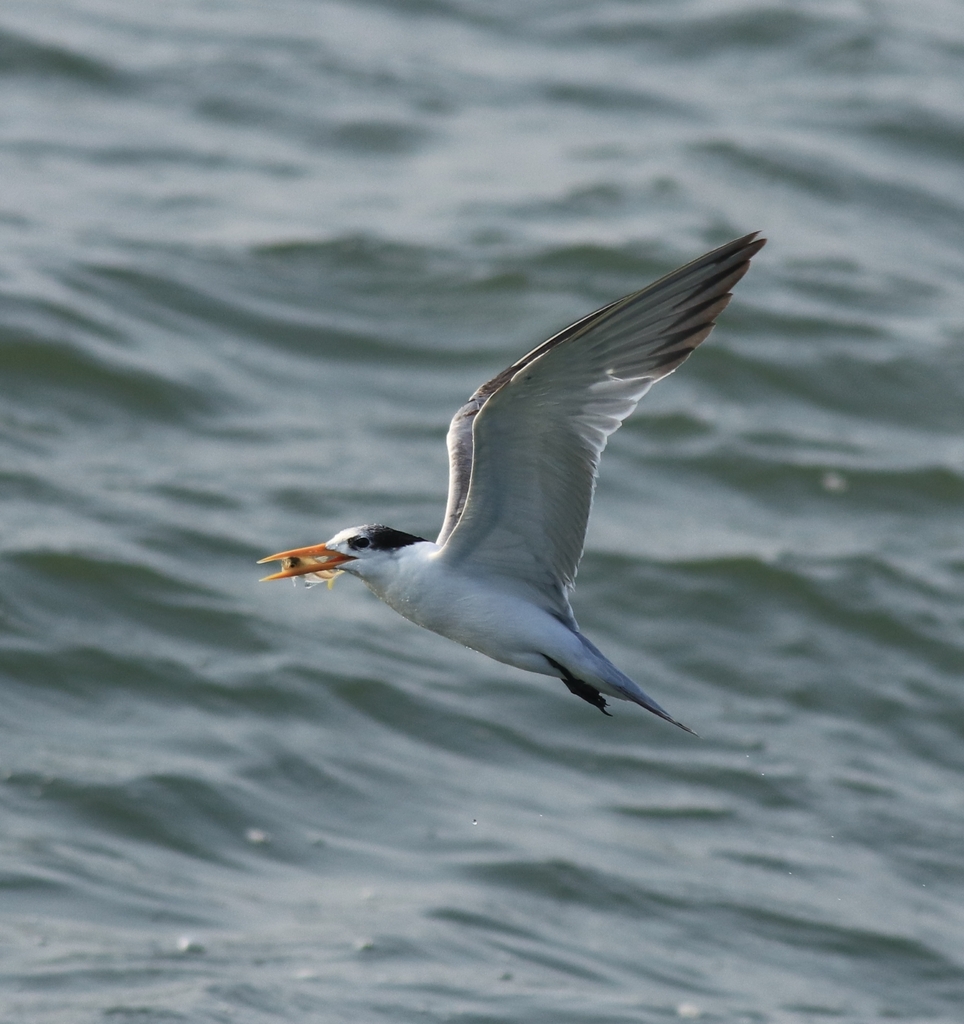
Lesser Crested Tern
Photo © Afsar Nayakkan
Photo © Afsar Nayakkan — CC BY 4.0 — Source: iNaturalist #224106674Identification
The lesser crested tern is a medium-large tern measuring 35–43 cm long with a wingspan of 88–105 cm. In summer plumage, adults display a striking black cap and black legs paired with a long, sharp orange bill. The upperparts, rump, and central tail feathers are grey, contrasting with white underparts. During summer, the primary flight feathers darken noticeably. In winter, the distinctive black cap recedes as the forehead becomes white. The bird's loud, grating call resembles that of its close relative, the Sandwich tern.
A useful field mark is the grey rump, which distinguishes this species from closely related terns. The similar-sized Sandwich tern has a black bill with a yellow tip, while the Elegant tern sports a slightly longer and more slender bill. Juveniles resemble young Sandwich terns but appear paler overall with a yellow-orange bill and only faint dark crescents on the mantle feathers. Within its range, the larger Greater crested tern and West African crested tern can be separated by their stouter bills and, in the latter case, a white rump and tail.
Range & Habitat
The lesser crested tern breeds across subtropical coastal regions extending from the Red Sea through the Indian Ocean to the western Pacific and Australia. A distinct population inhabits the southern Mediterranean coast on islands off Libya. Other populations are migratory, wintering as far south as South Africa, though Australian birds are likely sedentary year-round. The species occasionally appears as a vagrant in Europe, where it has been documented breeding both in pure pairs and in mixed pairs with Sandwich terns.
Three geographical subspecies exist: T. b. emigratus breeds in the Mediterranean and winters in West Africa; T. b. bengalensis inhabits the northern Indian Ocean including the Red Sea and Persian Gulf, wintering to South Africa; and T. b. torresii ranges from Indonesia to Queensland, Australia, remaining in similar areas throughout the year. Minor plumage differences and size variations distinguish these subspecies, with the Mediterranean population appearing slightly paler than others.
Behaviour & Diet
Like all Thalasseus terns, the lesser crested tern feeds primarily by plunge-diving for fish from saline environments. Unlike Arctic terns, which employ a characteristic "stepped-hover" technique, this species typically dives directly into the water. Courtship displays include the male offering fish to the female—a ritualistic behavior that strengthens pair bonds.
The species breeds in dense colonies on coasts and islands, nesting in simple ground scrapes and laying one to two eggs, occasionally three. Dense colonial nesting serves as a predator avoidance strategy. The subspecies T. b. emigratus exhibits a particularly clever adaptation, timing its nesting for late summer when predatory yellow-legged gulls have finished breeding and departed breeding areas. Nesting behavior mirrors that of Sandwich terns in many respects.
Best Time & Places to See It
For observing this species, focus on coastal regions and islands throughout the Red Sea, Indian Ocean, Persian Gulf, and western Pacific. The Mediterranean population around the Libyan coast offers an accessible European viewing opportunity. Timing varies by location: Australian populations are year-round residents, while Indian Ocean and Red Sea birds are present during breeding season, with some wintering populations reaching South Africa.
The Mediterranean subspecies provides an opportunity for European birdwatchers, though sightings remain occasional. Visiting breeding colonies during the nesting season offers the best chance to observe dense congregations and courtship behaviors. Winter months may reveal migrants at southern African coastal sites.
Photography Tips
Capture the lesser crested tern's distinctive summer plumage by photographing adults during breeding season, when the bold black cap, orange bill, and grey rump are most vibrant. The sharp orange bill and black legs provide excellent color contrast against coastal backgrounds. Photograph birds in flight to showcase the grey rump and upperparts—a key identification feature.
Plunge-diving sequences offer dramatic action shots; position yourself along productive feeding waters during optimal light hours. Colonial breeding sites allow photography of dense nesting formations and courtship displays, including males offering fish to females. Capture winter plumage variations, particularly the transition from black to white forehead, as birds move between breeding and wintering grounds. Early morning light best renders the subtle grey tones distinguishing this species from close relatives.
L’Albufera Natural Park
València, Spain
+321 birds+18 mammals
Where shallow lagoons meet Mediterranean coastal marshland, L'Albufera Nature Park unfolds as one of Spain's most vital wetland complexes. This protected landscape, designated under IUCN Category…
VIEW NATURAL PARKDoñana National Park
Hinojos, Spain
+300 birds+13 mammals
Where the Guadalquivir River delta spreads into the Atlantic, vast marshes, cork woodlands, and coastal dunes converge to create one of southwestern Europe's most biodiverse wetland…
VIEW NATIONAL PARKHat Noppharat Thara-Mu Ko Phi Phi National Park
Ao Nang, Thailand
+253 birds+9 mammals
Where limestone karsts rise dramatically from turquoise waters, Hat Noppharat Thara-Mu Ko Phi Phi National Park unfolds across a mosaic of beach, mangrove forest, and island…
VIEW NATIONAL PARKMu Ko Similan National Park
Lam Kaen, Thailand
+82 birds+1 mammals
Granite islands rise from the Andaman Sea in a scattered archipelago where limestone cliffs meet turquoise shallows, their steep faces weathered into caves and overhangs that…
VIEW NATIONAL PARKCabo de Gata-Níjar Natural Park
San José, Spain
+274 birds+11 mammals
Where volcanic ridges plunge toward the Mediterranean, Cabo de Gata-Níjar Nature Park unfolds across one of Europe's most arid coastlines, a landscape sculpted by tectonic violence…
VIEW NATURAL PARKDelta de l’Ebre Natural Park
Eucaliptus, Spain
+341 birds+18 mammals
Where the Ebro River spreads into a vast labyrinth of shallow lagoons, reed beds, and brackish marshes before surrendering to the Mediterranean, one of southern Europe's…
VIEW NATURAL PARKAddo Elephant National Park
Sundays River Valley Local Municipality, South Africa
+388 birds+55 mammals
Where the Eastern Cape's semi-arid scrublands meet transitional woodland, Addo sprawls across 13,478 square kilometres of one of southern Africa's most biodiverse landscapes. The terrain rises…
VIEW NATIONAL PARKKakadu National Park
Kakadu, Australia
+273 birds+46 mammals
Kakadu National Park is Australia’s largest national park and one of the world’s most remarkable protected areas, covering nearly 20,000 square kilometres in the tropical north…
VIEW NATIONAL PARKDaintree National Park
Dedin, Australia
+362 birds+37 mammals
Daintree National Park is one of the world’s oldest and most biologically diverse tropical rainforests, protecting an extraordinary landscape where ancient forests meet the Great Barrier…
VIEW NATIONAL PARKGheebulum Kunungai National Park
Moreton Island, Australia
+168 birds+7 mammals
Sand dunes rise and fall across Moreton Island's eastern shore, a landscape sculpted by wind and ocean currents into one of Australia's most dynamic coastal ecosystems.…
VIEW NATIONAL PARKEndeavour River National Park
Philadelphia, Australia
+203 birds+1 mammals
Where the Endeavour River winds through northeastern Queensland's tropical lowlands, a compact mosaic of rainforest, open woodland, and riverine corridor creates one of Australia's most ecologically…
VIEW NATIONAL PARKBribie Island National Park
Brisbane, Australia
+284 birds+20 mammals
Across tidal flats and shallow waterways north of Brisbane, Bribie Island National Park spreads across nearly four hundred square kilometres of subtropical coastal wilderness—a patchwork of…
VIEW NATIONAL PARKCamargue Regional Nature Park
Saintes-Maries-de-la-Mer, France
+378 birds+48 mammals
Where the Rhône Delta sprawls into the Mediterranean, a landscape of stark and haunting beauty emerges—vast salt marshes punctuated by shallow lagoons, reed beds, and scrubland…
VIEW NATURAL PARKWhitsunday Islands National Park
Whitsundays, Australia
+163 birds+9 mammals
Crystalline waters lap against seventy-four islands where rainforest canopies tumble down to pristine beaches and coral gardens flourish in the shallows. This archipelago off Queensland's coast…
VIEW NATIONAL PARKEstrecho Natural Park
Pedro Valiente, Spain
+281 birds+20 mammals
Where Mediterranean pine forests meet wind-sculpted coastal cliffs, one of Europe's most dynamic ecological crossroads unfolds across the Strait of Gibraltar. Spanning 686 square kilometers of…
VIEW NATURAL PARKBako National Park
Kuching, Malaysia
+210 birds+17 mammals
Weathered sandstone cliffs rise dramatically from the South China Sea, their ochre faces sculpted by millennia of wind and tide into a landscape of extraordinary geological…
VIEW NATIONAL PARKKuching Wetlands National Park
Kuching, Malaysia
+103 birds+4 mammals
Where brackish waters meet mangrove stilts and freshwater swamps blend into coastal mudflats, one of Southeast Asia's most dynamic wetland ecosystems unfolds across Sarawak's northwestern coast.…
VIEW NATIONAL PARKTaman Nasional Baluran
Situbondo, Indonesia
+189 birds+9 mammals
Across the northeastern tip of East Java, where monsoon winds sweep down from the Bali Strait, a landscape of contrasts unfolds within 374 square kilometres of…
VIEW NATIONAL PARKWest Bali National Park
Gerokgak, Indonesia
+240 birds+8 mammals
Across West Bali's northwestern reaches, where the Indian Ocean meets volcanic slopes and limestone cliffs plunge toward turquoise shallows, sprawls a protected realm of roughly 325…
VIEW NATIONAL PARKSembilang National Park
Banyuasin, Indonesia
+56 birds+3 mammals
Where tidal mangroves grade into freshwater swamp forest and the Musi River delta spreads across more than 7,000 square kilometres, Sembilang National Park represents one of…
VIEW NATIONAL PARKKomodo National Park
Komodo, Indonesia
+155 birds+14 mammals
Where volcanic peaks rise dramatically from turquoise waters, a primordial landscape unfolds across three main islands and countless smaller ones scattered throughout the Lesser Sunda archipelago.…
VIEW NATIONAL PARKGreat Sandy National Park
Australia
+306 birds+40 mammals
Where coastal dunes rise inland from the Queensland coastline, Great Sandy National Park encompasses a landscape of remarkable ecological diversity shaped by subtropical humid conditions year-round.…
VIEW NATIONAL PARKNoosa National Park
Marcus Beach, Australia
+216 birds+8 mammals
Subtropical eucalypt woodland and open forest meet coastal heathland along the Noosa Peninsula, where the temperate waters of the Tasman current moderate the Queensland climate into…
VIEW NATIONAL PARKCape Range National Park
Australia
+159 birds+15 mammals
Where arid limestone ridges plunge toward turquoise waters, Cape Range National Park frames one of Australia's most dramatic desert-ocean interfaces. The park's spine—a stark, weathered range…
VIEW NATIONAL PARKLake Nakuru National Park
Nakuru West, Kenya
+494 birds+32 mammals
Alkaline waters ringed by acacia woodland and grassland create one of East Africa's most distinctive wetland ecosystems, where the interplay of geology and climate sustains a…
VIEW NATIONAL PARKArabuko Sokoke Forest Reserve
Kilifi, Kenya
+383 birds+29 mammals
Coastal forest rises from the Indian Ocean plains of Kilifi County, where sandy soils and seasonal rainfall have sculpted a woodland ecosystem unlike anywhere else on…
VIEW NATURE RESERVEWatamu Marine National Park
Dabaso ward, Kenya
+328 birds+12 mammals
Where mangrove channels meet coral gardens and sandy shallows blend into the warm waters of the Indian Ocean, Watamu Marine National Park unfolds across the Kilifi…
VIEW NATIONAL PARKNo community photos yet. Log in to add the first one.
No community observations of this species yet.