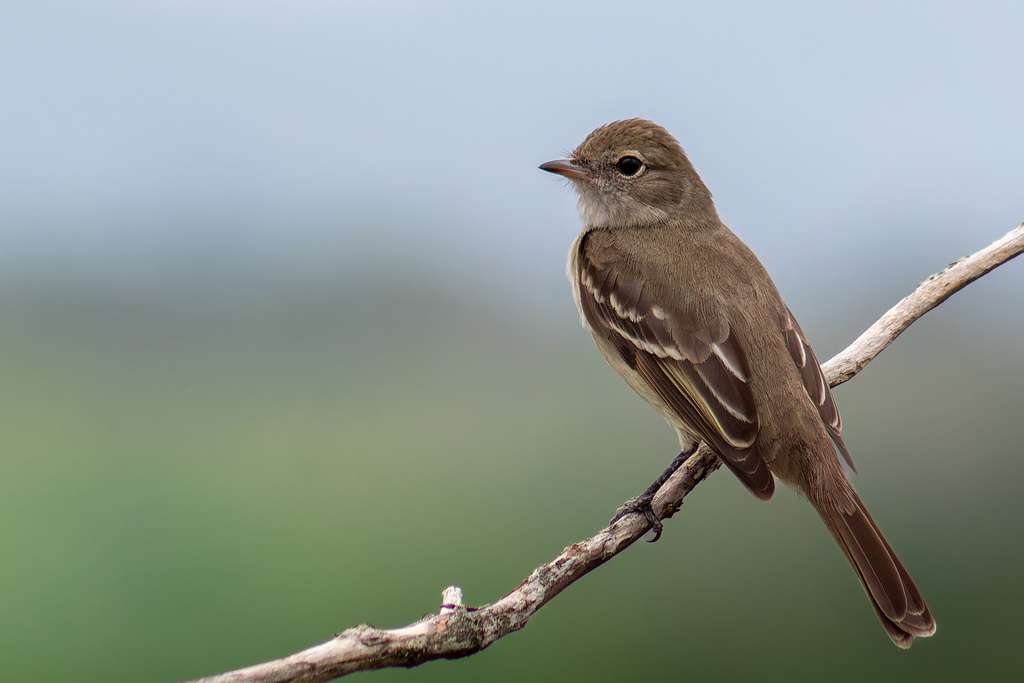
Lesser Elaenia
Photo © Enéas V. Gouvêa Junior
Photo © Enéas V. Gouvêa Junior — CC BY-SA 4.0 — Source: iNaturalist photo #576217878Identification
The lesser elaenia is a small tyrant flycatcher measuring 13 to 14 cm in length with a weight of 11.5 to 22 grams. Its most distinctive feature is a small, squarish crest, though this is often inconspicuous. The plumage is grayish olive on the head and upperparts, with a partially hidden white patch on the crown and a thin whitish eyering. The wings are mostly dusky with whitish edges on the flight feathers, and the white-tipped coverts create two conspicuous bars on the closed wing. The throat is gray, the breast grayish olive, and the belly and undertail coverts pale yellow. Males and females are identical in plumage. The subspecies E. c. albivertex is paler on the underparts. All individuals have a dark brown iris, black bill with a pinkish base to the mandible, and black legs and feet.
Range & Habitat
The lesser elaenia has a highly disjunct distribution across Central and South America, occurring in Costa Rica, Panama, Trinidad, and every mainland South American country except Chile and Uruguay. The nominate subspecies inhabits scattered interior locations in Costa Rica and the Pacific slope through Panama, while subspecies E. c. albivertex is found across much of northern and central South America, including Colombia, Venezuela, the Guianas, Ecuador, Peru, Bolivia, Paraguay, Argentina, and Brazil. The species has occasionally appeared as a vagrant on Bonaire and Curaçao.
The lesser elaenia favors open and semi-open tropical landscapes including scrublands, cerrado, light woodlands, secondary forest, brushy riparian areas, savanna grasslands, plantations, and hedgerows. Its elevation range varies considerably across its distribution, reaching 1,750 meters in Central America, 2,000 meters in Colombia, 3,000 meters in Venezuela, and 2,000 meters in Brazil.
Behaviour & Diet
The lesser elaenia feeds primarily on insects and berries, with the latter apparently dominating its diet in central Brazil. It typically forages singly or in pairs from the upper understory and above, gleaning while perched, hovering briefly, and making short sallies to catch prey in flight. It very rarely joins mixed-species feeding flocks. The species is a year-round resident throughout much of its range, though southern Brazilian populations apparently migrate northward during the austral winter, with occurrences in Rio Grande do Norte documented only between May and December.
Breeding occurs at different times across its range: beginning in March in Costa Rica, from mid-January to April or May in Panama, March to June in Colombia, April to June on Trinidad, and September to December in central Brazil. The female constructs a cup nest from plant fibers, leaves, and moss, lined with feathers and placed in a shrub or tree up to about 4 meters high. She incubates the clutch for 14 to 15 days and broods the nestlings, with both parents provisioning the young until fledging at 15 to 16 days after hatching.
Best Time & Places to See It
The lesser elaenia's status varies across its range. It is fairly common on Costa Rica's Pacific slope, locally common in Colombia, and locally common to fairly common in parts of Venezuela and Brazil. It is less common or poorly known in Ecuador, Peru, the Guianas, and Trinidad. The species is present in many public and private protected areas throughout its range. Given the seasonal breeding patterns and austral migration of southern populations, timing visits according to the breeding season in your target region will increase sighting chances.
Photography Tips
The lesser elaenia's small size and preference for the upper understory and canopy levels make it a challenging subject for photographers. Position yourself in open or semi-open habitats such as scrublands and light woodlands, where birds are more accessible than in dense forest. Early mornings are best, as the species produces a distinctive "very high, hurried, 'tju-wee tju-weederwee'" dawn song that can help you locate individuals. Look for the white wing bars on the closed wing and the partially hidden white crown patch as field marks. The bird's habit of foraging while perched and hovering briefly offers opportunities for photography, though patience and a telephoto lens will be necessary given its small stature and elevated foraging positions.
Emas National Park
Brazil
+333 birds+23 mammals
Across the high plateaux of central Brazil, where the cerrado grasslands roll toward distant horizons under an immense sky, Emas National Park anchors one of South…
VIEW NATIONAL PARKSerra do Cipó National Park
Brazil
+379 birds+5 mammals
Where granite escarpments rise above the Atlantic Forest transition zone in southeastern Brazil, Serra do Cipó National Park unfolds across a landscape of dramatic ridges, cascading…
VIEW NATIONAL PARKCorcovado National Park
Puerto Jiménez, Costa Rica
+444 birds+48 mammals
Where the Osa Peninsula juts into the Pacific, rainforest descends almost to the tide line, and Corcovado National Park protects one of Central America's most intact…
VIEW NATIONAL PARKManuel Antonio National Park
Quepos, Costa Rica
+426 birds+22 mammals
Where tropical rainforest descends steeply to a rocky Pacific coastline, Manuel Antonio National Park distills Central American biodiversity into one of Costa Rica's most compressed and…
VIEW NATIONAL PARKArenal Volcano National Park
Peñas Blancas, Costa Rica
+551 birds+21 mammals
Straddling the border between Alajuela and Guanacaste in northwestern Costa Rica, this national park rises dramatically around one of Central America's most active volcanic systems. The…
VIEW NATIONAL PARKBraulio Carrillo National Park
Las Horquetas, Costa Rica
+547 birds+18 mammals
Where the Caribbean slope descends from the central volcanic cordillera toward the humid lowlands of Heredia, Braulio Carrillo National Park preserves one of Costa Rica's most…
VIEW NATIONAL PARKGuanacaste National Park
Santa Elena, Costa Rica
+461 birds+17 mammals
Where the Pacific slopes of northwestern Costa Rica rise toward the Continental Divide, dry tropical forest gives way to cloud-laden peaks and misty ridges—a landscape that…
VIEW NATIONAL PARKNatural Munchique National Park
El Tambo, Colombia
+194 birds
Where the Western Cordillera rises steeply from the Pacific plains of southwestern Colombia, Natural Munchique National Park sprawls across 1,078 square kilometers of montane forest that…
VIEW NATIONAL PARKNatural Farallones de Cali National Park
Buenaventura, Colombia
+733 birds+27 mammals
Where the Pacific coastal plain meets the western slopes of the Andes, Farallones de Cali National Park sprawls across nearly 3,500 square kilometers of dramatic topography…
VIEW NATIONAL PARKNatural el Cocuy National Park
Güicán, Colombia
+313 birds+3 mammals
Where the Andes rise to their highest peaks in Colombia's eastern cordillera, El Cocuy National Park sprawls across more than 6,600 square kilometers of some of…
VIEW NATIONAL PARKPuracé National Natural Park
Puracé, Colombia
+327 birds+2 mammals
Where the Andes thrust upward across southwestern Colombia, Puracé National Natural Park spans nearly 2,631 square kilometers of some of South America's most dramatic montane terrain.…
VIEW NATIONAL PARKNatural Sierra de la Macarena National Park
Vista Hermosa, Colombia
+566 birds+15 mammals
Across nearly 20,000 square kilometres of Colombia's Meta Department, the terrain rises from lowland savanna into Andean foothills through a mosaic of gallery forests, palm-fringed wetlands,…
VIEW NATIONAL PARKItatiaia National Park
Brazil
+519 birds+12 mammals
Where granite peaks pierce the Atlantic rainforest canopy in southeastern Brazil, Itatiaia National Park rises as one of the country's oldest and most ecologically vital protected…
VIEW NATIONAL PARKViruá National Park
Brazil
+389 birds+6 mammals
Across the northern frontier of Roraima, where the forest canopy rises from ancient Amazonian lowlands, Viruá National Park protects nearly 3,700 square kilometres of terra firme…
VIEW NATIONAL PARKMonte Roraima National Park
Brazil
+226 birds+1 mammals
Where the tepuis rise from the Amazon basin like islands in a sea of forest, Monte Roraima National Park sprawls across 3,714 square kilometres of one…
VIEW NATIONAL PARKSete Cidades National Park
Brazil
+125 birds+1 mammals
Sete Cidades sprawls across 113 square kilometres of northeastern Brazil's interior plateau, where weathered sandstone formations rise dramatically from the cerrado landscape. The park's geology tells…
VIEW NATIONAL PARKChapada dos Guimarães National Park
Brazil
+450 birds+1 mammals
Where weathered sandstone plateaus rise above the cerrado grasslands of central Brazil, Chapada dos Guimarães National Park protects 624 square kilometres of ecological transition zone that…
VIEW NATIONAL PARKChapada dos Veadeiros National Park
Brazil
+324 birds+6 mammals
Where granite plateaus rise above the cerrado savanna in central Brazil, Chapada dos Veadeiros National Park unfolds across 6,665 square kilometres of some of the world's…
VIEW NATIONAL PARKChapada Diamantina National Park
Brazil
+346 birds+5 mammals
Where granite peaks and sandstone cliffs rise abruptly from the Brazilian interior, Chapada Diamantina National Park sprawls across 4,215 square kilometers of some of Brazil's most…
VIEW NATIONAL PARKSerra do Gandarela National Park
Brazil
+333 birds+3 mammals
Where granite massifs rise through Atlantic Forest in southeastern Brazil's highlands, Serra do Gandarela National Park protects nearly 1,000 square kilometres of montane terrain that few…
VIEW NATIONAL PARKBrasília National Park
Plano Piloto, Brazil
+338 birds+15 mammals
Cerrado grassland and scattered woodland sweep across the central Brazilian plateau where this national park sprawls across more than a thousand square kilometres of the Federal…
VIEW NATIONAL PARKYanachaga–chemillén National Park
Palcazu, Peru
+639 birds+6 mammals
Where the eastern slopes of Peru's central cordillera plunge into cloud forest, Yanachaga–Chemillén National Park protects nearly three thousand square kilometres of montane wilderness that few…
VIEW NATIONAL PARKBahuaja Sonene National Park
San Pedro de Putina Punco, Peru
+602 birds+8 mammals
Where the Madre de Dios and Heath rivers converge in southeastern Peru rises one of South America's most biodiverse wilderness regions: a vast protected realm of…
VIEW NATIONAL PARKTingo Maria National Park
Mariano Dámaso Beraún, Peru
+423 birds
Where the eastern slopes of the Peruvian Andes descend toward the Amazon basin, the landscape fractures into a maze of limestone ridges, humid gorges, and cloud-wrapped…
VIEW NATIONAL PARKCordillera Azul National Park
Pampa Hermosa, Peru
+322 birds+1 mammals
Where the eastern Andes descend into the western Amazon basin, Cordillera Azul National Park sprawls across nearly 38,000 square kilometres of some of Peru's most pristine…
VIEW NATIONAL PARKCoiba National Park
Montijo, Panama
+260 birds+10 mammals
An archipelago of volcanic and sedimentary islands rises from the Pacific waters off Panama's southwestern coast, its densest rainforest canopy unbroken for millennia. Coiba National Park…
VIEW NATIONAL PARKBaru Volcano National Park
Cerro Punta, Panama
+402 birds+6 mammals
Where the land rises sharply toward the Caribbean's western spine, Baru Volcano National Park sprawls across roughly 220 square kilometres of southwestern Panama, anchored by the…
VIEW NATIONAL PARKGeneral de División Omar Torrijos Herrera National Park
La Pintada, Panama
+401 birds+2 mammals
Across the highlands of central Panama, where the continental divide funnels moisture-laden trade winds into steep river valleys, the terrain rises and falls in a landscape…
VIEW NATIONAL PARKSoberanía National Park
Cristóbal, Panama
+495 birds+34 mammals
Rainforest and riverine woodland blanket the rolling terrain of this 714-square-kilometre national park in Colón Province, where the Caribbean watershed feeds a maze of streams and…
VIEW NATIONAL PARKChagres National Park
Caimitillo, Panama
+486 birds+19 mammals
Where the Chagres River carves through the humid tropics of central Panama, a vast montane and lowland forest sprawls across more than 2,300 square kilometers, anchoring…
VIEW NATIONAL PARKPortobelo National Park
Portobelo, Panama
+366 birds+9 mammals
Where the Caribbean's turquoise waters meet the Darién's verdant shore, Portobelo National Park sprawls across 570 square kilometers of coastal forest, mangrove wetland, and coral-fringed islands…
VIEW NATIONAL PARKParque Internacional la Amistad
Teribe, Panama
+325 birds+11 mammals
Where the continental divide rises between the Caribbean and Pacific watersheds, a wilderness of extraordinary biological richness unfolds across the Talamanca Range and into lowland rainforest—a…
VIEW NATIONAL PARKRincón de la Vieja National Park
Liberia, Costa Rica
+451 birds+30 mammals
Where volcanic slopes rise abruptly from the Guanacaste lowlands, Rincón de la Vieja National Park sprawls across a landscape shaped by geothermal drama and seasonal extremes.…
VIEW NATIONAL PARKTapantí Macizo de la Muerte National Park
Orosi, Costa Rica
+503 birds+18 mammals
Where montane cloud forest rises steeply from the Orosi Valley, Tapantí Macizo de la Muerte National Park enfolds a landscape of perpetual moisture and emerald complexity.…
VIEW NATIONAL PARKLa Amistad International Park
Crorina, Costa Rica
+532 birds+20 mammals
Where the Caribbean slopes of Costa Rica's Talamanca Mountains rise steeply inland from Limón, the boundary between two nations dissolves into an unbroken expanse of rainforest.…
VIEW NATIONAL PARKVolcán Tenorio National Park
Guatuso, Costa Rica
+480 birds+12 mammals
Where volcanic slopes rise through Costa Rica's northwestern borderlands, Volcán Tenorio National Park sprawls across terrain shaped by ancient lava flows and mineral-rich springs. The park's…
VIEW NATIONAL PARKNo community photos yet. Log in to add the first one.
No community observations of this species yet.