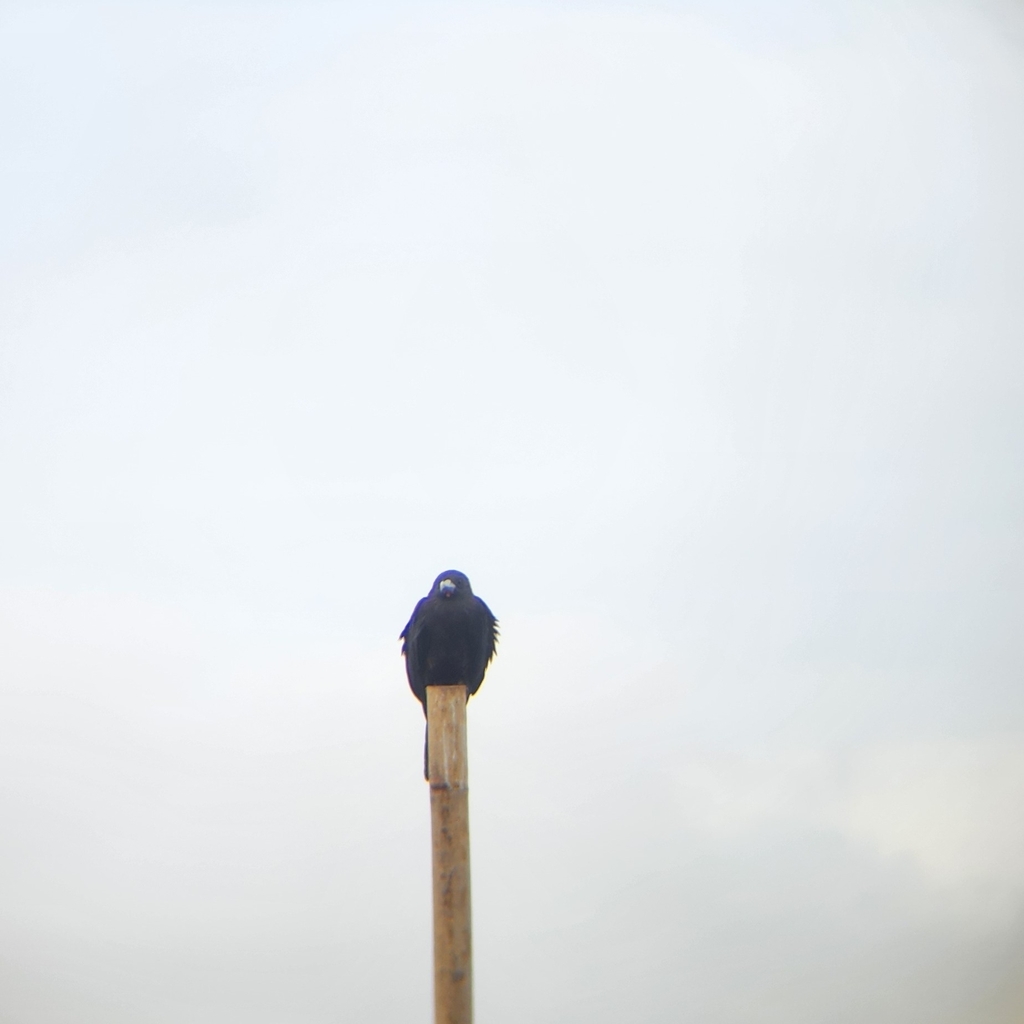
Lesser Frigatebird
Photo © Octavianti Shanna
Photo © Octavianti Shanna — CC BY 4.0 — Source: iNaturalist #208837699Identification
The lesser frigatebird is the smallest species of frigatebird, measuring 66–81 cm in length with a wingspan of 155–193 cm and a distinctive long, forked tail. These birds are built for flying with very light skeletons and long, narrow wings that make them masters of the air. Males are mostly black with a striking white patch on the flank extending onto the underwing, plus a pale bar on the upper wing. Most notably, males display a large, bright red sac on the throat, which they inflate dramatically during courtship displays. Females are slightly larger and heavier than males, featuring a black head and neck with a white collar, breast, and belly, along with a narrow red ring around the eye. Juveniles and immatures are harder to distinguish, but white spurs in the armpits are a helpful identifying feature.
Range & Habitat
The lesser frigatebird occurs over tropical and subtropical waters across the Indian and Pacific Oceans, as well as off the Atlantic coast of Brazil. It is regarded as the most common and widespread frigatebird in Australian seas. The species breeds on remote islands, including Christmas Island in the Indian Ocean. Three subspecies are recognised, occupying different regions: one across the central and eastern Indian Ocean and western Pacific; another in the western Indian Ocean, breeding on Aldabra atoll; and a third in the South Atlantic off Brazil.
These seabirds are most likely to be seen from mainland coasts prior to tropical cyclones, after which they disappear again. They breed in colonies ranging from small populations to vast gatherings, with the largest colonies found on the Phoenix Islands and Line Islands in the central Pacific.
Behaviour & Diet
Lesser frigatebirds rarely swim and cannot walk, but they are extraordinary fliers and can climb around trees and bushes where they nest. Their diet consists mainly of squid and flying fish, which they snatch from the ocean's surface in flight. The species is also known for kleptoparasitism—harassing other seabirds such as boobies and tropicbirds as they return from feeding, forcing them to regurgitate their catch, which the frigatebirds then intercept before it reaches the water. This piratical behaviour appears more common among females but accounts for only a small proportion of their overall diet.
Best Time & Places to See It
Breeding occurs between May and December in the Australian region. Christmas Island in the Indian Ocean is a reliable location for sightings in recent years. The Phoenix Islands and Line Islands in the central Pacific hold the largest colonies. In Australian waters, the period immediately before the onset of tropical cyclones offers good opportunities for mainland sightings, though birds disappear once the weather clears. The Aldabra Islands in the western Indian Ocean support at least 6,000 breeding pairs, and islands off Australia's north coast host another 15,000 pairs.
Photography Tips
The inflated red gular sac of displaying males is a spectacular and unmissable photographic subject during the breeding season. The bird's superb aerial mastery means you should anticipate dynamic in-flight shots; their long, narrow wings and forked tail are particularly striking when photographed against open sky. Males' white flank patches and pale wing bars provide good contrast for photography. When photographing females and juveniles, look for the diagnostic white spurs in the armpits to confirm identification. Colonial breeding sites offer opportunities for capturing group behaviour and nesting interactions, though remember that these birds remain vulnerable during breeding, so approach with care and respect.
Hat Noppharat Thara-Mu Ko Phi Phi National Park
Ao Nang, Thailand
+253 birds+9 mammals
Where limestone karsts rise dramatically from turquoise waters, Hat Noppharat Thara-Mu Ko Phi Phi National Park unfolds across a mosaic of beach, mangrove forest, and island…
VIEW NATIONAL PARKDaintree National Park
Dedin, Australia
+362 birds+37 mammals
Daintree National Park is one of the world’s oldest and most biologically diverse tropical rainforests, protecting an extraordinary landscape where ancient forests meet the Great Barrier…
VIEW NATIONAL PARKGheebulum Kunungai National Park
Moreton Island, Australia
+168 birds+7 mammals
Sand dunes rise and fall across Moreton Island's eastern shore, a landscape sculpted by wind and ocean currents into one of Australia's most dynamic coastal ecosystems.…
VIEW NATIONAL PARKEndeavour River National Park
Philadelphia, Australia
+203 birds+1 mammals
Where the Endeavour River winds through northeastern Queensland's tropical lowlands, a compact mosaic of rainforest, open woodland, and riverine corridor creates one of Australia's most ecologically…
VIEW NATIONAL PARKRinyirru National Park
Lakefield, Australia
+258 birds+7 mammals
Where the savanna grasslands of far north Queensland meet seasonal wetlands and eucalypt woodlands, Rinyirru National Park sprawls across more than 12,500 square kilometres of rugged,…
VIEW NATIONAL PARKBribie Island National Park
Brisbane, Australia
+284 birds+20 mammals
Across tidal flats and shallow waterways north of Brisbane, Bribie Island National Park spreads across nearly four hundred square kilometres of subtropical coastal wilderness—a patchwork of…
VIEW NATIONAL PARKWhitsunday Islands National Park
Whitsundays, Australia
+163 birds+9 mammals
Crystalline waters lap against seventy-four islands where rainforest canopies tumble down to pristine beaches and coral gardens flourish in the shallows. This archipelago off Queensland's coast…
VIEW NATIONAL PARKTaman Nasional Baluran
Situbondo, Indonesia
+189 birds+9 mammals
Across the northeastern tip of East Java, where monsoon winds sweep down from the Bali Strait, a landscape of contrasts unfolds within 374 square kilometres of…
VIEW NATIONAL PARKWest Bali National Park
Gerokgak, Indonesia
+240 birds+8 mammals
Across West Bali's northwestern reaches, where the Indian Ocean meets volcanic slopes and limestone cliffs plunge toward turquoise shallows, sprawls a protected realm of roughly 325…
VIEW NATIONAL PARKAketajawe Lolobata National Park
Oba Tengah, Indonesia
+123 birds+2 mammals
Across the northeastern arm of Halmahera, where the Wallace Line once marked the boundary between Asian and Australasian fauna, lies a sprawling wilderness of over 13,800…
VIEW NATIONAL PARKManusela National Park
Maluku Tengah, Indonesia
+112 birds+3 mammals
Across the Maluku Tengah district of Indonesia's eastern archipelago, a sprawling expanse of 4,175 square kilometers of largely intact tropical forest rises from coastal lowlands toward…
VIEW NATIONAL PARKKomodo National Park
Komodo, Indonesia
+155 birds+14 mammals
Where volcanic peaks rise dramatically from turquoise waters, a primordial landscape unfolds across three main islands and countless smaller ones scattered throughout the Lesser Sunda archipelago.…
VIEW NATIONAL PARKGreat Sandy National Park
Australia
+306 birds+40 mammals
Where coastal dunes rise inland from the Queensland coastline, Great Sandy National Park encompasses a landscape of remarkable ecological diversity shaped by subtropical humid conditions year-round.…
VIEW NATIONAL PARKNoosa National Park
Marcus Beach, Australia
+216 birds+8 mammals
Subtropical eucalypt woodland and open forest meet coastal heathland along the Noosa Peninsula, where the temperate waters of the Tasman current moderate the Queensland climate into…
VIEW NATIONAL PARKCape Range National Park
Australia
+159 birds+15 mammals
Where arid limestone ridges plunge toward turquoise waters, Cape Range National Park frames one of Australia's most dramatic desert-ocean interfaces. The park's spine—a stark, weathered range…
VIEW NATIONAL PARKNo community photos yet. Log in to add the first one.
No community observations of this species yet.