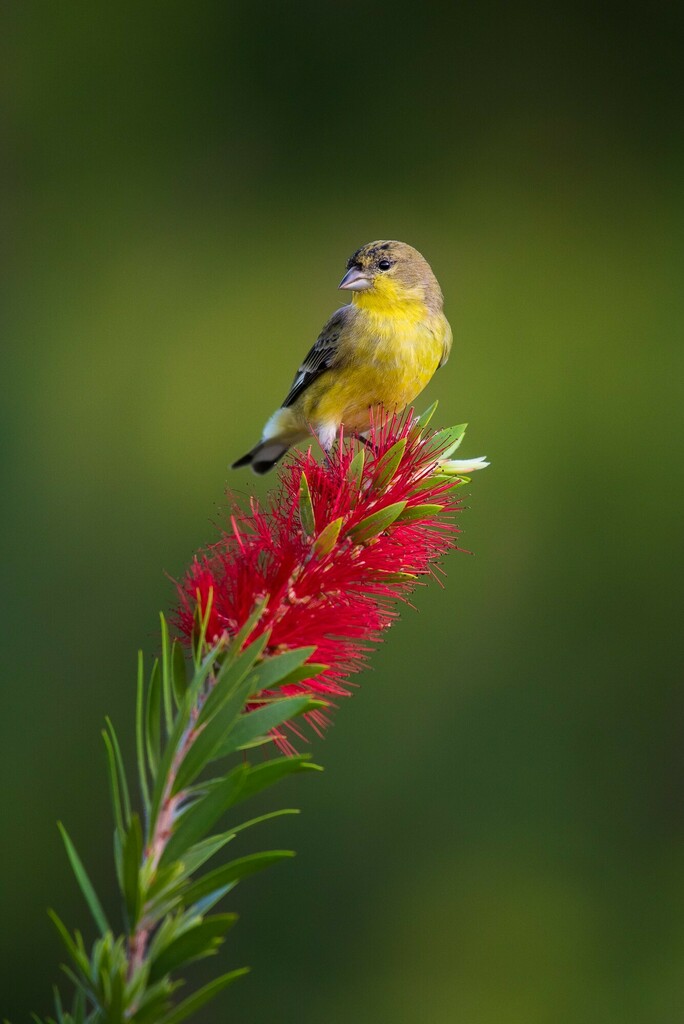
Lesser Goldfinch
Photo © Adam Jackson
Photo © Adam Jackson — CC0 1.0 — Source: iNaturalist photo #339456026Identification
The lesser goldfinch is the smallest North American finch in the genus Spinus, measuring just 9–12 cm in length and weighing 8–11.5 g. Males are unmistakable, with bright yellow underparts, prominent white patches on the wings and outer tail feathers, and a black forehead. The key distinguishing feature across their range is the color of the back: males vary from solid black in the eastern Rocky Mountains and Texas southward, to medium or bright green in western North America. Females and immatures are more subtle, with grayish olive-green upperparts, yellowish underparts, minimal white on the wings, and little to no white on the tail. Both sexes have the typical small, pointed finch bill. In flight, listen for a distinctive harsh chig chig chig call, or a high-pitched, drawn-out whistle that rises or falls in pitch.
The lesser goldfinch's small size, combined with the females' lack of the black forehead and their plain upperparts without white or yellow, can create confusion with New World warblers—though the finch bill should settle any doubt. The geographic variation in male plumage is striking enough that five subspecies are recognized, though these may be better understood as color morphs or geographic forms along a continuum.
Range & Habitat
This species is native to the Americas, ranging from the southwestern United States—as far north as the Columbia River in Washington—south through Mexico to Venezuela and Peru. Populations in the U.S. are partly migratory, vacating some northern areas seasonally, while others remain year-round residents. In recent decades, the lesser goldfinch has rapidly expanded as a year-round resident across much of the Pacific Northwest. The greatest diversity of male plumage forms occurs in Colorado and New Mexico, where both dark-backed and green-backed birds occur regularly.
The species shows remarkable habitat flexibility, occurring in almost any landscape with trees or shrubs except dense forest. It is common and conspicuous in many regions, frequently visiting suburban gardens and parks. Lesser goldfinches are particularly attracted to areas with thistles and other seed-bearing plants, and have become regular feeder visitors in the American Southwest.
Behaviour & Diet
Lesser goldfinches are highly social, often occurring in flocks or loose associations. They are vocal birds with a repertoire that includes their characteristic harsh chig chig chig calls and a distinctive high-pitched, drawn-out whistle. Their song is a prolonged warble or twitter, more phrased than that of the related American goldfinch and often incorporating imitations of other bird species. In flight, they display the undulating, bouncing pattern typical of goldfinches, frequently calling as they move.
As finches, they are seed-eaters, with a preference for small seeds from thistles and other wild plants. This diet makes them particularly attracted to thistle feeders and seed-bearing vegetation in gardens and parks, where they can become abundant visitors.
Best Time & Places to See It
The lesser goldfinch is present year-round throughout much of Mexico and Central America and in expanding areas of the southwestern United States. In the northern parts of its range, such as the Pacific Northwest, the best viewing season is becoming increasingly flexible as populations establish year-round residency, though seasonal abundance may still fluctuate. The species is common and conspicuous in suitable habitat, making it relatively easy to locate.
Target open woodlands, scrubland, gardens, and parks with scattered trees or shrubs. In the Southwest, suburban areas and gardens with native vegetation or feeders offer reliable sightings. Areas of mixed oak woodland and chaparral are particularly productive. Flocks are often observed moving through open country or visiting seed-bearing plants, especially thistles.
Photography Tips
The lesser goldfinch's small size and acrobatic behavior demand a fast shutter speed (at least 1/1000th second) and patience. Males are strikingly patterned and photograph well in good light; seek backlighting or side-lighting to emphasize the bright yellow underparts and white wing and tail markings. The color variation between green-backed and black-backed males offers compelling compositional opportunities, particularly if you can capture both morphs together.
Feed stations attract them reliably in the Southwest, allowing for close-range photography. Early morning light is ideal for revealing the subtle plumage details of females and immatures. Their undulating flight and constant vocalizations make them active subjects; focus on perched birds for sharpness, then anticipate takeoff for flight shots. Frame the distinctive black forehead and facial pattern of males prominently to showcase their identifying features.
Arches National Park
Baru Volcano National Park
Bear River Migratory Bird Refuge
Big Bend National Park
Bitter Lake National Wildlife Refuge
Black Canyon of the Gunnison National Park
Bosque del Apache National Wildlife Refuge
Braulio Carrillo National Park
Bryce Canyon National Park
Nothing matches these filters.
No community photos yet. Log in to add the first one.
No community observations of this species yet.