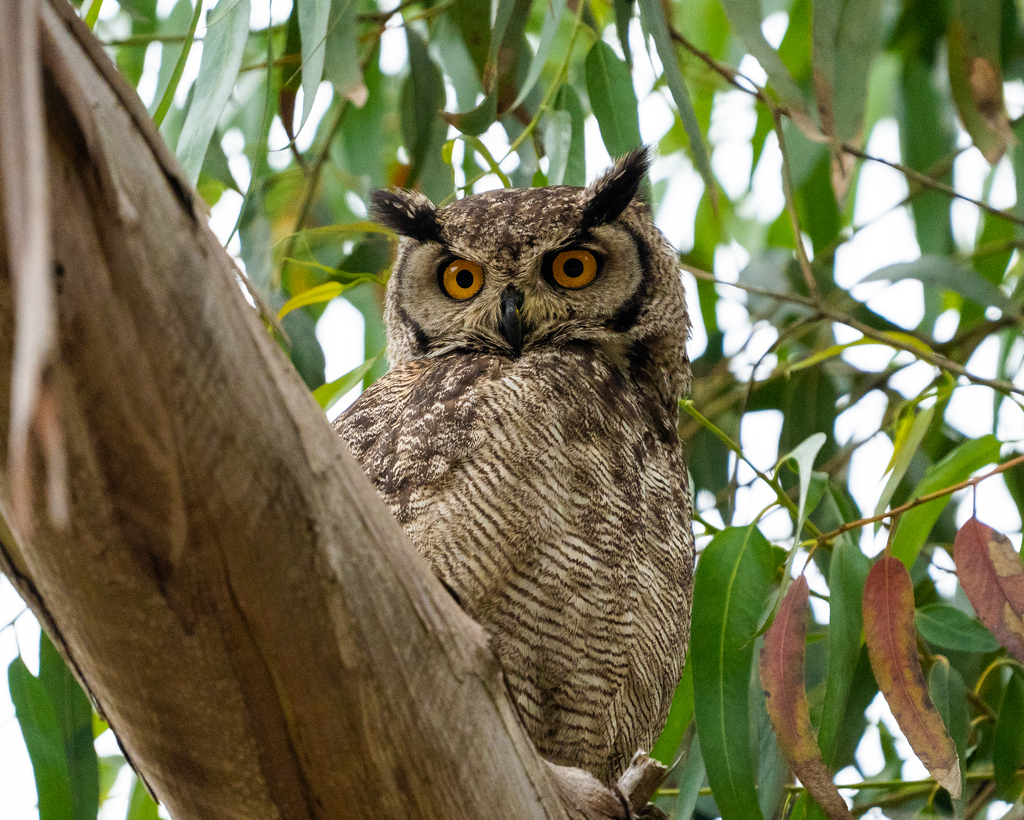
Lesser Horned Owl
Photo © Nicolás Villaseca Merino
Photo © Nicolás Villaseca Merino — CC BY-SA 4.0 — Source: iNaturalist photo #434983081Identification
The lesser horned owl is a large South American owl measuring about 45 centimetres (18 inches) in length, with birds from the northern parts of its range being noticeably larger than their southern counterparts. Its most distinctive features are the prominent ear-like tufts on its head and broad wings, which give it a powerful silhouette in flight. The plumage is predominantly grey-brown but varies considerably between individuals, with pale underparts marked by narrow grey-brown bars and dark blotches across the breast. Look for the striking black border framing the facial disc and the white stripes above its penetrating yellow eyes.
Confusion with the great horned owl is possible, but the lesser horned owl is noticeably smaller, with weaker feet and bill, narrower barring on the underparts, and shorter ear-tufts. Once you hear the distinctive call—a deep double-note followed by a loud, vibrating note—identification becomes straightforward. Indigenous peoples know this owl well and named it "tucúquere," an onomatopoetic reference to its haunting vocalization.
Range & Habitat
This species is endemic to southern South America, with a range extending from central Peru and western Bolivia southward through the length of Chile and western Argentina, reaching as far as the windswept landscapes of Tierra del Fuego. The lesser horned owl is highly adaptable, inhabiting open forests, scrubland, farmland, and grassland across this vast geographic spread. Its presence across such diverse terrain and latitude makes it one of the region's most widespread large raptors.
Behaviour & Diet
The lesser horned owl is primarily nocturnal, hunting over open country under cover of darkness. Rodents form the foundation of its diet, but this opportunistic predator also takes other mammals, birds, reptiles, and insects depending on availability. Its hunting strategy exploits the open habitats it favours, allowing it to spot prey moving across exposed ground.
Breeding birds nest on cliffs or crevices between rocks, taking advantage of elevated, protected sites. The female typically lays two or three eggs and undertakes all incubation duties while the male provides sustenance, delivering food throughout this demanding period. This parental investment strategy is typical of large owls and ensures the female maintains optimal condition for egg production and chick-rearing.
Best Time & Places to See It
Your best opportunities to encounter a lesser horned owl are in open, sparsely vegetated landscapes throughout its range in Peru, Bolivia, Chile, and Argentina, particularly in western regions. Night-time is when this species is most active, making nocturnal excursions essential for sightings. Listening for the distinctive deep hooting call after dark will often lead you to this elusive owl. The species' use of cliff faces and rocky outcrops as nesting and roosting sites means searching rocky terrain during daylight may reveal roosting birds.
Photography Tips
Photographing the lesser horned owl requires patience and nocturnal capabilities. If you locate a roosting bird during the day, approach carefully to avoid disturbance and use telephoto lenses to maintain distance. For night photography, headlamp spotting combined with infrared or thermal imaging equipment offers the best chance of capturing this nocturnal hunter. The owl's striking facial disc and ear-tufts are particularly photogenic, so frame your shots to emphasize these features when conditions allow.
Huascarán National Park
Independencia, Peru
+201 birds+5 mammals
Where granite peaks pierce the Andean sky above 6,000 metres, Huascarán National Park sprawls across more than 11,500 square kilometres of Peru's Cordillera Blanca, a landscape…
VIEW NATIONAL PARKTorres del Paine National Park
Torres del Paine, Chile
+143 birds+10 mammals
Where granite spires pierce the Patagonian sky, Torres del Paine commands one of South America's most dramatic landscapes. Across 4,106 square kilometres of southern Chile, jagged…
VIEW NATIONAL PARKLaja National Park Lagoon
Antuco, Chile
+123 birds+1 mammals
Where the Andes descend into the Biobío Region's temperate forests, a vast lagoon fills the caldera of the extinct Antuco volcano, cradled by steep native woodland…
VIEW NATIONAL PARKPuyehue National Park
Puyehue, Chile
+110 birds+4 mammals
Across the volcanic spine of the Los Lagos Region, where the Andes descend toward temperate rainforest, Puyehue National Park encompasses nearly 2,600 square kilometers of one…
VIEW NATIONAL PARKLauca National Park
Putre, Chile
+139 birds+17 mammals
Where the Andes rise toward the altiplano in Chile's far north, Lauca National Park sprawls across more than 3,000 square kilometres of some of South America's…
VIEW NATIONAL PARKCerro Castillo National Park
Coyhaique, Chile
+89 birds+3 mammals
Granite peaks and windswept steppe converge across this vast Patagonian landscape, where the Andes' eastern flank drops into terrain sculpted by ice age glaciers and relentless…
VIEW NATIONAL PARKPatagonia National Park
Cochrane, Chile
+133 birds+8 mammals
Where the Andes meet the Patagonian steppe, vast grasslands and shrublands sweep across rolling terrain carved by ancient glaciation, their contours softened by distance and dramatic…
VIEW NATIONAL PARKReserva Nacional las Vicuñas
Putre, Chile
+87 birds+6 mammals
High desert plateaus interlace with volcanic ridges across this 4,204-square-kilometre expanse at the border between Chile and Bolivia, where altitudes exceed 3,500 metres and the climate…
VIEW NATIONAL PARKReserva Nacional Magallanes
Punta Arenas, Chile
+78 birds+2 mammals
Where windswept steppe meets sub-Antarctic forest near the southern tip of continental South America, Reserva Nacional Magallanes unfolds across roughly 352 square kilometres of profound ecological…
VIEW NATIONAL PARKParque Provincial Península de Magallanes
Argentina
+125 birds+4 mammals
Granite peaks and windswept steppe converge across this 415-square-kilometre peninsula jutting into the cold Atlantic waters of southern Patagonia, where the Magallanes landscape embodies the raw,…
VIEW NATIONAL PARKMonte León National Park
Argentina
+100 birds+4 mammals
Where the Patagonian steppe meets the Atlantic, Monte León National Park protects a landscape of windswept coastal cliffs, rocky outcrops, and semi-arid grassland spanning over 1,200…
VIEW NATIONAL PARKLos Glaciares National Park
Argentina
+121 birds+3 mammals
Where granite peaks and sprawling ice fields dominate the landscape, Los Glaciares National Park encompasses over ten thousand square kilometres of Patagonian wilderness in southern Argentina.…
VIEW NATIONAL PARKPerito Moreno National Park
Argentina
+78 birds
Where the Patagonian steppe descends into a landscape carved by ancient ice, Perito Moreno National Park sprawls across nearly 1,590 square kilometres of some of South…
VIEW NATIONAL PARKLos Cardones National Park
Argentina
+193 birds+6 mammals
Where the Andes descend into northwestern Argentina, Los Cardones National Park sprawls across nearly 1,200 square kilometres of one of South America's most distinctive high-altitude desert…
VIEW NATIONAL PARKLanín National Park
Argentina
+128 birds+7 mammals
Where the volcanic spine of the Andes plunges into Patagonian steppe, Lanín National Park sprawls across nearly 4,700 square kilometers of one of Argentina's most visually…
VIEW NATIONAL PARKLago Puelo National Park
Argentina
+109 birds+1 mammals
Where temperate forests descend to crystalline waters in the foothills of the Andes, Lago Puelo National Park sprawls across nearly 300 square kilometers of pristine wilderness…
VIEW NATIONAL PARKNo community photos yet. Log in to add the first one.
No community observations of this species yet.