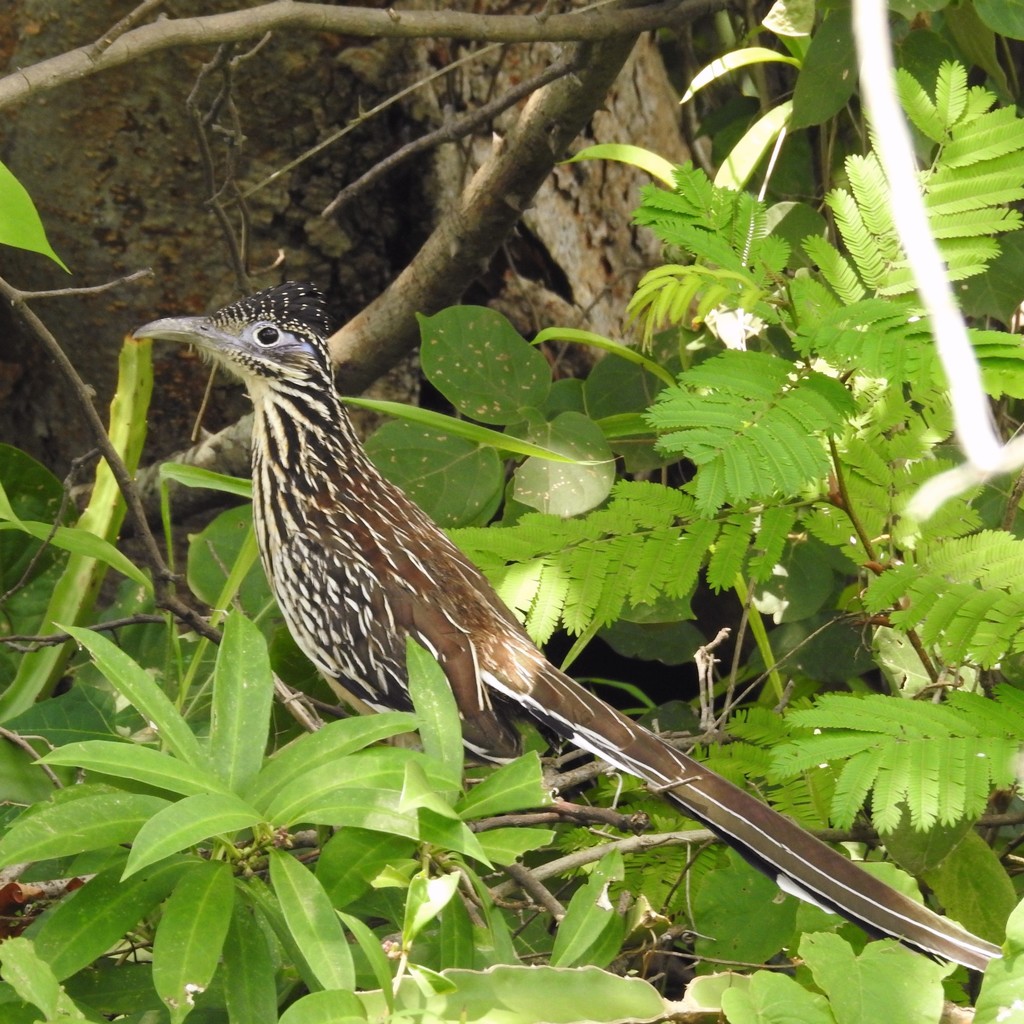
Lesser Roadrunner
Photo © Matteo Cassella
Photo © Matteo Cassella — CC BY-SA 4.0 — Source: iNaturalist #93006054Identification
The lesser roadrunner is a slender, long-legged bird measuring 46–51 cm in length, with the tail accounting for about 24 cm. Males weigh 174–207 grams, females 162–192 grams. The crown, crest, and neck are black with a bronze glow and small light brown spots, while the back is dark brown with light speckles, lightening to maroon towards the rump. The breast is white, and the tail feathers are black with a dark purple lustre. The eye ring is pale lavender to bright blue, with a narrow band behind the eye turning bright red on the neck. The upper beak is gray and the lower beak bluish-gray.
Compared to its larger relative, the greater roadrunner, the lesser roadrunner is noticeably smaller with a less streaked throat and chest, brownish tones on the rump and outer wings, yellowish undersides, and a significantly shorter bill. Young birds resemble adults but have ocher-colored lines and duller eye-ring skin.
Range & Habitat
The lesser roadrunner is found throughout Mesoamerica, occurring in arid lowlands up to 3,000 meters in altitude. Its breeding range extends from southwestern Mexico northward into the western Sierra Madre Occidental, through northern Central America, and disjunctly into the northern Yucatán Peninsula. It overlaps with the greater roadrunner in a small area spanning Sonora, Sinaloa, Jalisco, and Michoacán.
This species favors open ground with scrub and thorny bushes, and readily adapts to cultivated lands including henequen and corn fields. It also inhabits semi-open areas above the treeline on stratovolcanoes such as Conchagua, San Miguel, Santa Ana, and San Salvador.
Behaviour & Diet
The lesser roadrunner is a ground-dweller, spending most of its time running along open areas, roads, and under cover at speeds up to 20 mph, though it is capable of limited flight and will perch in bushes or low trees. Like other roadrunners, it basking behavior is distinctive: early in the morning, the bird positions itself on a fence post or bush with tail cocked and wings drooped, turning its back to the sun to expose black skin on its scapular feathers, which absorb heat. Its call is a series of soft cooing notes, about one per second, descending in pitch over three to seven repetitions.
An opportunistic feeder, the lesser roadrunner hunts seeds, fruit, small reptiles, and frogs. It forages along roadsides for large insects and roadkill, with grasshoppers and caterpillars comprising a significant portion of its diet.
Best Time & Places to See It
The breeding season runs from April to July in Mexico and extends into August in El Salvador, making these months ideal for observation. The species is best found in the arid lowlands and open scrublands of Mesoamerica, particularly in southwestern Mexico, northern Central America, and the Yucatán Peninsula. Look for birds in open ground areas with scattered brush, along roadsides, and in semi-open volcanic regions.
Photography Tips
Photograph lesser roadrunners in early morning light when they are basking on exposed perches such as fence posts or low bushes—this behavior offers excellent opportunities to capture the striking eye-ring, colorful neck patch, and distinctive posture. The bird's preference for running along roadsides and open ground makes it relatively accessible for photography, though patience and a telephoto lens are recommended to avoid disturbance. Focus on capturing the bird's characteristic long tail, slender profile, and the subtle bronze and maroon tones of its plumage.
Dzibilchantún National Park
Barcelona, Mexico
+144 birds+2 mammals
Across the limestone plains of Yucatán, where cenotes pierce the bedrock and tropical forest clings to shallow soils, lies Dzibilchantún—a modest yet ecologically vital national park…
VIEW NATIONAL PARKLagunas de Montebello National Park
Laguna de Montebello, Mexico
+360 birds+2 mammals
Where turquoise lagoons pierce the limestone plateau of southeastern Chiapas, the Lagunas de Montebello National Park unfolds across roughly 174 square kilometers of spectral water and…
VIEW NATIONAL PARKSian Ka’an
Chunyaxché, Mexico
+350 birds+16 mammals
Where the Yucatán Peninsula dissolves into wetland and mangrove, a vast mosaic of forest, lagoon, and coastal margin creates one of Mexico's most biodiverse strongholds. Across…
VIEW BIOSPHERE RESERVENo community photos yet. Log in to add the first one.
No community observations of this species yet.