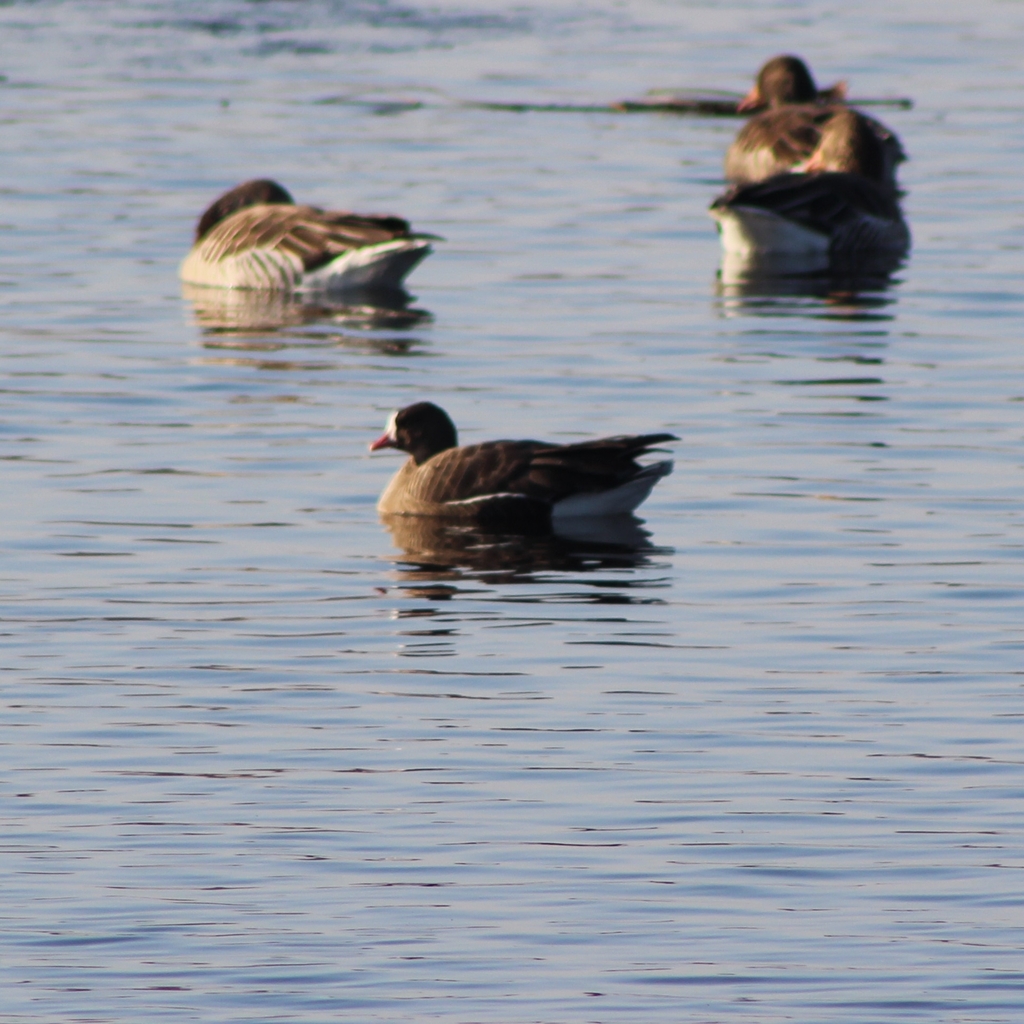
Lesser White-fronted Goose
Photo © bart klaessens
Photo © bart klaessens — CC BY 4.0 — Source: iNaturalist #192873815Identification
The lesser white-fronted goose is a compact waterfowl, noticeably smaller than its close relative the greater white-fronted goose, measuring just 53–66 cm in length with a wingspan of 120–135 cm—roughly the size of a mallard. Both white-fronted goose species are distinguished from greylags by their bright orange legs and mouse-coloured upper wing-coverts, in contrast to the greylag's flesh-coloured bill and bluish-grey wing-coverts. The key identifying features include a very conspicuous white face with broad black bars crossing the belly. Adult lesser white-fronted geese are additionally characterized by an obvious yellow eye-ring and a white facial blaze that extends up to the crown.
Range & Habitat
The lesser white-fronted goose breeds in the northernmost Palearctic but is a scarce breeder in Europe. A genetically distinct Fennoscandian population breeds in northern Norway and northern Sweden, following separate migration routes. The Norwegian population overwinters in Greece, Bulgaria, and Turkey, with a major stopover at Hortobágy National Park in Hungary, where birds may spend up to two months in autumn and one month during spring migration. The Swedish population follows a western migration route, wintering in the Netherlands and Germany. The species winters further south in Europe more broadly and is a rare winter vagrant to Great Britain and India. Historically, individual birds appeared regularly at WWT Slimbridge in Gloucestershire, England, though modern records there are far less frequent due to population decline.
Behaviour & Diet
The lesser white-fronted goose shares many characteristics with its larger relative, the greater white-fronted goose. As a migratory species, it undertakes lengthy seasonal journeys between its northern breeding grounds and southern wintering areas, relying on critical stopover sites along its migration routes. The species is highly social, travelling in flocks during migration and overwintering periods. The Fennoscandian population's reliance on specific stopover sites such as Hortobágy demonstrates the importance of wetland habitats throughout its annual cycle.
Best Time & Places to See It
The lesser white-fronted goose is an endangered species, making sightings challenging for most travellers. Hortobágy National Park in Hungary represents the most reliable location, particularly during autumn and spring migration periods when the Fennoscandian population passes through. The park serves as a major stopover site where birds congregate for extended periods. Winter sightings in the Netherlands and Germany offer additional opportunities for the Swedish population, while the Norwegian population winters in Greece, Bulgaria, and Turkey. Historical records from WWT Slimbridge in England suggest it was once a site for encountering this species, though modern sightings there are now rare. Note that summer birds or individuals among feral geese populations are likely of captive origin rather than wild birds.
Photography Tips
The lesser white-fronted goose's small size and distinctive markings offer rewarding photographic subjects for patient observers at key migration sites. The bright orange legs, conspicuous white face, black belly bars, and yellow eye-ring provide excellent diagnostic features to capture in photographs. Visiting during migration periods at stopover sites like Hortobágy increases the probability of encountering these birds in concentrations. Early morning light is ideal for highlighting the contrast between the white facial blaze and darker plumage. A telephoto lens is recommended given the species' wariness and the distances often required for observation at wetland sites.
Lower Oder Valley National Park
Schwedt/Oder, Germany
+216 birds+21 mammals
Where the Oder River winds through northeastern Brandenburg, the Lower Oder Valley National Park protects one of Central Europe's most vital wetland systems. This sprawling mosaic…
VIEW NATIONAL PARKSchleswig-Holsteinisches Wattenmeer National Park
Germany
+378 birds+49 mammals
Where the North Sea ebbs and flows across a vast expanse of exposed mud and sand, the Schleswig-Holsteinisches Wattenmeer National Park reveals one of Europe's most…
VIEW NATIONAL PARKDanube Delta Biosphere Reserve
Tulcea, Romania
+277 birds+27 mammals
Where the Danube surrenders to the Black Sea, a vast labyrinth of channels, reed beds, and freshwater lakes sprawls across nearly 13,400 square kilometers of eastern…
VIEW NATIONAL PARKHortobágy National Park
Hortobágy, Hungary
+260 birds+17 mammals
Across the North Great Plain of Hungary stretches one of Europe's most expansive semi-natural grassland systems, where horizon-wide vistas of steppe and wetland create a landscape…
VIEW NATIONAL PARKFertő–hanság National Park
Fertőszéplak, Hungary
+246 birds+11 mammals
Where the Austro-Hungarian plains meet the foothills of Western Transdanubia, nearly 900 square kilometres of wetland, reed bed, and mixed woodland form one of Central Europe's…
VIEW NATIONAL PARKSt. Paul Island
Saint Paul, United States
+255 birds+8 mammals
Windswept tundra rolls across this remote Pribilof island, where volcanic basalt cliffs plunge into the Bering Sea and fog rolls in thick enough to erase the…
VIEW PROTECTED LANDSCAPELosiny Ostrov National Park
Balashikhinsky District, Russia
+173 birds+20 mammals
Across the forested plateaus of Moscow Oblast, where the Losinka River winds through mixed woodland and marshy clearings, lies a national park that captures the ecological…
VIEW NATIONAL PARKCirceo National Park
Italy
+232 birds+6 mammals
Where limestone headlands plunge toward the Tyrrhenian Sea, Circeo National Park preserves a rare mosaic of Mediterranean coastal habitats that few Italian reserves can match. The…
VIEW NATIONAL PARKBiebrza National Park
Goniądz, Poland
+242 birds+33 mammals
Where the Narew River sprawls across northeastern Poland's flatlands, Biebrza National Park unfolds as one of Europe's largest and most ecologically vital wetland complexes. Encompassing roughly…
VIEW NATIONAL PARKKerkini Lake National Park
Serres, Greece
+291 birds+18 mammals
Where the Strymon River widens into a sprawling freshwater lake hemmed by the Rhodope Mountains, Kerkini National Park unfolds across northern Greece as one of southeastern…
VIEW NATIONAL PARKYancheng National Nature Reserve
Yancheng, China
+208 birds+4 mammals
Where the East China Sea's tidal rhythms sculpt the Jiangsu coast, Yancheng National Nature Reserve sprawls across one of Asia's most dynamic wetland complexes. This vast…
VIEW NATURE RESERVEPoyang Lake National Nature Reserve
Shangrao, China
+270 birds+7 mammals
Where the Yangtze River's massive floodplain spreads across central China, Poyang Lake National Nature Reserve encompasses one of the continent's most dynamic and water-rich wetland systems.…
VIEW NATURE RESERVENo community photos yet. Log in to add the first one.
No community observations of this species yet.