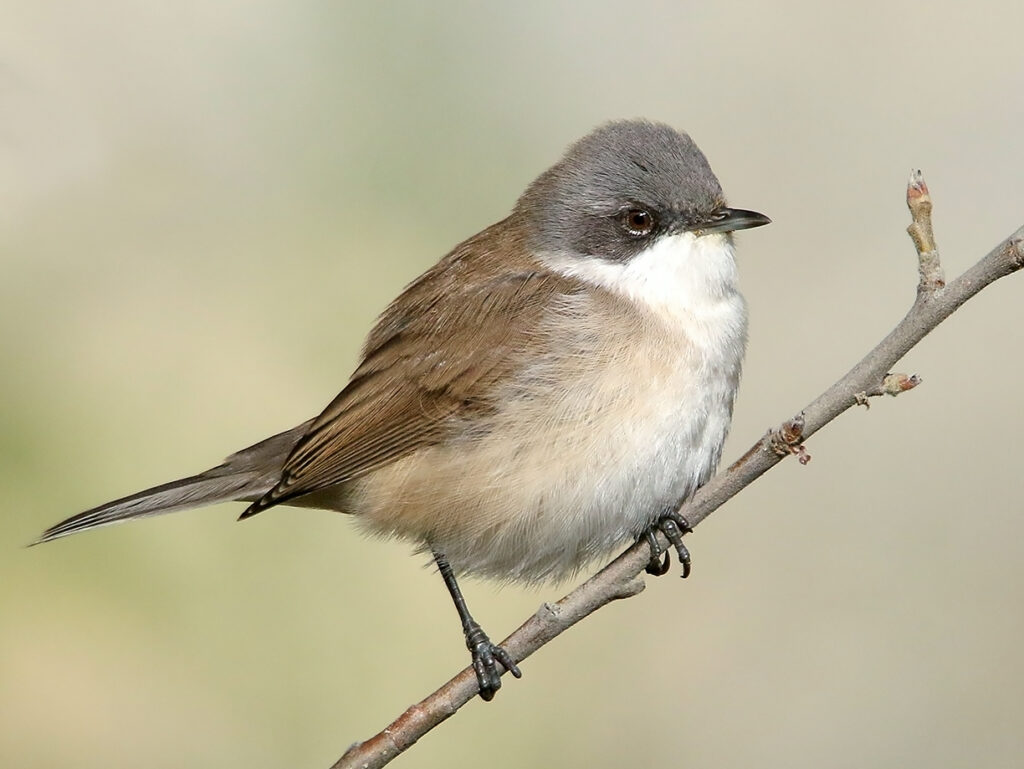
Lesser Whitethroat
Photo © Imran Shah from Islamabad, Pakistan
Photo © Imran Shah from Islamabad, Pakistan — CC BY-SA 4.0 — Source: Wikimedia CommonsIdentification
The lesser whitethroat is a small warbler with distinctive markings that make it relatively straightforward to identify in the field. It features a grey back, whitish underparts, and a grey head marked by a striking darker "bandit mask" through the eyes, contrasting with its white throat. Unlike the closely-named common whitethroat, this species lacks chestnut wings and has a more uniform head-face colouration. The sexes are almost identical, which is unusual among sylviid warblers. Being slightly smaller than the common whitethroat, it requires careful observation to distinguish from its larger relative.
The song is a useful identification tool for those who hear it: a fast and rattling sequence of tet or che calls, quite distinct from the scolding song of the common whitethroat. This distinctive vocal signature can be invaluable when spotting the bird in dense vegetation where visual identification may be challenging.
Range & Habitat
The lesser whitethroat is a common and widespread breeder across temperate Europe, except in the southwest, and throughout the western and central Palearctic. This strongly migratory species winters in Africa just south of the Sahara, as well as in Arabia and India, undertaking impressive seasonal journeys between its breeding and wintering grounds.
This warbler favours fairly open country and cultivated areas that provide large bushes suitable for nesting alongside scattered trees. It builds its nest low in shrubs or brambles, typically laying between three and seven eggs per breeding season.
Behaviour & Diet
Like most warblers, the lesser whitethroat is primarily insectivorous, actively foraging for invertebrate prey among vegetation. However, it is not exclusively an insect-eater; it will opportunistically take berries and other soft fruits, particularly outside the breeding season or when insects are scarce.
The species is characterised by its strong migratory behaviour, with populations undertaking long-distance journeys between their European breeding grounds and African and Asian wintering areas. This makes them seasonal visitors to many parts of their range.
Best Time & Places to See It
The best opportunities to observe lesser whitethroats occur during the breeding season in temperate Europe, where they occupy open country and cultivated landscapes with suitable scrub and trees. As a strongly migratory species, timing is crucial—birds arrive at their breeding grounds in spring and depart in autumn for their wintering grounds in Africa, Arabia and India.
Photography Tips
Photographing this small warbler requires patience and attention to habitat. Look for birds in open country with scattered bushes and trees, particularly during early morning when they are most active and vocal. The distinctive dark "bandit mask" and white throat provide excellent subjects for close-up photography if you can get near enough. The bird's preference for low vegetation in brambles and shrubs means staying alert at eye level or slightly below. Using the distinctive rattling call as an aid to location can help you position yourself for better photographic opportunities.
Åsnens National Park
Bannau Brycheiniog National Park
Bavarian Forest National Park
Dartmoor National Park
Dovrefjell-Sunndalsfjella National Park
Eryri National Park
Exmoor National Park
Hamburgisches Wattenmeer National Park
Harz National Park
Nothing matches these filters.
No community photos yet. Log in to add the first one.
No community observations of this species yet.