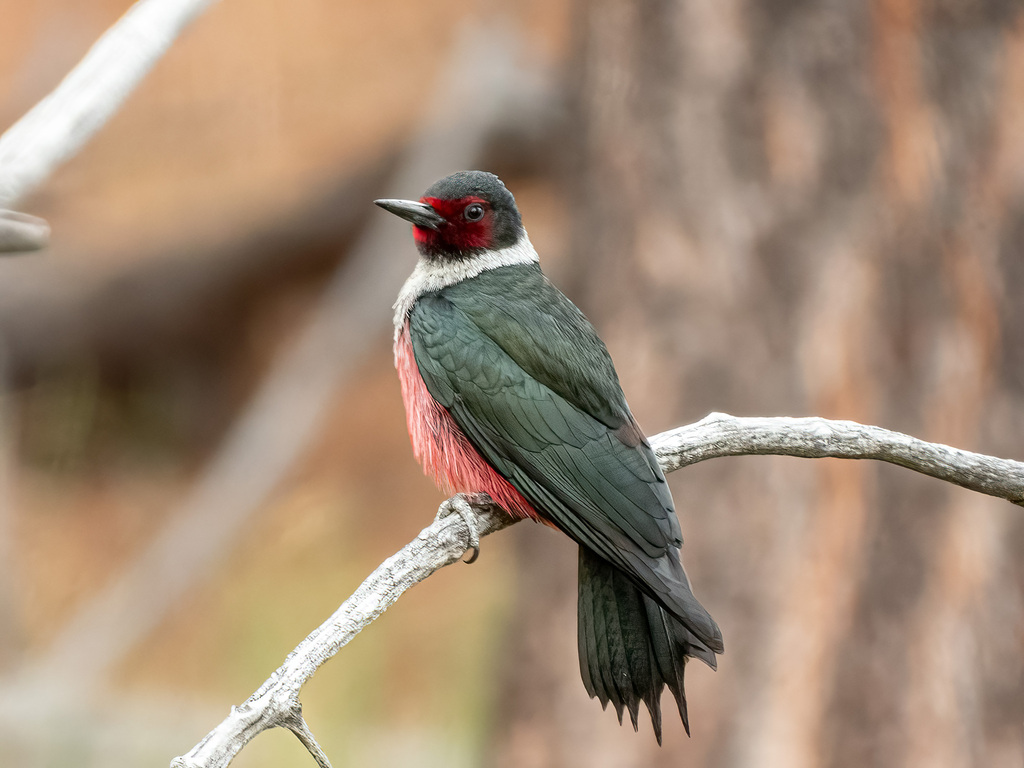
Lewis’s Woodpecker
Photo © Jason Alexander
Photo © Jason Alexander — CC BY 4.0 — Source: iNaturalist photo #454113727Identification
Lewis's woodpecker is one of the largest North American woodpeckers, measuring 10–11 inches (26–28 cm) in length with a wingspan of 19–21 inches (49–52 cm). It has distinctive plumage: a blackish-green back, black rump, gray collar and upper breast, pinkish belly, and striking red face. The wings are notably broader than other woodpeckers, giving the bird a stockier appearance.
In flight, Lewis's woodpecker moves with an unhurried, crow-like gait using slow but steady wing flaps—quite different from the rapid, jerky flight of typical woodpeckers. Its calls are notably harsh compared to other woodpecker species, with a varied repertoire of phrases.
Range & Habitat
This species is locally common across the northwestern and western United States, ranging from the Pacific coast to the central states. It inhabits open pine woodlands and scattered tree landscapes with snags, preferring exposed perches rather than dense forest cover. In summer, populations extend north into Canada, while winter birds range south to Southern California and the U.S.–Mexico border.
Lewis's woodpecker has also been documented in five Midwestern states—South Dakota, Michigan, Illinois, Minnesota, and Wisconsin—as well as California, Oregon, Washington, Idaho, Montana, Nevada, Colorado, New Mexico, and Utah. Its nomadic lifestyle makes migration patterns difficult to predict.
Behaviour & Diet
Lewis's woodpecker exhibits remarkably un-woodpecker-like feeding behavior. While it does bore into trees with its chisel-like bill to extract insects, it also catches insects in mid-air through aerial hawking—a habit shared with only a few other species such as acorn woodpeckers and red-headed woodpeckers. It supplements its insect diet with berries and nuts, often storing shelled nuts in tree cavities for winter consumption.
This species is notably gregarious and feeds at open bird feeders, sometimes displaying aggression toward other birds. Breeding pairs may be lifelong mates, returning to the same nest cavity year after year. Females lay 5–9 plain white eggs, with both parents sharing incubation duties. Young fledge four to five weeks after hatching.
Best Time & Places to See It
Lewis's woodpecker is best found in open pine woodlands and areas with scattered trees and snags throughout the western United States. Look for them perching openly rather than hidden in dense canopy. Summer offers the best opportunity to find them in northern regions, including parts of Canada, while winter birding in Southern California and near the U.S.–Mexico border may yield sightings. Check documented sightings in states like Montana, Oregon, Washington, and Colorado.
Photography Tips
Photograph this species in open habitats where it perches visibly on snags and bare branches. The bird's distinctive red face, gray collar, and pinkish underparts are best captured in good natural light. Its slower, crow-like flight offers better photographic opportunities than faster-flying woodpeckers, particularly when birds are hawking for insects in open air.
Alaska Maritime National Wildlife Refuge
Arches National Park
Badlands National Park
Banff National Park
Bear River Migratory Bird Refuge
Big Bend National Park
Black Canyon of the Gunnison National Park
Bosque del Apache National Wildlife Refuge
Bryce Canyon National Park
Nothing matches these filters.
No community photos yet. Log in to add the first one.
No community observations of this species yet.