Light-vented Bulbul
Photo © Peggy Newman
Photo © Peggy Newman — CC BY 4.0 — Source: iNaturalist #241791816Identification
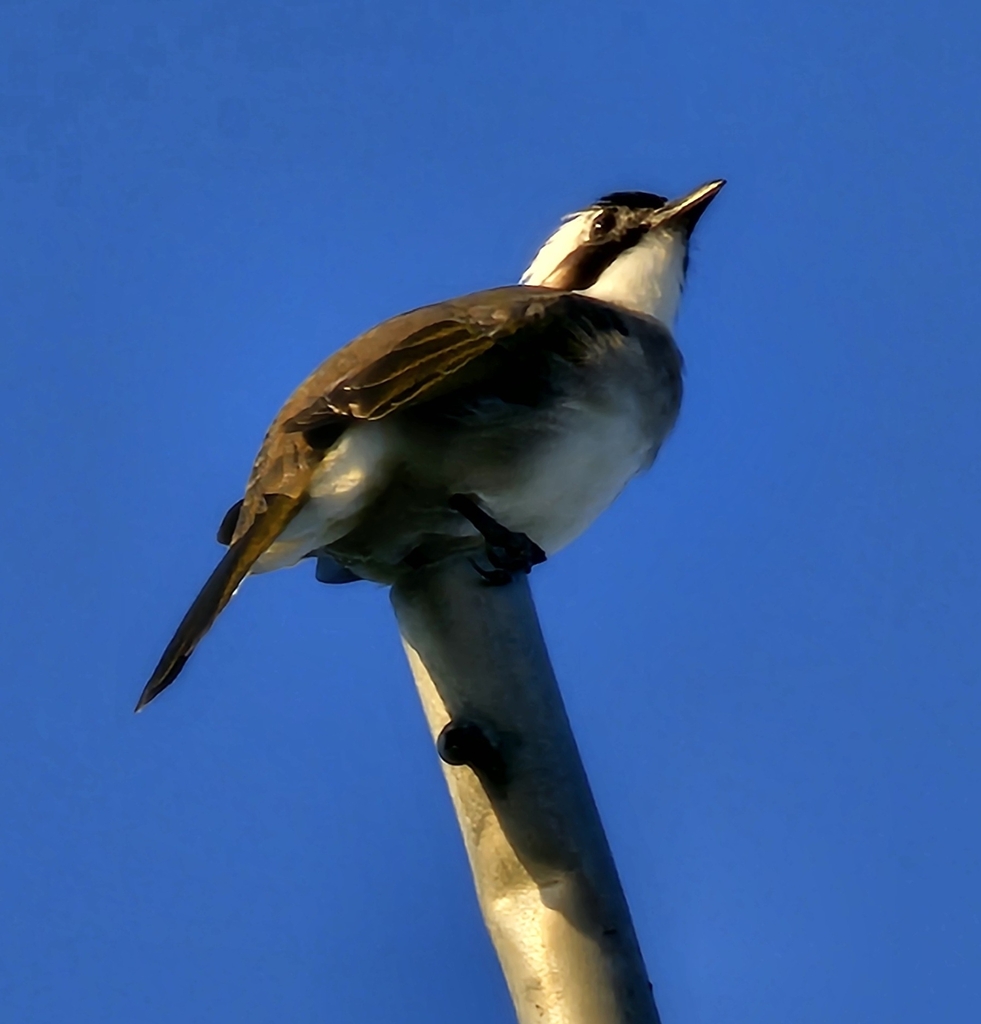
The light-vented bulbul is a compact songbird measuring around 19 cm (7.5 in) in length. Its most striking features are the bold black crown and moustachial stripe contrasting sharply with white patches on the nape and sides of the head, and white plumage extending from the eyes to the back of the head. The upperparts are greyish-brown mixed with olive, while the wings and tail are brown fringed with bright olive. The underparts are whitish with a pale brown breastband. This species is highly vocal, singing brightly and variably with a distinctive cha-ko-lee...cha-ko-lee... sound.
Range & Habitat
The light-vented bulbul, also known as the Chinese bulbul, is found throughout Asia. Four subspecies are recognized, distributed across central and eastern China, southeastern China and northern Vietnam, Taiwan, and the southern Ryukyu Islands of Japan. This common songbird favors lightly wooded habitats and is frequently seen in towns, suburbs, and urban parks across its range. In Hong Kong, it is abundant in lightly wooded areas, cultivated land, and shrubland, though the red-whiskered bulbul is the more common bulbul of urban parks there. In Taiwan, however, the light-vented bulbul dominates all these habitat types, except along the east coast where it is replaced by Styan's bulbul. It is particularly abundant in Shanghai, where it ranks as perhaps the third most common bird after tree sparrows and spotted doves.
Behaviour & Diet
The light-vented bulbul is a notably noisy and vocal species, singing brightly with considerable variation. Its characteristic call is a distinctive cha-ko-lee...cha-ko-lee... sound. As a bulbul, this species feeds primarily on fruit and insects, though specific dietary details are not extensively documented in available sources.
Best Time & Places to See It
The light-vented bulbul is a year-round resident throughout its range and can be encountered reliably in suitable habitats. Urban parks, gardens, and lightly wooded areas provide the best opportunities for sightings. Shanghai offers exceptional viewing opportunities given the species' abundance there, while Taiwan and Hong Kong are also reliable locations. The species' preference for accessible suburban and urban habitats makes it one of the more easily observed bulbuls for visitors to East Asia.
Photography Tips
The bold head pattern of the light-vented bulbul—its distinctive black crown and moustachial stripe contrasting with white facial patches—provides excellent photographic subjects. The species' active, vocal nature and preference for open perches in parks and gardens makes photography relatively straightforward. The olive fringes on the wings and tail catch light attractively, so position yourself to take advantage of side or backlighting. Early morning visits to urban parks and gardens will provide the best activity levels and lighting conditions for photography.
Wulingyuan
Jundiping, China
+97 birds+3 mammals
Sandstone peaks erupting from forested valleys define this sprawling 993-square-kilometre national park in Hunan Province, where vertical cliffs rise dramatically above lush subtropical woodland. The landscape—a…
VIEW NATURAL MONUMENTGiant Panda National Park
Mianyang, China
+447 birds+47 mammals
Where the eastern slopes of China's Sichuan plateau descend into cloud-wrapped valleys, one of Asia's most biodiverse landscapes unfolds across more than 350,000 square kilometres. This…
VIEW NATIONAL PARKMount Nanling Forest Park
Ruyang Forest Farm, China
+179 birds+3 mammals
Granite ridges and weathered peaks rise through a canopy of subtropical montane forest where Ruyang Forest Farm anchors one of southern China's most biodiverse landscapes. Across…
VIEW FOREST & JUNGLEJiuzhai Valley
Jiuzhaigou County, China
+226 birds+7 mammals
Where crystalline alpine streams cascade through limestone gorges and karst terrain rises in dramatic vertical walls, Jiuzhai Valley unfolds across nearly 1,300 square kilometers of southwestern…
VIEW NATURAL MONUMENTHuanglong Scenic and Historic Interest Area
Ngawa Tibetan and Qiang Autonomous Prefecture, China
+194 birds+7 mammals
Across the high plateau of northwestern Sichuan, a geological wonder unfolds where limestone terraces and mineral-rich springs have sculpted one of China's most distinctive natural monuments.…
VIEW NATURAL MONUMENTHainan Tropical Rainforest National Park
Haikou, China
+69 birds+1 mammals
Tropical forests blanket the volcanic slopes of central Hainan, where moisture-laden winds from the South China Sea collide with mountainous terrain to create some of China's…
VIEW NATIONAL PARKWuyishan National Park
Yanshan County, China
+141 birds+2 mammals
Where subtropical monsoon rains sustain a perpetually humid landscape, Wuyishan National Park rises from Fujian's eastern plateau as a realm of forested ridges, cascading streams, and…
VIEW NATIONAL PARKWolong National Nature Reserve
Wenchuan County, China
+333 birds+17 mammals
Where the Qingyi River cuts through the eastern flanks of the Minshan Range, a temperate montane forest cloaks steep valleys in dense canopy that thins dramatically…
VIEW NATURE RESERVEYancheng National Nature Reserve
Yancheng, China
+208 birds+4 mammals
Where the East China Sea's tidal rhythms sculpt the Jiangsu coast, Yancheng National Nature Reserve sprawls across one of Asia's most dynamic wetland complexes. This vast…
VIEW NATURE RESERVEPoyang Lake National Nature Reserve
Shangrao, China
+270 birds+7 mammals
Where the Yangtze River's massive floodplain spreads across central China, Poyang Lake National Nature Reserve encompasses one of the continent's most dynamic and water-rich wetland systems.…
VIEW NATURE RESERVENo community photos yet. Log in to add the first one.
No community observations of this species yet.