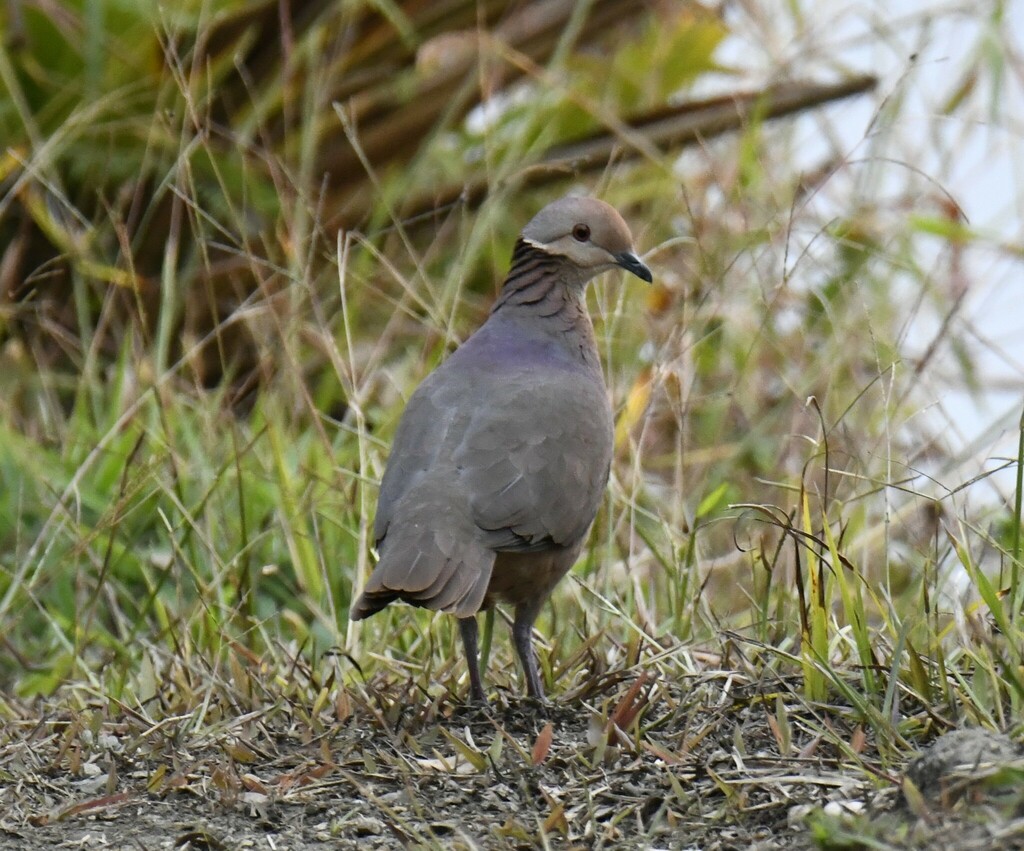
Lined Quail-Dove
Photo © Zac Peterson
Photo © Zac Peterson — CC BY 4.0 — Source: iNaturalist #201652363Identification
The lined quail-dove is a compact forest pigeon measuring 27 to 29 cm in length, weighing between 230 and 284 grams. Males display distinctive plumage featuring a pinkish-buff forehead that darkens to purplish-brown on the crown, with a pale gray arc extending from the eye to the nape. Characteristic dark stripes run from the bill through the eye and along the malar area, while the cheeks are buffy in tone. The mantle is reddish-purple, and the remaining upperparts are reddish-brown with striking purple or bronze-green iridescence on the hindneck. Loose neck feathers create the impression of dark furrows. The breast ranges from pale to brownish-gray with purple sides, while the belly and flanks are buffy-fawn. The bird's striking bare blue eye-ring surrounds an iris that can vary from yellow to orange-red, and its legs and feet are red.
Females are nearly identical to males but possess a subtle brownish tinge to the gray breast. Juveniles are noticeably redder overall with numerous brown and blackish bars throughout their plumage, making them readily distinguishable from adults.
Range & Habitat
The lined quail-dove is found in three main regions: Colombia's Sierra Nevada de Santa Marta and the Colombian Andes; the Venezuelan Andes and coastal mountain ranges; and Trinidad and Tobago. The nominate subspecies inhabits the mountainous regions of Colombia and Venezuela, while the Trinidad and Tobago population represents a distinct subspecies. The species occupies tropical lowland and evergreen montane forests, ranging from sea level to 2,500 meters in elevation, making it accessible to birdwatchers across a variety of forest zones.
Behaviour & Diet
The lined quail-dove is a ground forager, typically moving singly or in pairs as it searches for seeds on the forest floor. The bird's breeding season varies by location: in Colombia, breeding extends from at least April through October, while in Trinidad and Tobago it begins earlier in the year. Nests are constructed as deep cups of small twigs lined with dead leaves, placed in tree forks at heights around 3.7 meters, typically containing two eggs.
The species produces a distinctive vocalization: a single, monotonous low-pitched note described as "whoOOo," with the sound's greatest amplitude in the middle. Remarkably, two birds often sing simultaneously at slightly different pitches, creating a subtle harmonic effect that characterizes their presence in the forest.
Best Time & Places to See It
The breeding season offers the best opportunity to locate this species through its distinctive call. In Colombia and Venezuela's mountain forests, April through October is optimal, while in Trinidad and Tobago, earlier months are recommended. The species is believed to be fairly common within its range, though its forest-floor foraging habits mean it can be challenging to observe despite reasonable abundance. Tropical montane forests from 1,000 to 2,500 meters elevation are particularly productive.
Photography Tips
The lined quail-dove's preference for ground foraging and dense forest understory requires patience and careful positioning. Early morning hours often yield the best light and activity levels. Use the species' distinctive call as a locating tool; once a bird is vocalizing, position yourself quietly to capture images. The striking red eye-ring, iridescent hindneck, and contrasting facial markings are key features to highlight. Be prepared for dim forest conditions by using appropriate camera settings for low-light photography, and remember that ground-level angles will emphasize the bird's terrestrial habits.
Natural Serranía de los Yariguíes National Park
El Carmen de Chucurí, Colombia
+320 birds+3 mammals
Where the northern cordilleras of Colombia rise toward cloud forest, the Serranía de los Yariguíes unfolds across nearly 1,820 square kilometers of some of the most…
VIEW NATIONAL PARKNatural Chingaza National Park
Junín, Colombia
+285 birds+6 mammals
Where the Andes rise above three thousand metres in the Cundinamarca region, high-altitude grasslands and cloud forests converge in a landscape shaped by both geology and…
VIEW NATIONAL PARKNatural Sumapaz National Park
Cubarral, Colombia
+368 birds+1 mammals
Where the Andes descend toward the Amazon basin, the high páramo grasslands of Sumapaz National Park sprawl across more than five thousand square kilometers of Meta…
VIEW NATIONAL PARKEl Tamá National Park
Toledo, Colombia
+435 birds
Where the Andes descend toward the Caribbean coastal lowlands of northern Colombia, El Tamá National Park sprawls across nearly 3,800 square kilometres of montane forest, cloud…
VIEW NATIONAL PARKNo community photos yet. Log in to add the first one.
No community observations of this species yet.