Little Auk
Photo © Christoph Moning
Photo © Christoph Moning — CC BY 4.0 — Source: iNaturalist photo #101346043Identification
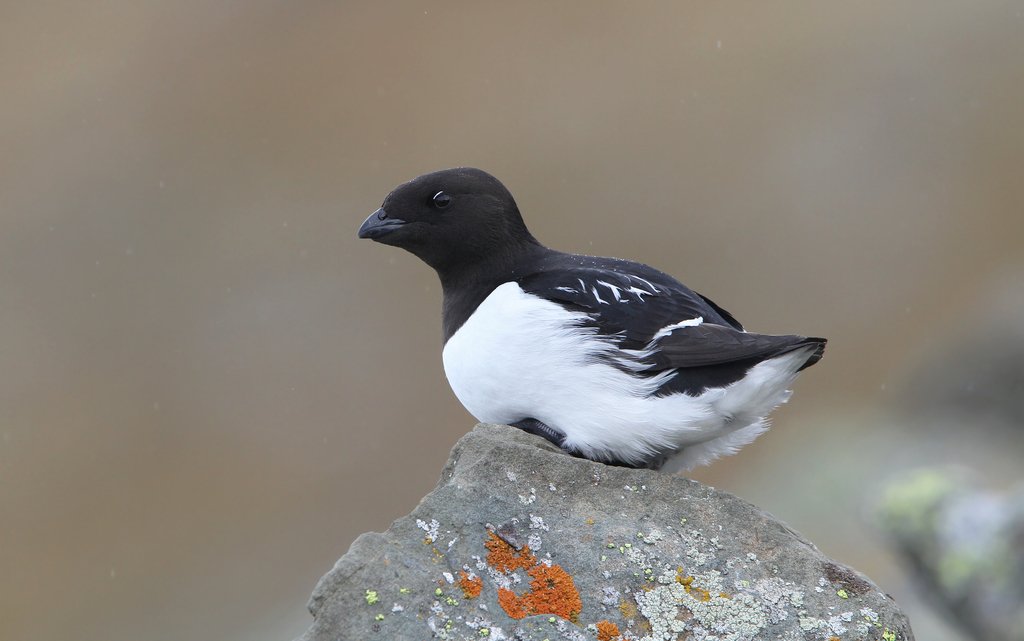
The little auk is the smallest Atlantic auk, measuring just 19–21 cm in length with a wingspan of 34–38 cm and weighing between 130–200 g. It is roughly half the size of an Atlantic puffin, making it instantly recognizable among its larger auk relatives. In breeding plumage, adults display a striking black head, neck, back, and wings contrasted with pure white underparts. White trailing edges on the secondary feathers and white fringes on the scapular feathers add subtle detail to the plumage. The bill is characteristically short and stubby, and the tail is small and rounded. During winter, birds develop white coloring on the lower face and fore neck. The nominate subspecies A. a. alle is marginally smaller than A. a. polaris, though the difference is subtle in the field.
Range & Habitat
Little auks breed in huge colonies in the high Arctic of the North Atlantic Ocean. The nominate subspecies A. a. alle breeds across Greenland, Novaya Zemlya, Svalbard, Baffin Island, Jan Mayen, and the former breeding site of north Iceland, where the species is now extinct. The subspecies A. a. polaris breeds on Franz Josef Land and possibly Severnaya Zemlya. Small numbers also breed on several Bering Sea islands including Little Diomede Island, King Island, St. Lawrence Island, St. Matthew Island, and the Pribilof Islands. Breeding habitat consists of large colonies on scree slopes along marine cliffsides, where birds nest in rock crevices or beneath large boulders. In winter, the species disperses widely across Arctic and North Atlantic waters, with the largest concentrations near pack ice edges and smaller numbers ranging south to northern Great Britain and Nova Scotia.
Behaviour & Diet
Little auks are agile underwater foragers, diving to pursue their prey with fast, direct flight powered by rapid whirring wing beats characteristic of their short wings. They feed primarily on crustaceans, particularly copepods; a single 150 g bird requires approximately 60,000 copepods daily. They also consume small mollusks and fish. Recent evidence indicates they hunt using visually-guided suction-feeding rather than filter-feeding. During breeding season, they forage close to shore, while in winter they feed near ice edges and coastlines. These birds are highly vocal at breeding colonies, producing varied twitters and cackling calls, but remain silent at sea. They are monogamous and exhibit strong nest-site fidelity, often using the same rock crevice year after year. A single pale greenish-blue egg is incubated by both parents for 28–31 days. Chicks fledge at 26–29 days old, typically synchronously with others in the colony and usually under cover of darkness.
Best Time & Places to See It
To observe breeding colonies, visit the high Arctic during summer months, particularly Greenland, Svalbard, and Novaya Zemlya, where populations breed in vast numbers. Winter offers opportunities across the northern North Atlantic, with concentrations near pack ice edges and smaller populations ranging to northern Great Britain and Nova Scotia. Late autumn storms in November and December may drive birds south of their normal range into the North Sea and occasionally to coastal areas farther south, creating opportunities for unexpected sightings. The Farne Islands in Northumberland, England, recorded remarkable concentrations following strong northerly gales, demonstrating how weather patterns concentrate these birds in accessible locations.
Photography Tips
The little auk's small size and rapid, direct flight present challenges for photographers. Their preference for foraging close to shore during breeding season and near ice edges in winter may improve photo opportunities compared to open ocean settings. The striking contrast between black and white breeding plumage is highly photogenic, while winter birds show subtle shifts in facial coloring that reward careful observation. The synchronous fledging of young birds at dusk provides a rare opportunity to photograph mass movement, though this nocturnal activity demands specialized equipment and positioning. During winter, storm-driven concentrations in accessible areas like the North Sea offer chances to photograph these normally remote seabirds.
Arctic Ecology and Ecosystem Conservation Tour
Cape Breton Highlands National Park
Cape Breton Highlands National Park, Canada
+215 birds+18 mammals
Where the Atlantic coast of Nova Scotia rises in weathered cliffs and glacially carved valleys, Cape Breton Highlands National Park spans a landscape where boreal and…
VIEW NATIONAL PARKKosterhavets National Park
Västra Götalands län, Sweden
+211 birds+9 mammals
Where the west coast of Sweden dissolves into an archipelago of granite skerries and pine-clad islands, Kosterhavets National Park emerges as one of northern Europe's most…
VIEW NATIONAL PARKSouth Spitsbergen National Park
Norway
+41 birds+15 mammals
Glaciers and tundra meet in Norway's high Arctic, where South Spitsbergen National Park sprawls across the southernmost reaches of the Svalbard archipelago. Here, massive valley glaciers…
VIEW NATIONAL PARKNorthwest Spitsbergen National Park
Norway
+58 birds+17 mammals
Where the High Arctic converges with the Norwegian mainland, Northwest Spitsbergen National Park sprawls across one of Earth's most extreme and pristine wildernesses. Crowned by jagged…
VIEW NATIONAL PARKNorthern Isfjorden National Park
Norway
+40 birds+12 mammals
Where the Arctic fjord system cuts deep into Svalbard's northwestern coast, Northern Isfjorden National Park protects a landscape of stark geological drama—towering cliff faces, tidewater glaciers,…
VIEW NATIONAL PARKLower Saxon Wadden Sea National Park
Norderney, Germany
+193 birds+12 mammals
Where the North Sea meets the German coast, a vast expanse of tidal mudflats, salt marshes, and shallow waters creates one of Europe's most dynamic estuarine…
VIEW NATIONAL PARKHamburgisches Wattenmeer National Park
Hamburg, Germany
+206 birds+6 mammals
Where the North Sea exhales across the Elbe estuary, the tidal mudflats of Hamburgisches Wattenmeer National Park emerge twice daily in a landscape of extraordinary ecological…
VIEW NATIONAL PARKVorpommersche Boddenlandschaft National Park
Küstengewässer einschließlich Anteil am Festlandso, Germany
+230 birds+19 mammals
Where the Baltic coast dissolves into a labyrinth of shallow lagoons and coastal wetlands, Vorpommersche Boddenlandschaft National Park protects one of northern Europe's most dynamic and…
VIEW NATIONAL PARKSchleswig-Holsteinisches Wattenmeer National Park
Germany
+378 birds+49 mammals
Where the North Sea ebbs and flows across a vast expanse of exposed mud and sand, the Schleswig-Holsteinisches Wattenmeer National Park reveals one of Europe's most…
VIEW NATIONAL PARKSirmilik National Park
Qikiqtaaluk Region, Canada
+58 birds+4 mammals
Where the Canadian Arctic archipelago fractures into a labyrinth of islands, Sirmilik National Park protects one of the High North's most pristine marine and terrestrial ecosystems.…
VIEW NATIONAL PARKL’Île-Bonaventure-Et-Du-Rocher-Percé National Park
Le Rocher-Percé, Canada
+214 birds+3 mammals
A dramatic thrust of russet sandstone pierces the Gulf of Saint Lawrence, its weathered arch framing a seascape where cool Atlantic currents sweep past cliffs alive…
VIEW NATIONAL PARKGros Morne National Park
Canada
+180 birds+19 mammals
Where glacier-carved fjords pierce the interior of Newfoundland, Gros Morne National Park unfolds across nearly four thousand square kilometres of some of Canada's most dramatic coastal…
VIEW NATIONAL PARKBic National Park
Rimouski, Canada
+250 birds+9 mammals
Where the St. Lawrence River meets the Gaspé Peninsula, a rugged coastline of forests, wetlands, and rocky shores unfolds across nearly 95 square kilometres of protected…
VIEW NATIONAL PARKForillon National Park
Gaspé, Canada
+258 birds+16 mammals
Where the Gaspésie Peninsula juts into the Gulf of Saint Lawrence, granite cliffs and coastal headlands frame one of eastern Canada's most dramatic marine-terrestrial boundaries. Forillon…
VIEW NATIONAL PARKSassen-Bünsow Land National Park
Soere, Norway
+30 birds+10 mammals
Where Arctic tundra sprawls across glaciated plateaus in the remote Svalbard archipelago, a realm of raw geological drama unfolds. Sassen-Bünsow Land National Park encompasses a landscape…
VIEW NATIONAL PARKForlandet National Park
Vera, Norway
+38 birds+12 mammals
Windswept Arctic tundra meets jagged coastal cliffs where the Barents Sea crashes against Norway's northernmost wilderness. This sliver of protected terrain on the Nordkapp Peninsula comprises…
VIEW NATIONAL PARKCairngorms National Park
Muir, United Kingdom
+192 birds+31 mammals
Where ancient granite massifs rise above the Scottish Highlands, a subarctic wilderness unfolds across 1,748 square kilometres of raw, elemental terrain. Windswept plateaus give way to…
VIEW NATIONAL PARKLoch Lomond & the Trossachs National Park
Duchray, United Kingdom
+188 birds+40 mammals
Where ancient woodlands rise from glassy lochs and rugged Highland peaks pierce the lowland horizon, Scotland's most biodiverse landscape unfolds across 720 square kilometres of wild…
VIEW NATIONAL PARKSt. Paul Island
Saint Paul, United States
+255 birds+8 mammals
Windswept tundra rolls across this remote Pribilof island, where volcanic basalt cliffs plunge into the Bering Sea and fog rolls in thick enough to erase the…
VIEW PROTECTED LANDSCAPEDisko Bay
Kitsissuarsuit, Greenland
+46 birds+9 mammals
Where Arctic fjords carve deep into Greenland's western coast, Disko Bay creates a protected landscape of extraordinary ecological complexity. The waters here merge temperate Atlantic currents…
VIEW PROTECTED LANDSCAPEScoresby Sund
Vandreblok, Greenland
+43 birds+9 mammals
Where granite peaks pierce an Arctic sky and the world's largest fjord system carves deep into northeastern Greenland, a primordial landscape unfolds in shades of ice-blue…
VIEW PROTECTED LANDSCAPENortheast Greenland National Park
Northeast Greenland National Park, Greenland
+34 birds+10 mammals
Where granite peaks plunge into the Arctic Ocean and pack ice dominates a landscape of incomparable vastness, one of Earth's most remote wildernesses reveals itself. Spanning…
VIEW NATIONAL PARKNuuk Fjord System
Nuuk, Greenland
+54 birds+3 mammals
Where granite peaks plunge directly into the Arctic Ocean, a labyrinth of deep fjords carves through Greenland's southwestern coast, their waters eternally shadowed by towering rock…
VIEW PROTECTED LANDSCAPECabo Peñas
Susacasa, Spain
+303 birds+21 mammals
Where sea cliffs rise sheer from the Bay of Biscay, Susacasa's observation point commands one of Asturias's most dramatic coastal vistas. The landscape here is defined…
VIEW OBSERVATION POINTAcadia National Park
Bar Harbor, United States
+291 birds+27 mammals
Where the Maine coast rises in granite cliffs and spruce-clad headlands, Acadia National Park unfolds across Mount Desert Island and its surrounding waters, a landscape carved…
VIEW NATIONAL PARKAlaska Maritime National Wildlife Refuge
Alaska, United States
+391 birds+58 mammals
Where the North Pacific collides with Alaska's rugged coastline, a sprawling archipelago of islands, rocky outcrops, and coastal headlands forms one of North America's most remote…
VIEW WILDLIFE SANCTUARYMerritt Island National Wildlife Refuge
Brevard County, United States
+341 birds+19 mammals
Brackish marshes and palmetto scrub define this wildlife sanctuary spanning the coastal lowlands of central Florida, where the Atlantic tide meets freshwater systems in a dynamic…
VIEW WILDLIFE SANCTUARYChincoteague National Wildlife Refuge
Chincoteague, United States
+362 birds+16 mammals
Across the barrier islands and salt marshes of Virginia's Eastern Shore, where Atlantic tides sculpt an intricate mosaic of sandy spits and tidal flats, lies one…
VIEW WILDLIFE SANCTUARYPea Island National Wildlife Refuge
Dare County, United States
+356 birds+15 mammals
Where the Outer Banks taper toward the Atlantic, a sliver of barrier island creates a microcosm of coastal ecology. Pea Island National Wildlife Sanctuary spans over…
VIEW WILDLIFE SANCTUARYLindisfarne National Nature Reserve
Holy Island, United Kingdom
+240 birds+13 mammals
Windswept tidal flats and rocky outcrops define this reserve on Holy Island, where the North Sea's relentless rhythm shapes both landscape and wildlife. The terrain shifts…
VIEW NATURE RESERVEHolkham National Nature Reserve
North Norfolk, United Kingdom
+235 birds+11 mammals
Where Norfolk's coastal flatlands meet the North Sea, Holkham National Nature Reserve unfolds across nearly 4,000 hectares of some of England's most dynamic and least predictable…
VIEW NATURE RESERVENo community photos yet. Log in to add the first one.
No community observations of this species yet.