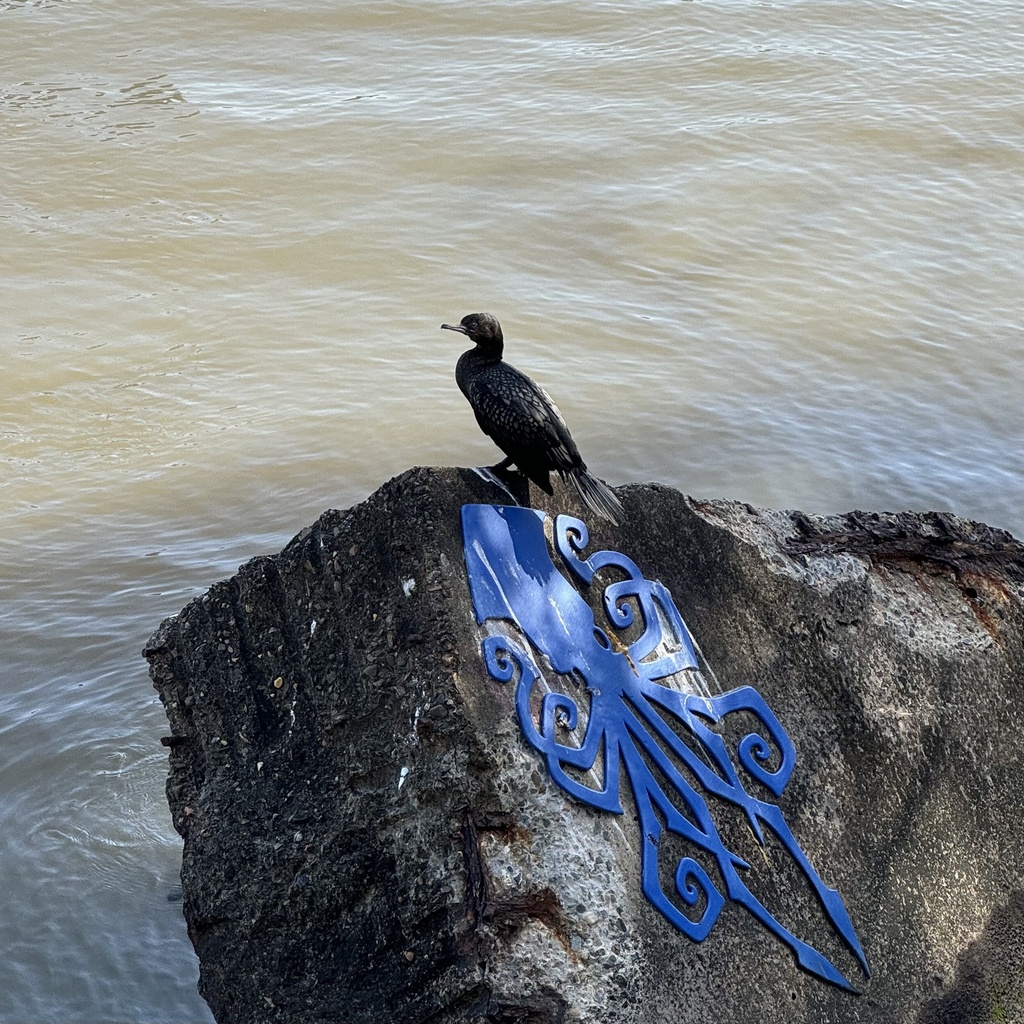
Little Black Cormorant
Photo © Sockrosma
Photo © Sockrosma — CC BY 4.0 — Source: iNaturalist #239582548Identification
The little black cormorant is a compact waterbird measuring 60–65 cm in length, making it one of the smaller members of the cormorant family. As its name suggests, it is entirely black in plumage, with a distinctive greenish sheen across the back. The most striking feature is its bright green iris—a key identifier for adults, though juveniles have brown eyes. During breeding season, white feathers appear irregularly around the head and neck, with a whitish eyebrow stripe becoming evident. The bill is long and slender, coloured grey, while the legs and feet are black. Males and females are identical in appearance, though immature birds display a mix of brown and black plumage before acquiring full adult colouration.
Range & Habitat
This species is distributed widely across the Indo-Pacific region, ranging from the Malay Peninsula through Indonesia and New Guinea to all mainland Australian states and territories, as well as New Zealand's North Island. The little black cormorant is predominantly a freshwater specialist, favouring rivers, lakes, and inland water bodies, though it occasionally ventures into sheltered coastal areas. It is almost always found in or immediately adjacent to water, where it spends the majority of its time feeding and resting.
Behaviour & Diet
The little black cormorant is more gregarious than most of its relatives, forming large flocks that sometimes adopt V-formation flight patterns when travelling. Its diet consists primarily of fish, with a higher fish-to-crustacean ratio compared to the sympatric little pied cormorant. In some regions, introduced species such as common carp comprise over half of its food intake. When feeding as a group, these cormorants display coordinated behaviour: flocks move together in tight formations of 10–20 metres, taking off and landing in synchrony, then diving collectively to chase and catch schooling fish.
Best Time & Places to See It
The little black cormorant can be encountered year-round across its range, though breeding activity peaks in spring or autumn in southern Australia, and before or after the monsoon season in tropical regions. Look for them on inland lakes, rivers, and wetlands, particularly where they gather in flocks. Large storage lakes and river systems with abundant fish populations are reliable locations. Early morning and late afternoon are typically the most active feeding periods.
Photography Tips
The bird's all-black plumage and small size require careful exposure metering to avoid underexposure; expose for the bird and allow the background to fall naturally. The bright green eye is a compelling detail—approach carefully and use a telephoto lens to capture this feature without disturbing the bird. Flocking behaviour offers excellent opportunities for group compositions; photograph birds in their characteristic V-formation flight or densely packed on the water. The whitish breeding plumage and eyebrow stripe visible during the breeding season provide striking seasonal variation worth documenting. Overcast days can help balance the high contrast between the black plumage and bright water.
Abel Tasman National Park
Arthur’s Pass National Park
Bald Rock National Park
Barrington Tops National Park
Belair National Park
Ben Boyd National Park
Blue Mountains National Park
Boodjamulla National Park
Bouddi National Park
Nothing matches these filters.
No community photos yet. Log in to add the first one.
No community observations of this species yet.