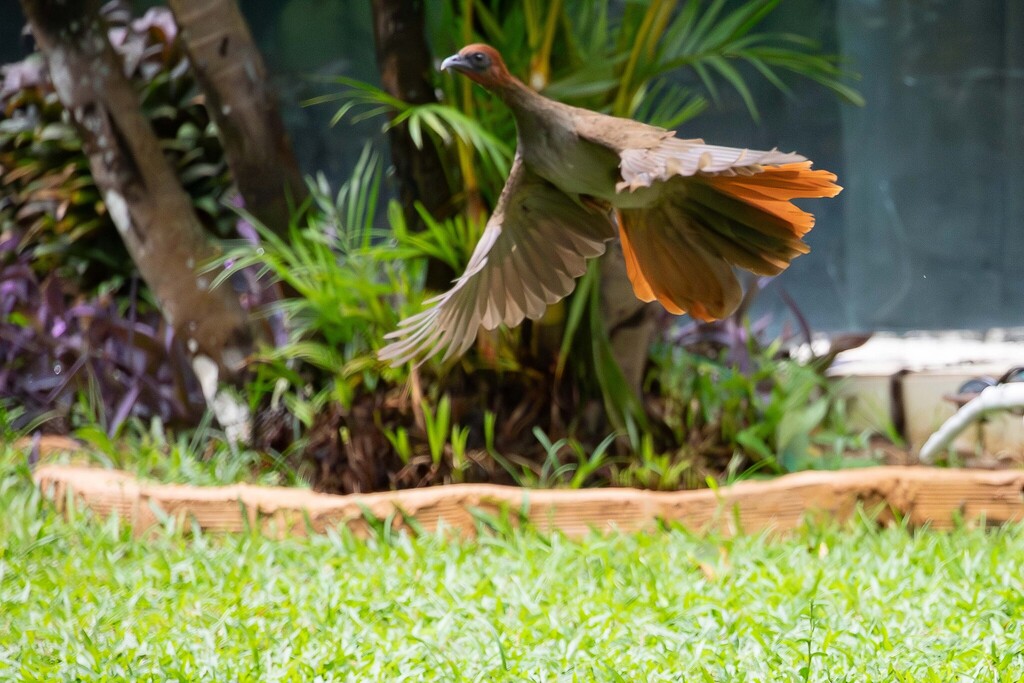
Little Chachalaca
Photo © Claudio Martins de Souza
Photo © Claudio Martins de Souza — CC BY-SA 4.0 — Source: iNaturalist photo #577772911Identification
The Little Chachalaca is a medium-sized game bird measuring 43 to 54 centimetres in length and weighing between 345 and 620 grams. Its most distinctive features include a reddish-chestnut head and reddish-brown to gray-brown upperparts, contrasting with gray underparts. The central tail feathers are gray-brown while the outer tail feathers display a rusty colour, and the primary flight feathers are dark brown. Its facial skin is dark slate gray, providing a striking frame for the head. These field marks make it relatively straightforward to identify in its range, particularly when spotted in small groups.
Range & Habitat
The Little Chachalaca is found across northern South America, ranging from southern and eastern Venezuela eastward through the Guianas and into northern Brazil, extending south to the Amazon River east of the Rio Negro. It is considered hypothetical in Colombia. Rather than inhabiting dense forest interiors, this species favours more open and disturbed landscapes, including undergrowth along rivers, forest clearings, abandoned pastures, dense secondary forest, and coastal brush. It is remarkably adaptable to elevation, occurring from sea level up to 1,700 metres.
Behaviour & Diet
Little Chachalacas are typically observed foraging in pairs or small flocks, moving through both trees and the ground in search of food. Their diet consists primarily of berries and fruits, though they also supplement their intake with flowers and leaves. The species is notably vocal, producing a loud, rollicking duet with a distinctive repeated call that sounds like 'WATCH-a-lak', delivered mainly at dawn and dusk—sounds that are likely to be among your first indications of their presence.
Breeding occurs during multiple seasons, with egg-laying recorded in May, September, and December in the Guianas. Females build small cup nests from roots, leaves, and sticks, placing them fairly low in shrubs or trees. The typical clutch consists of three eggs.
Best Time & Places to See It
The Little Chachalaca is widely distributed across Venezuela, Guyana, Suriname, French Guiana, and northern Brazil. Your best opportunities to encounter this species will be in areas of secondary forest, river undergrowth, and coastal brush habitats rather than pristine primary forest. Early morning and dusk hours are particularly productive for observation, as the birds are most vocal and active during these periods. The multiple breeding seasons across its range suggest year-round presence, though specific seasonal patterns outside the Guianas remain poorly documented.
Photography Tips
Patience and early rising will reward photographers seeking to capture the Little Chachalaca. The species' habit of foraging in open areas—clearings, abandoned pastures, and river margins—provides better photographic opportunities than most forest Cracidae. Listen for their distinctive 'WATCH-a-lak' calls at dawn and dusk to locate active birds. Since they often occur in pairs or small groups in relatively accessible secondary habitats, approach quietly and allow the birds to come to you rather than pursuing them directly. The reddish-chestnut head and contrasting gray underparts provide excellent colour contrast for photography, particularly in early morning or late afternoon light.
Viruá National Park
Brazil
+389 birds+6 mammals
Across the northern frontier of Roraima, where the forest canopy rises from ancient Amazonian lowlands, Viruá National Park protects nearly 3,700 square kilometres of terra firme…
VIEW NATIONAL PARKMonte Roraima National Park
Brazil
+226 birds+1 mammals
Where the tepuis rise from the Amazon basin like islands in a sea of forest, Monte Roraima National Park sprawls across 3,714 square kilometres of one…
VIEW NATIONAL PARKAnavilhanas National Park
Brazil
+468 birds+8 mammals
Across the Rio Negro in central Amazonas, an archipelago of over a thousand islands rises from the world's largest rainforest river system, creating a labyrinth of…
VIEW NATIONAL PARKNo community photos yet. Log in to add the first one.
No community observations of this species yet.