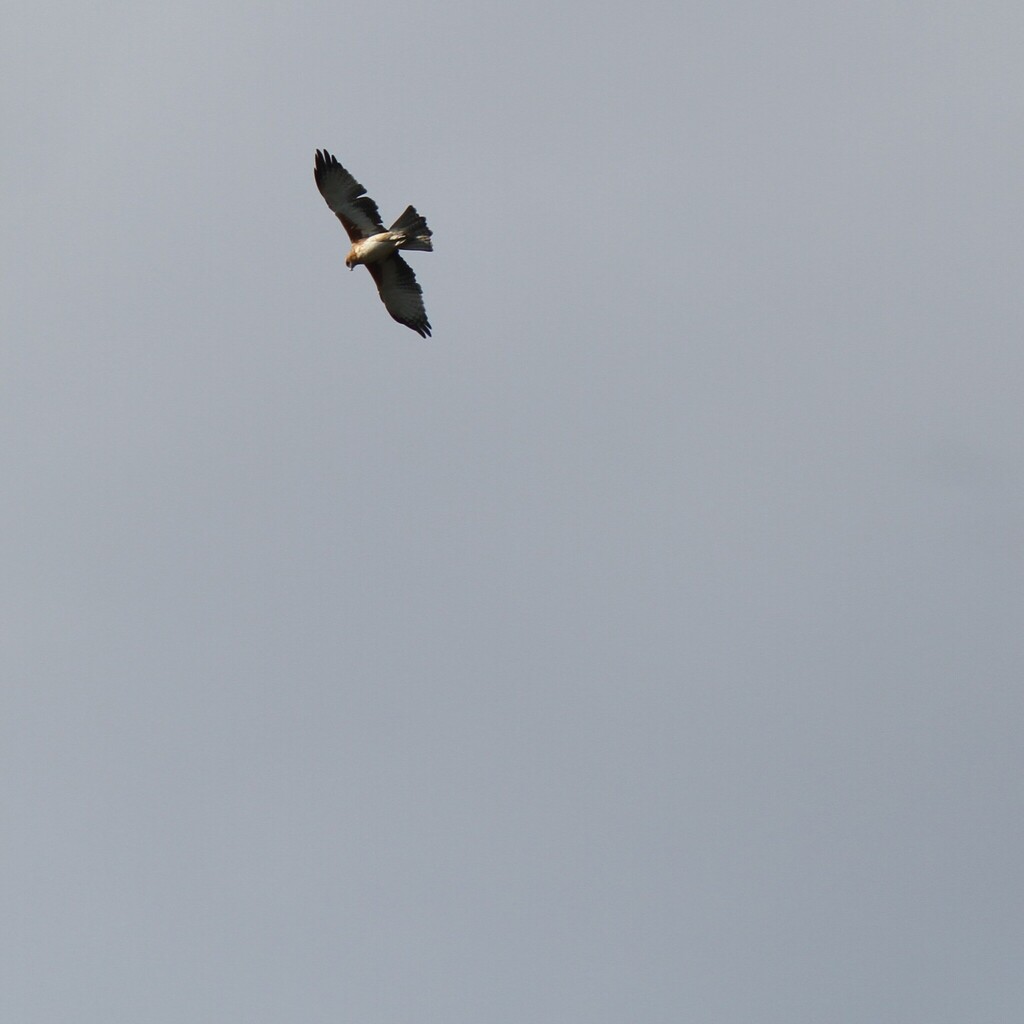
Little Eagle
Photo © A.J. Anderson
Photo © A.J. Anderson — CC BY 4.0 — Source: iNaturalist #358610434Identification
The little eagle is a compact bird of prey measuring 45–55 cm in length, roughly the size of a peregrine falcon, with a wingspan of about 120 cm. Males are notably smaller and lighter than females, weighing around 815 g. It has fully feathered legs, a distinctive square-cut barred tail, and powerful flight with strong wing beats, flat-winged glides, and soaring on slightly raised or flat wings.
Two colour forms occur, both changing with age. The light form—most common—displays dark brown upperparts with black streaks on the head and neck, contrasting with a sandy to pale underside. The dark form shows darker brown or rich rufous colouring on the head and underparts. Juveniles are more strongly rufous with less pattern contrast. Females are typically larger and darker than males.
Range & Habitat
The little eagle is endemic to Australia, found across most of the continent except heavily forested parts of the Great Dividing Range. It favours open woodland, grassland, arid regions, and riparian corridors, avoiding dense forest. Higher abundance occurs on hillsides with mixed wooded and open areas. The species has experienced significant population decline over recent decades due to habitat loss and the decline of rabbit populations following calicivirus release—rabbits were a primary prey species replacing native mammals lost to extinction.
National bird atlas data shows concerning trends: reporting rates declined from 65% of grid cells (1977–81) to 59% (1998–2002), with a 14% national decline in reporting rate. The decline has been particularly severe in New South Wales and the Australian Capital Territory, where reductions exceed 39–50% over two to three decades.
Behaviour & Diet
Little eagles hunt live prey and occasionally take carrion, searching from soaring flights up to 500 m altitude or from elevated exposed perches. They are agile, fast hunters that swoop to take prey on the ground in open areas, or snatch from trees and shrubs. Their diet is broad and opportunistic, varying with local prey availability.
Breeding pairs nest in mature trees within open woodland or along tree-lined watercourses, constructing stick nests lined with leaves. They may reuse nests across years or occupy abandoned crow nests. Each pair breeds once annually, laying one or two eggs in late August to early September. After a 37-day incubation, young fledge at approximately eight weeks. Pairs defend nesting territories through soaring displays, undulating flight, conspicuous perching, and calling. Movement patterns vary individually, with some birds altitudinally migratory, dispersive, or permanently resident. They are wary, typically departing at the first sign of human disturbance.
Best Time & Places to See It
Little eagles are most likely to be observed in open woodland and riparian areas during their active breeding season (late August through to fledging in late October or November). Look along tree-lined watercourses and on hillsides with mixed open and wooded habitat. Early morning and late afternoon often provide the best viewing opportunities as the eagles soar and hunt during these periods.
New South Wales and Victoria historically offered the highest reporting rates, though populations have declined significantly. Riparian corridors and forest margins remain productive areas. Patience and scanning open skies during calm weather will increase your chances of spotting these elusive raptors.
Photography Tips
Photograph little eagles soaring or perched on prominent branches where they use trees as hunting lookouts. Early morning light is ideal for capturing the contrast between their dark upperparts and pale underside in light-form birds. Use a good telephoto lens (at least 400 mm) as these are wary birds that flush easily from human approach.
During breeding season, locate active nest sites and photograph from a distance to avoid disturbance. Capture their characteristic soaring and undulating flight displays, which are most active during the breeding season. Overcast days can be challenging for flight photography, so wait for clear conditions when eagles soar highest and most actively.
Bald Rock National Park
Barrington Tops National Park
Belair National Park
Ben Boyd National Park
Blue Mountains National Park
Boodjamulla National Park
Bribie Island National Park
Bunya Mountains National Park
Cape Range National Park
Nothing matches these filters.
No community photos yet. Log in to add the first one.
No community observations of this species yet.